
Why more B2B products are adding data agents, how the embedded ones work, and what separates answers you can trust from guesses.

Ka Ling Wu
Co-Founder & CEO, Upsolve AI
10 min

Data agent is an AI system that autonomously answers data questions: it interprets a request in plain language, retrieves the right context, generates and validates the analysis, then returns a trustworthy answer or visualization.
Unlike a static dashboard that only shows what someone decided to chart in advance, a data agent responds to whatever your users actually ask, handles the follow-up question, and adapts as the conversation continues.
For a B2B SaaS product, that difference is becoming the line between an analytics section customers ignore and one they use every day. Your customers no longer want to hunt through a dashboard for the number they need. They want to ask a question and get an answer.
his guide explains what a data agent is, why an embedded data agent is quickly becoming table stakes for product teams, and how to ship one in weeks rather than the six to twelve months an in-house build typically takes.
Key Takeaways |
|---|
|
What Is a Data Agent?
A data agent is software that turns a natural-language question into a correct, contextual answer without a human analyst in the loop. It receives the question, maps it to the underlying data, retrieves the definitions and business rules that give the question meaning, generates the query, checks the result, and returns an answer, a chart, or both.
Think of it like the difference between a filing cabinet and a research assistant. A dashboard is the filing cabinet: everything is organized, but you have to know exactly what you are looking for and where it lives. A data agent is the assistant: you describe what you need, and it does the retrieval, the reasoning, and the presentation for you.
The Four Things a Data Agent Actually Does
Under the hood, a capable data agent runs a loop that a static report never could:
Interprets intent: It parses a plain-language question and figures out what the user is really asking, including ambiguous terms like "active users" or "last quarter."
Retrieves context: It pulls the relevant schema, metric definitions, and business rules so the answer reflects how your company (or your customer) actually defines things.
Generates and runs the analysis: It builds the query, executes it against the right tables, and assembles the result.
Validates and responds: It checks the output against known-good patterns, then returns a trustworthy answer or builds the visualization the user described.
That last step is what people mean when they talk about being able to chat with your data: the user asks in their own words, and the agent handles everything between the question and the answer.
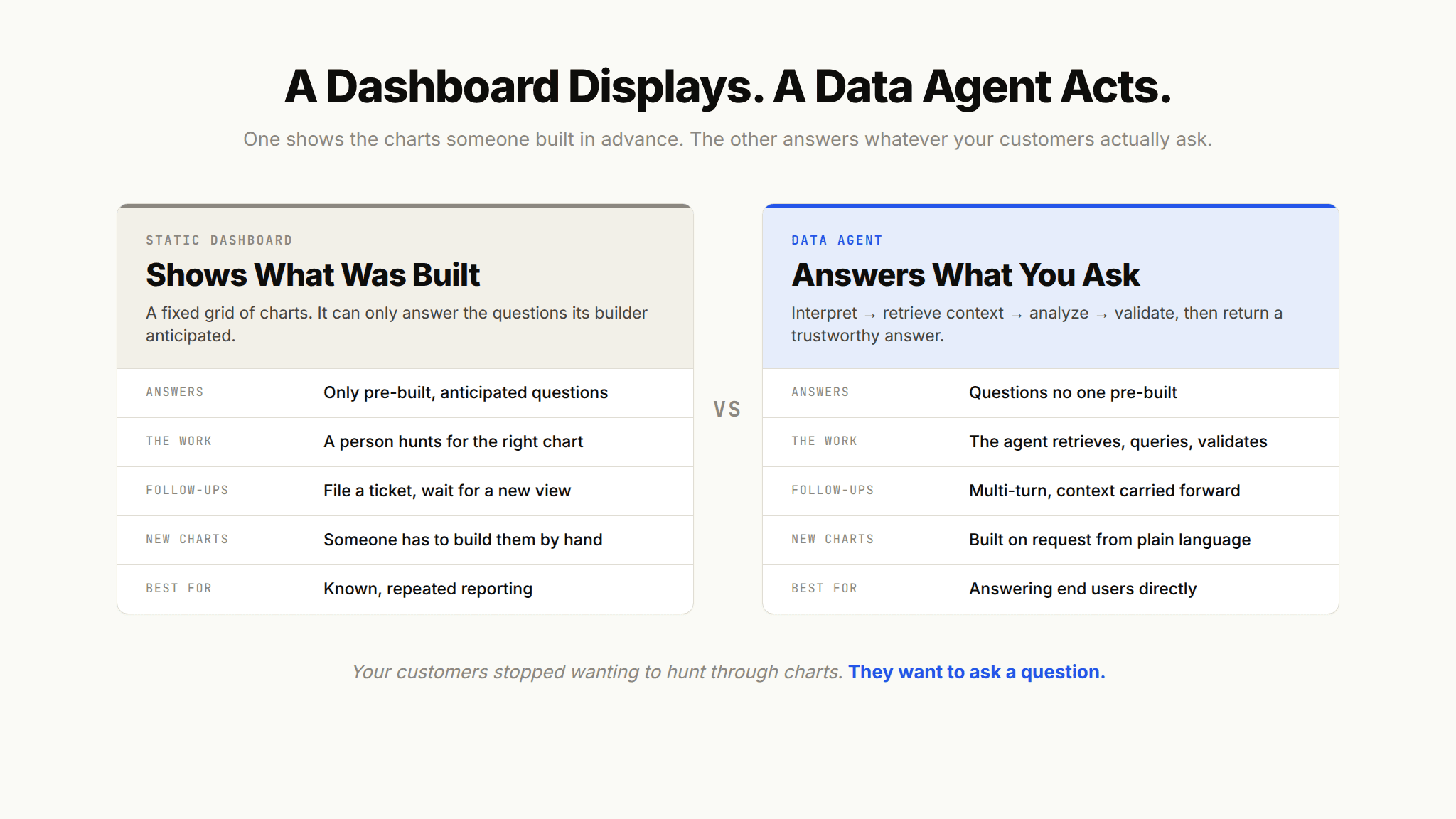
Data Agent vs. Copilot vs. Dashboard
These terms get used interchangeably, and that confusion is expensive when you are choosing what to build into your product. The distinction is about who does the work.
Capability | Static Dashboard | Data Copilot | Data Agent |
|---|---|---|---|
Answers questions defined in advance | Yes | Yes | Yes |
Answers questions no one anticipated | No | Partially | Yes |
Acts autonomously (retrieves, queries, validates) | No | Assists the user | Yes |
Handles multi-turn follow-ups | No | Sometimes | Yes |
Builds new visualizations on request | No | Suggests | Yes |
Best for | Known, repeated reporting | Speeding up an analyst | Answering end users directly |
A copilot assists a person who is already doing the analysis. A data agent does the analysis. For a deeper breakdown of the mechanics, see how analytics agents actually work end to end.
Why Static Dashboards Stopped Being Enough
For a decade, the promise of embedded analytics was self-service: give customers a dashboard, and they will answer their own questions. It half worked. Dashboards proliferated inside products, but a new problem emerged. Every dashboard only answers the questions its builder anticipated, and real users always have the next question.
This is the same wall that internal data teams hit, and it is why the self-service promise so often failed to deliver on its own. The moment a customer wants to slice the data a way you did not pre-build, they are back to filing a support ticket or emailing your customer success team. For a SaaS product, that friction shows up as lower engagement, more support load, and a feature that looks impressive in the sales demo but goes stale in production.
The Data Has a Short Half-Life
Insights decay fast. By the time a customer requests a custom report, waits for your team to build it, and receives it days later, the decision it was meant to inform has often already been made. Scheduled reports and fixed dashboards are, in effect, answers to yesterday's questions. A data agent collapses that cycle to seconds because the customer never has to wait for a human to build anything.
Customers Now Expect to Ask, Not Hunt
User expectations have shifted permanently. People spend their day asking AI tools questions in plain language and getting immediate answers. When they open your product's analytics tab and find only a grid of fixed charts, it feels dated. A large majority of enterprises now rely on embedded analytics in their daily workflows, and the bar for what "good" looks like inside a product keeps rising. An embedded data agent meets that expectation directly: the customer types a question, and your product answers it.
Why Your B2B SaaS Product Needs a Data Agent
If you lead product at a B2B SaaS company, the strategic case for an embedded data agent comes down to three pressures converging at once.
1. Competitive Parity Is Becoming Table Stakes
The embedded analytics market is expanding quickly, projected to grow from roughly $56.89 billion in 2026 to $162 billion by 2035. A large share of that growth is AI-native capability being built directly into products. When a competitor ships an analytics agent that lets their customers ask questions in plain language, a static dashboard in your product starts to look like a liability. Analytics is increasingly where B2B products win or lose on stickiness.
2. Analytics Load Is Eating Your Team
Every custom report request from a customer lands somewhere: engineering, data, or customer success. Those teams are already at capacity. A data agent absorbs the long tail of "can you also show me..." requests that would otherwise become tickets, freeing your team to build product instead of one-off charts. The value is not just customer-facing; it is a release valve on internal load.
3. Retention Follows Usage
An analytics feature customers actually use is an analytics feature that keeps them in your product. When customers can get answers on demand, the analytics section stops being a checkbox on the sales sheet and becomes a daily habit. That daily habit is what shows up later as retention.

Ship in Weeks, Not Quarters: The Build vs. Buy Reality
Here is where most product teams underestimate the challenge. Building a data agent that demos well is genuinely quick. Building one that survives contact with real customers, real data, and real edge cases is where projects go to die.
Why In-House Builds Stall
The MIT State of AI in Business 2025 study found that 95% of enterprise AI pilots deliver no measurable impact, and Gartner separately predicts that more than 40% of agentic AI projects will be canceled by the end of 2027 due to escalating cost, unclear value, and inadequate controls. The pattern in that research is consistent: pilots stall not because the model is weak, but because the system cannot retain context, adapt to a real workflow, or improve over time.
The same MIT research found that externally partnered deployments succeed roughly twice as often as internal builds (about 67% versus 33%). For a product team, the lesson is direct: a from-scratch data agent is not a two-week project. It is a six to twelve month project once you account for context management, accuracy testing, multi-tenant security, and the ongoing maintenance of keeping definitions current.
What "Buy" Actually Buys You
The reason a platform approach compresses the timeline is that the hardest parts are already solved. Instead of building the interpretation loop, the context layer, the evaluation harness, and the multi-tenant isolation yourself, you configure them. That is the difference between shipping an embedded data agent in one to two weeks and spending two or three quarters getting a prototype to behave in production.
Consideration | Build In-House | Embed a Platform |
|---|---|---|
Time to first production deployment | 6 to 12 months | 1 to 2 weeks |
Context management | You build and maintain it | Configured, not coded |
Multi-tenant security | Custom engineering | Built into the platform |
Accuracy evaluation | You design the test suite | Included tooling |
Ongoing maintenance | Your roadmap absorbs it | Handled by the platform |
The right answer depends on your roadmap, your team's bandwidth, and how soon your customers expect this. If analytics is central to how your product competes and you have engineering capacity to spare, a build can be justified. If it is a capability you need working in front of customers fast, embedding a platform gets you there without pulling engineers off everything else on the roadmap.
The Real Differentiator: Context, Not the Model
Here is the part almost every team gets wrong. When a data agent returns a confidently incorrect answer, the instinct is to blame the model. Swap in a better one and the problem persists, because the failure was never the model. The failure was context.
Consider a simple question: "What was our revenue last quarter?" A language model can write flawless SQL. But it does not know whether "revenue" means recognized revenue or bookings at your company, which table is authoritative, whether "last quarter" follows the calendar or your fiscal calendar, or which customers to exclude as internal test accounts. That knowledge lives in people's heads, in Slack threads, and in a dbt file someone last touched years ago. The model cannot see any of it.
This is exactly the conclusion the field has converged on. Andreessen Horowitz argues that data agents are essentially useless without the right context, and OpenAI's writeup on its own in-house data agent stresses that high-quality answers depend on rich, accurate context rather than raw model capability.
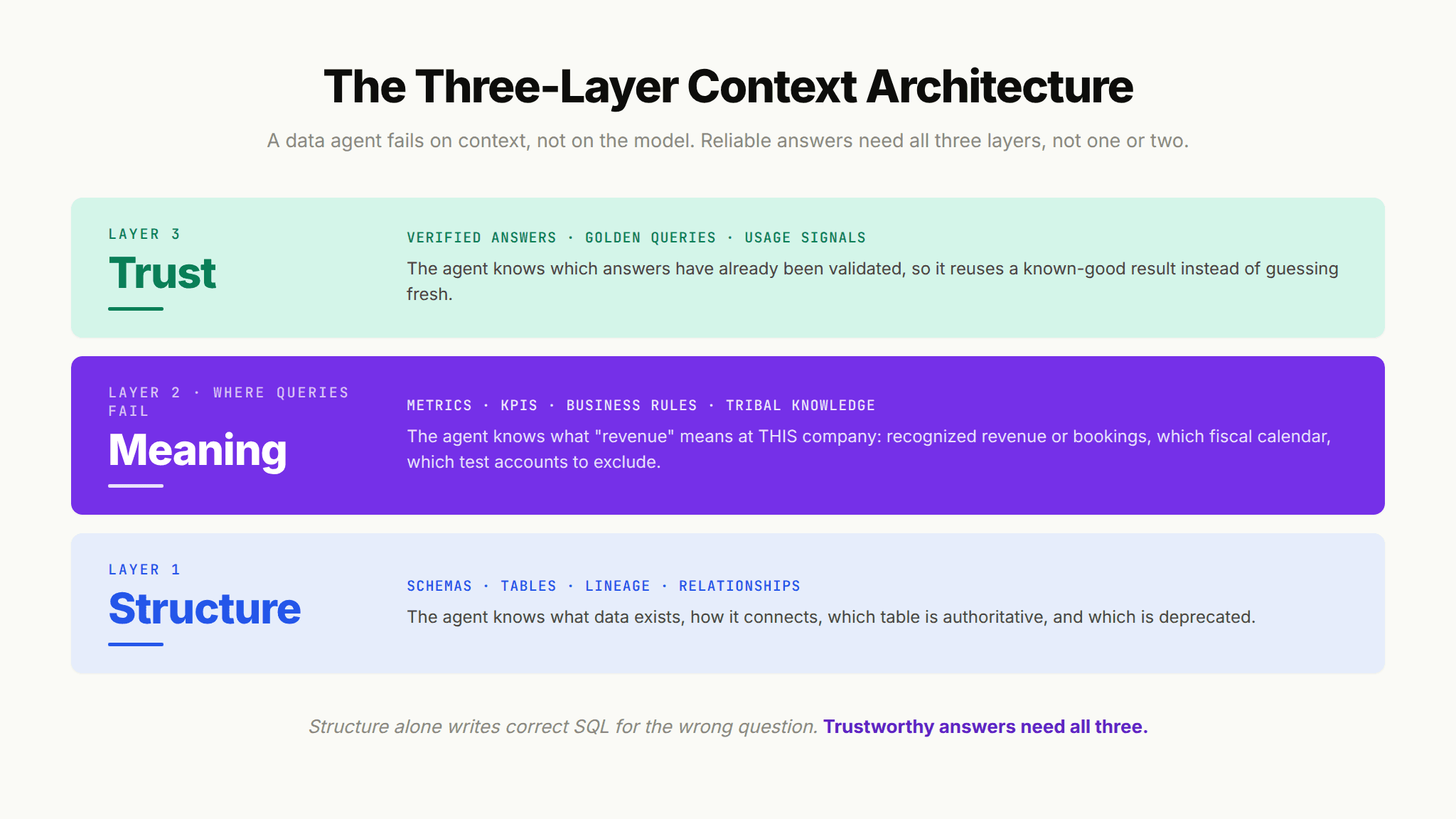
The Three-Layer Context Architecture
Reliable data agents need three distinct layers of context, and most tools solve only one or two:
Structure: The schemas, tables, lineage, and relationships. This is how the agent knows what data exists and how it connects.
Meaning: The metrics, KPIs, business rules, and institutional knowledge. This is how the agent knows what "revenue" means at your company specifically.
Trust: The verified answers, golden query sets, and usage signals. This is how the agent knows which answers have already been validated.
An agent that has Structure but not Meaning writes correct SQL that answers the wrong question. An agent with Meaning but not Trust gives plausible answers no one has confirmed. You need all three, encoded as durable context infrastructure rather than scattered across your team's memory. For the full framework, see how context engineering makes or breaks a product-embedded agent.
How to Evaluate an Embedded Data Agent
Once you decide a data agent belongs in your product, the evaluation criteria are not the ones a generic AI agent builder advertises. General-purpose agent frameworks are built for tasks like customer service or workflow automation, and they lack the analytics-specific machinery that determines whether answers are actually correct.
Criteria That Matter for Product Teams
Context management: Can it encode your customers' metric definitions and business rules, not just read a schema? This is the single biggest predictor of accuracy.
Multi-tenant isolation: Can it enforce that each customer sees only their own data, within your existing security model? For embedded use, this is non-negotiable.
Surface flexibility: Can it deploy where your customers already are, whether that is an embedded component in your app, Slack, or another interface?
Accuracy evaluation: Does it ship with tooling to test answers against a known-good set, so you can prove reliability before customers see it?
Improvement loop: Does it get more accurate as users interact with it, or does it stay static?
The details of stacking these criteria against real platforms live in our guide to evaluating agent builder platforms for analytics, which is the right next step once you know what you are looking for.
Where Upsolve Fits
Upsolve AI is context infrastructure for analytics agents, built specifically for the problem above. Agent Studio is where your team encodes institutional knowledge and builds production-ready agents: configuring context across the three layers, setting guardrails, and testing accuracy with golden query evaluation.
The Agentic Dashboard is what your customers experience: they ask questions in plain language, describe the charts they want, and the agent builds them. It deploys as an embedded component in your product, and because it operates within your existing security model with SOC 2 Type II and HIPAA compliance, it fits the requirements a B2B product team already has to meet. Teams typically go live in about 14 days.
What Product Teams Underestimate Before Launch
Chasing a Better Model Instead of Better Context
The most common trap is spending weeks benchmarking language models when the accuracy gap is a context gap. A stronger model on top of missing definitions still guesses at what "revenue" or "active account" means. The lever that actually moves accuracy is encoding Meaning and Trust, and teams that keep swapping the engine tend to plateau at the same disappointing place.
Launching Without an Accuracy Test Suite
If you ship an agent with no way to check answers, your customers become the test suite, and that is how trust breaks in front of the people you most need to keep. Golden query testing, a known set of questions paired with verified answers, needs to exist before launch so you can prove reliability rather than discover problems through complaints. This is the single cheapest safeguard most teams skip.
Treating Customer-Facing Like Internal
An internal data agent and an embedded, customer-facing one are different products with different requirements. The moment your agent serves multiple customers, row-level isolation and per-tenant context stop being optional and become architectural. Teams that prototype against a single dataset often discover this late, and retrofitting tenant isolation into a working agent is far more painful than designing for it up front.
Put a Data Agent in Front of Your Customers
If your customers are asking for answers your dashboards cannot give them, a data agent is the shortest path from question to insight inside your product. You do not need to spend two quarters building the context layer, the evaluation harness, and the multi-tenant plumbing from scratch.
Upsolve's Agent Studio and embedded Agentic Dashboard let you encode your customers' context and ship a production-ready data agent in about two weeks. You can try it with your own CSV to see the experience, or book a demo to walk through an embedded deployment for your product.
Frequently Asked Questions
What is a data agent?
A data agent is an AI system that autonomously answers data questions in plain language: it interprets the request, retrieves the relevant context, generates and runs the analysis, validates the result, and returns a trustworthy answer or visualization. It differs from a dashboard because it responds to questions no one pre-built and handles follow-ups.
How is a data agent different from a dashboard?
A dashboard displays charts that someone decided to build in advance, so it can only answer anticipated questions. A data agent does the analysis on demand, which means it answers whatever a user actually asks, adapts to follow-up questions, and can build new visualizations on request rather than showing only fixed views.
Why does a B2B SaaS product need an embedded data agent?
Because customer expectations and the market have shifted together. Embedded analytics is on track to more than double this decade, competitors are shipping AI-native analytics, and customers now expect to ask questions rather than hunt through charts. An embedded data agent improves engagement, reduces support load, and supports retention.
How long does it take to build a data agent?
An in-house build that is production-ready typically takes six to twelve months once you account for context management, accuracy evaluation, and multi-tenant security. Embedding a context infrastructure platform compresses that to roughly one to two weeks, which is a large part of why externally partnered deployments reach production far more often than internal builds.
Why do most data agents fail in production?
They fail on context, not on the model. Gartner expects more than 40% of agentic AI projects to be canceled by 2027, and MIT found that the vast majority of enterprise AI pilots deliver no measurable business impact. The common cause is that agents cannot access the metric definitions, business rules, and institutional knowledge that make answers correct.
Is a data agent secure enough for customer-facing use?
It can be, if it operates within your existing security model and enforces multi-tenant isolation so each customer sees only their own data. Look for SOC 2 Type II and, where relevant, HIPAA compliance, plus row-level access controls that respect the permissions your product already uses.

Try Upsolve for Embedded Dashboards & AI Insights
Embed dashboards and AI insights directly into your product, with no heavy engineering required.
Fast setup
Built for SaaS products
30‑day free trial