
Learn how MCP changes analytics agent architecture, where it helps, and why context matters more than connectivity alone for trust.

Ka Ling Wu
Co-Founder & CEO, Upsolve AI
10 min

Your AI agent connects to the warehouse on the first try. It reads every table, writes clean SQL, and nails the demo question. Then a real user asks for "revenue last quarter," and it quietly hands back the wrong number. The connection worked perfectly. The answer was wrong anyway.
That gap is the whole story of MCP for analytics. Model Context Protocol (MCP) is an open standard that lets an AI agent reach your warehouse, your BI platform, and your semantic layer through one consistent interface, instead of a hand-built integration for each one. It solves connectivity cleanly. What it does not solve is comprehension: whether the agent knows that "revenue" means ARR and not booked sales, that one table is authoritative and another was deprecated two years ago, or that your fiscal quarter ended in January.
Hold onto that distinction, because it decides everything downstream. Get it right and MCP becomes the backbone of a production analytics stack. Get it wrong and you have shipped an agent that is confidently incorrect at scale. Which outcome you land on depends far less on the protocol than on what you put behind it.
Key Takeaways |
|---|
|
What Is MCP? A Definition for Analytics Teams
The Model Context Protocol is an open standard, introduced by Anthropic in late 2024, that standardizes how AI applications connect to and share data with external tools, systems, and data sources. Think of it as a universal adapter, often described as "USB-C for AI," that lets any language model read from a database, call an API, or interact with an enterprise system through one consistent interface.
Before MCP, every AI integration was a bespoke engineering project. Connecting an agent to your Postgres database meant writing custom code. Connecting that same agent to Slack meant writing more. Each integration was tightly coupled to both the model's API format and the tool's interface, which created an N-times-M problem: every data tool multiplied by every AI application, each pairing needing its own connector, authentication, and maintenance.
MCP collapses that into a single protocol. In December 2025, Anthropic donated the standard to the Linux Foundation's Agentic AI Foundation, and within roughly a year OpenAI, Google, and Microsoft had all shipped MCP support, turning it from one vendor's protocol into shared industry infrastructure. By early 2026, Anthropic reported more than 10,000 active public MCP servers (per DigitalApplied's adoption tracker), and every major platform in the enterprise stack had shipped support.
Why this matters for analytics: If your team is evaluating analytics agents, MCP is now the connectivity layer most platforms assume. The question is no longer whether a tool speaks MCP. It is what that tool puts behind the protocol.
How MCP Works: Hosts, Clients, and Servers
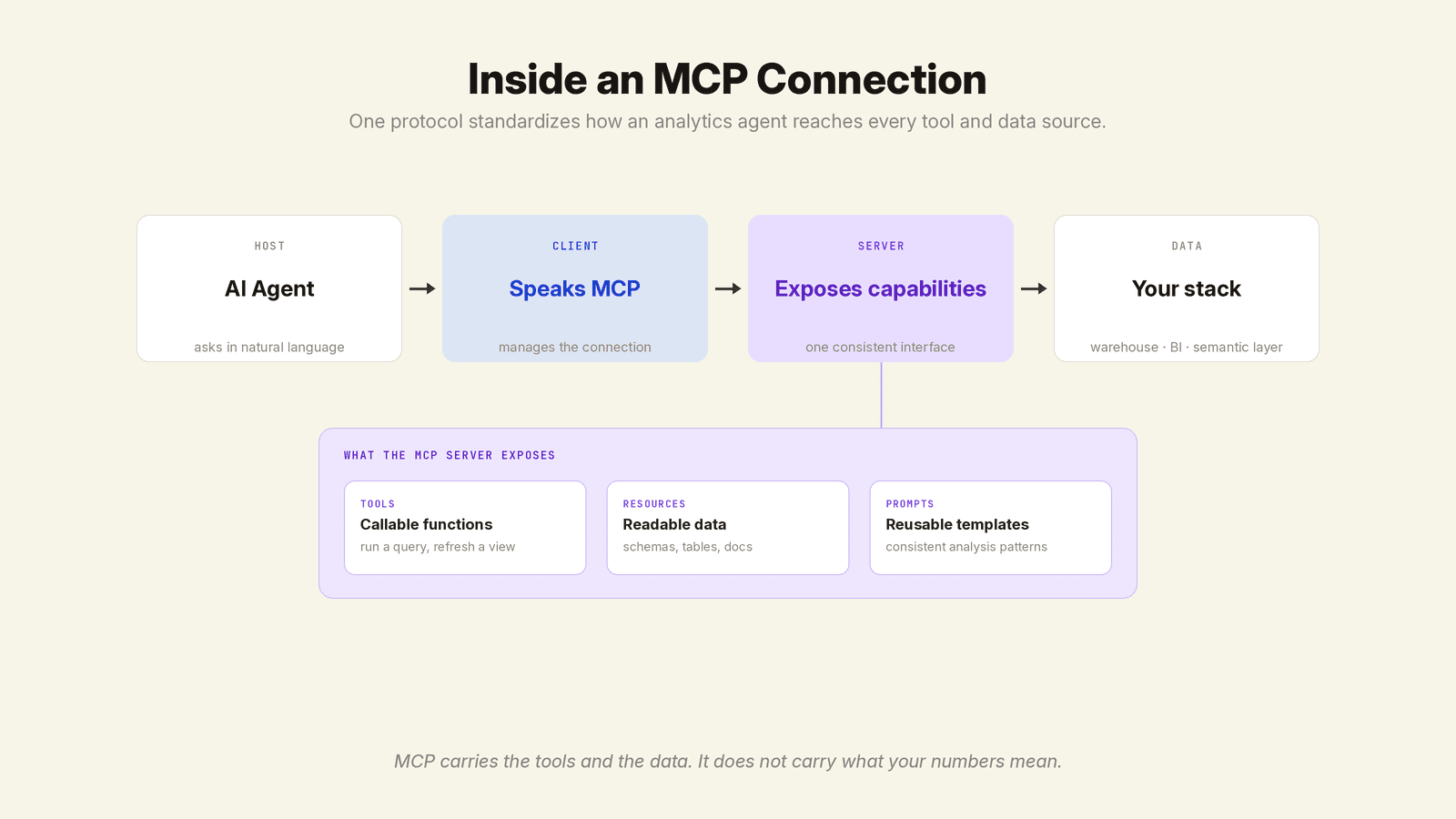
MCP defines three roles, and understanding them clarifies exactly where the protocol's responsibility ends.
The Host
The host is the AI application the user interacts with, typically an agent that works with a language model and needs services from external systems. In an analytics setting, the host might be a chat surface in Slack, an embedded agent inside your product, or a coding assistant that needs live data.
The Client
For each server it connects to, the host spins up a dedicated client. The client speaks the protocol and manages the connection on behalf of the model. This is the piece that handles discovery: it asks each server what it can do and relays that back to the agent.
The Server
The server is a lightweight process that exposes specific capabilities. In analytics, a server might provide access to a Snowflake warehouse, a dbt project, or a BI platform's API. Each server declares its capabilities through three primitives.
The Three MCP Primitives
Every MCP server exposes its capabilities using three building blocks, and the agent discovers all of them at runtime without any model-specific customization.
Tools: Callable functions the agent can invoke, such as running a SQL query, refreshing a dashboard, or fetching a metric value.
Resources: Data the agent can read, such as a schema description, a documentation file, or a table definition.
Prompts: Reusable templates for common workflows, so a recurring analysis follows a consistent pattern.
The important property here is structured discovery. When a client connects to a server, it can enumerate every available tool and resource along with its schema and description. The agent needs no hardcoded knowledge of a specific API; it reads what is available and decides how to use it in context. As Databricks explains, an MCP server exposes a machine-readable capability surface discovered at runtime, unlike the fixed, hardcoded endpoints of a traditional API.
This is genuinely useful. It is also exactly the point where teams overestimate what they are getting.
MCP Provides Tools, Not Context
Here is the core argument, and it is the one thing to take from this piece. MCP is a transport and discovery standard. It carries tools and resources from a server to an agent. It does not carry the institutional knowledge that makes an answer correct.
Consider what happens when you stand up an MCP server over your data warehouse. The agent can now discover every table and run any query. Ask it for "revenue last quarter" and it will confidently write SQL. But which table is authoritative? Is revenue ARR, run rate, or recognized revenue? Does "last quarter" mean the calendar quarter or your fiscal one? Should canceled orders be excluded? None of that lives in the schema. It lives in people's heads, in Slack threads, and in a dbt YAML file last touched two years ago.
MCP does not solve any of it. It hands the agent a connection and a list of tables, then steps back. As Kaelio notes in its analysis of enterprise MCP deployments, agents left to interpret unstructured schemas hallucinate, producing answers that look authoritative and are quietly wrong. The protocol worked. The agent reached the data. The answer was still untrustworthy.
This is the same wall a16z described in its essay on why data agents need context: without the right context, even a capable model delivers little real value. The model was never the bottleneck. Context engineering is the missing piece, and MCP provides tools, not context. The protocol is necessary infrastructure. On its own, it is not sufficient.
The reality: A perfectly functioning MCP connection to a poorly governed warehouse just gives an agent a faster way to be confidently incorrect. Connectivity without context accelerates the wrong outcome.
Where MCP Fits in the Three-Layer Context Architecture
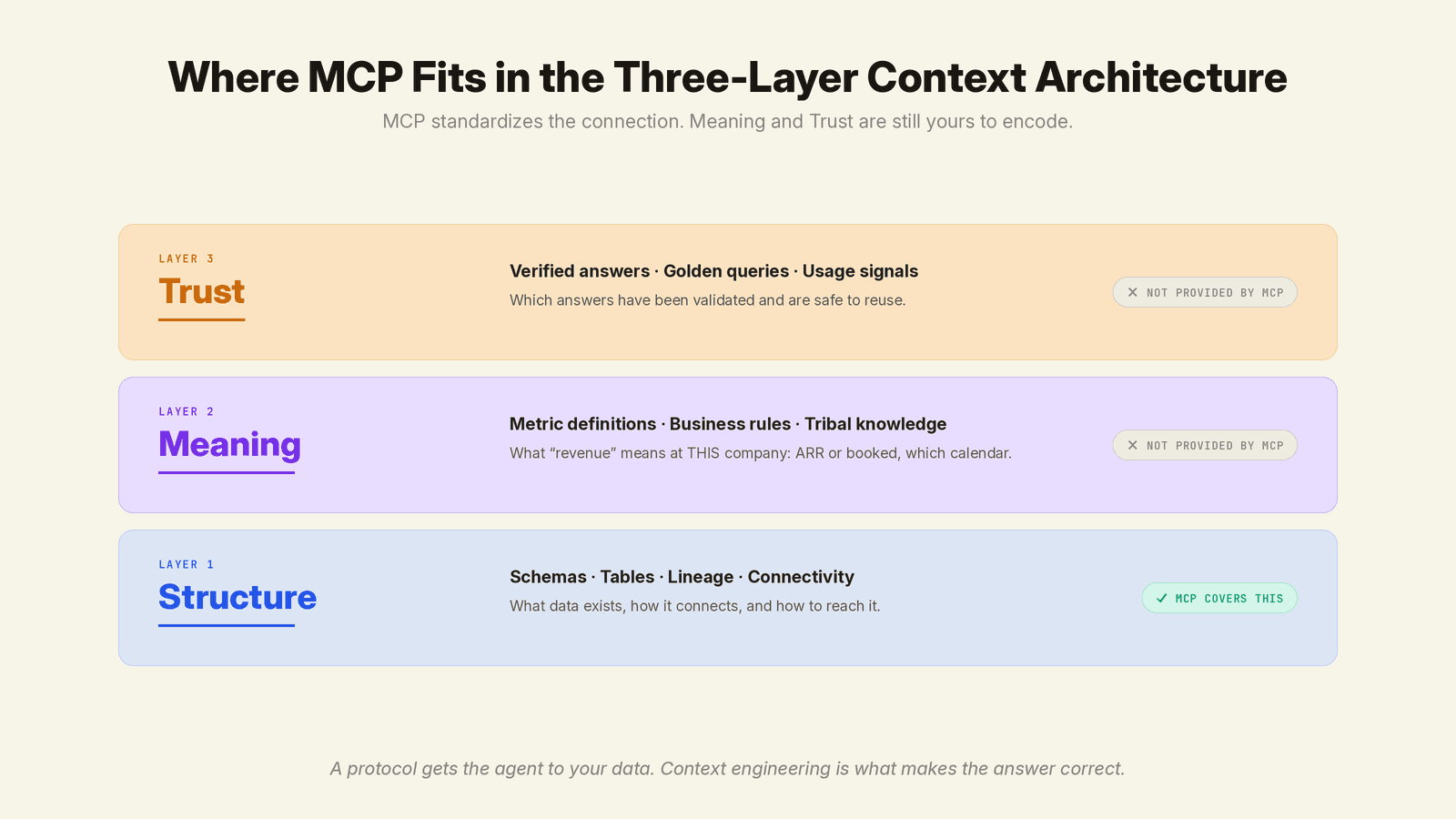
A reliable analytics agent needs three distinct layers of context, and mapping MCP against them shows precisely what it covers and what it leaves open.
Layer | What It Contains | Does MCP Provide It? |
|---|---|---|
Structure | Schemas, tables, lineage, relationships, connectivity to sources | Partially. MCP provides the connection and exposes raw schema, but not lineage or curated relationships. |
Meaning | Metrics, KPIs, business rules, definitions, tribal knowledge | No. MCP transports definitions only if a server is built to expose them. The protocol itself carries none. |
Trust | Verified answers, golden queries, usage signals, corrections | No. MCP has no concept of a validated answer or a quality signal. |
MCP does real work in the Structure layer. It is the cleanest way yet invented to give an agent access to what data exists and how to reach it. But Meaning and Trust are where accuracy is won or lost, and the protocol is silent on both. A platform that ships an MCP endpoint and stops there has solved one third of the problem and marketed it as the whole.
This also explains why so many proofs of concept stall. They rarely fail at the connectivity step. They fail when real users ask real questions and the agent, with no encoded Meaning or Trust, gets them subtly wrong. When OpenAI built its own internal data agent, the lesson it stressed was the same one: as OpenAI describes, the quality of an answer rises and falls with the context behind it, not just the model's access to data. MCP gets you to the demo. It does not get you to production.
The Semantic Layer as an MCP Context Source
If MCP carries whatever a server exposes, the obvious move is to expose something better than raw tables. This is where the semantic layer enters, and it is the most important architectural pattern in MCP for analytics.
A semantic layer is the Meaning layer for analytics agents: it holds metric definitions, business rules, and the relationships that turn columns into meaningful concepts. Put a semantic layer behind an MCP server and the agent stops discovering bare columns. It discovers governed metrics. Asking for "revenue" returns the company's single definition of revenue, not the agent's best guess across a dozen candidate columns.
That is why semantic-layer vendors moved quickly to ship MCP endpoints. AtScale, for instance, exposes its semantic models to any MCP-compatible agent through a containerized server, so BI-layer policies and definitions reach the agent without copying data. The pattern is sound: MCP handles transport, the semantic layer supplies meaning.
But a semantic layer behind MCP still leaves gaps worth spelling out.
What the Semantic Layer Covers
Consistent metric definitions so the agent does not guess what "revenue" means.
Business rules and relationships that encode how concepts connect.
Governance and access controls that travel with the query.
What It Still Misses
The Trust layer. A semantic layer defines metrics, but it does not track which specific answers have been validated against a golden query set, or which user corrections should reshape future responses.
Unstructured institutional knowledge. Much of what a thoughtful analyst knows never reaches a semantic model: the caveat about Q3, the data-quality issue in one region, the reason a metric briefly spiked.
A continuous improvement loop. Definitions stay static until someone updates them. Production accuracy requires detecting context gaps from real conversations and closing them.
So a semantic layer makes MCP far more useful, and it is the right foundation. It is also not the finish line. You need Structure, Meaning, and Trust, and most stacks assemble only the first two.
Where MCP Earns Its Place in the Stack
Set the limitations aside, and MCP enables patterns that were impractical before. These are where it pays for itself.
Multi-source agents. Because any host that speaks MCP can connect to any MCP server, an agent can reason across your warehouse, your CRM, and your support tool through one protocol instead of three integrations.
Auditable data access. Every tool call routes through a defined, loggable interface. The server enforces its own access controls and exposes only the operations the agent is permitted to perform, giving security teams a single point of governance.
Live context over static retrieval. Unlike retrieval methods built on indexed, static documents, MCP opens on-demand access to live databases and streams, as Databricks describes, so the agent works from current data when freshness matters.
Surface flexibility. The same MCP server can feed a Slack agent, an embedded product agent, and a coding assistant, because the protocol is model-agnostic and surface-agnostic.
For teams comparing platforms, MCP support has become table stakes. What separates the options is what each one puts behind the protocol.
Where Teams Go Wrong With MCP
Three patterns account for most of the disappointment teams report after their first MCP build.
1. Treating MCP Access as a Finished Agent
Standing up a server over the warehouse feels like progress, because the agent immediately starts answering. The trap is shipping it. Without encoded Meaning and Trust, those answers are unverified. Treat MCP connectivity as the start of the work, then encode the institutional knowledge the agent needs to be correct.
2. Exposing Raw Schemas Instead of Governed Context
A server that hands an agent every table invites it to invent relationships and definitions. Put a governed layer (a semantic layer at minimum) behind the server so the agent discovers meaningful concepts, not raw columns.
3. Underestimating the Security Surface
MCP widens the attack surface, and security maturity has lagged adoption. Independent security audits have found public MCP servers exposed with no authentication, a steep rise in prompt-injection reports, and only a small share of servers using OAuth. Require authentication, scope permissions tightly, and audit tool descriptions before granting any write access.
MCP Is Maturing Fast
MCP is moving quickly, which matters if you are building on it now. The 2026-07-28 specification release candidate is the largest revision since launch. It makes the protocol stateless at the transport layer so servers scale on ordinary HTTP infrastructure, adds an Extensions framework, introduces a Tasks extension for long-running work, and hardens authorization to align with OAuth and OpenID Connect.
The direction of travel is clear: the maintainers are tackling the operational problems that surface when MCP runs in real production environments, including audit trails, SSO-integrated auth, and gateway behavior. None of that work changes the core point. Every improvement makes MCP a better transport. None of them encodes what your metrics mean or which answers are trustworthy. The protocol is getting better at carrying context. It will never be the source of it.
Connectivity Is the Floor, Not the Ceiling
MCP answers how an agent reaches your data. It leaves open the harder question of whether the agent understands it. If you are evaluating where MCP fits in a production stack, the useful frame is the full context an agent needs, not the connection alone. The protocol is a starting point, not the finish line, so when you are weighing your options, see how the tradeoffs play out across analytics agent platforms.
Frequently Asked Questions
What is MCP in analytics?
MCP, or Model Context Protocol, is an open standard that lets AI analytics agents connect to data sources like warehouses, BI tools, and semantic layers through one consistent interface instead of custom integrations. It standardizes how an agent reaches and reads data, but it does not supply the business definitions that make analysis accurate.
Does MCP replace the semantic layer?
No. MCP and the semantic layer solve different problems. MCP is the transport that connects an agent to a source. The semantic layer is a context source that defines what metrics mean. The strongest pattern puts a semantic layer behind an MCP server, so the protocol carries governed meaning rather than raw tables.
Why do MCP-connected agents still give wrong answers?
Because MCP provides connectivity, not context. An agent with raw database access through MCP can run any query but has no encoded knowledge of which table is authoritative or how a metric is defined, so it guesses. Accuracy requires layering Meaning and Trust on top of the connection, which the protocol does not provide.
Is MCP secure for enterprise analytics?
It can be, but it takes care. Each server enforces its own access controls and logs every tool call, which helps. Security audits have also flagged risks such as prompt injection and public servers exposed without authentication. Require auth, scope permissions, and audit servers before granting write access.
How does MCP differ from a traditional API?
A traditional API exposes fixed endpoints that a client must hardcode and update whenever the API changes. An MCP server exposes a discoverable capability surface that an agent reads at runtime, along with schemas and descriptions, and supports stateful, streaming interactions suited to multi-step agent workflows. It is built for agents rather than for hardcoded integrations.
Do analytics platforms need MCP support?
MCP support has effectively become a baseline expectation, since it is how most agents now connect to data and tools. The differentiator is not whether a platform speaks MCP, but what context it puts behind the protocol. Evaluate platforms on the Meaning and Trust they encode, not connectivity alone.

Try Upsolve for Embedded Dashboards & AI Insights
Embed dashboards and AI insights directly into your product, with no heavy engineering required.
Fast setup
Built for SaaS products
30‑day free trial