
Learn what agentic analytics is, how AI agents replace dashboards, and why context is key to accurate enterprise data answers.

Ka Ling Wu
Co-Founder & CEO, Upsolve AI
10 min
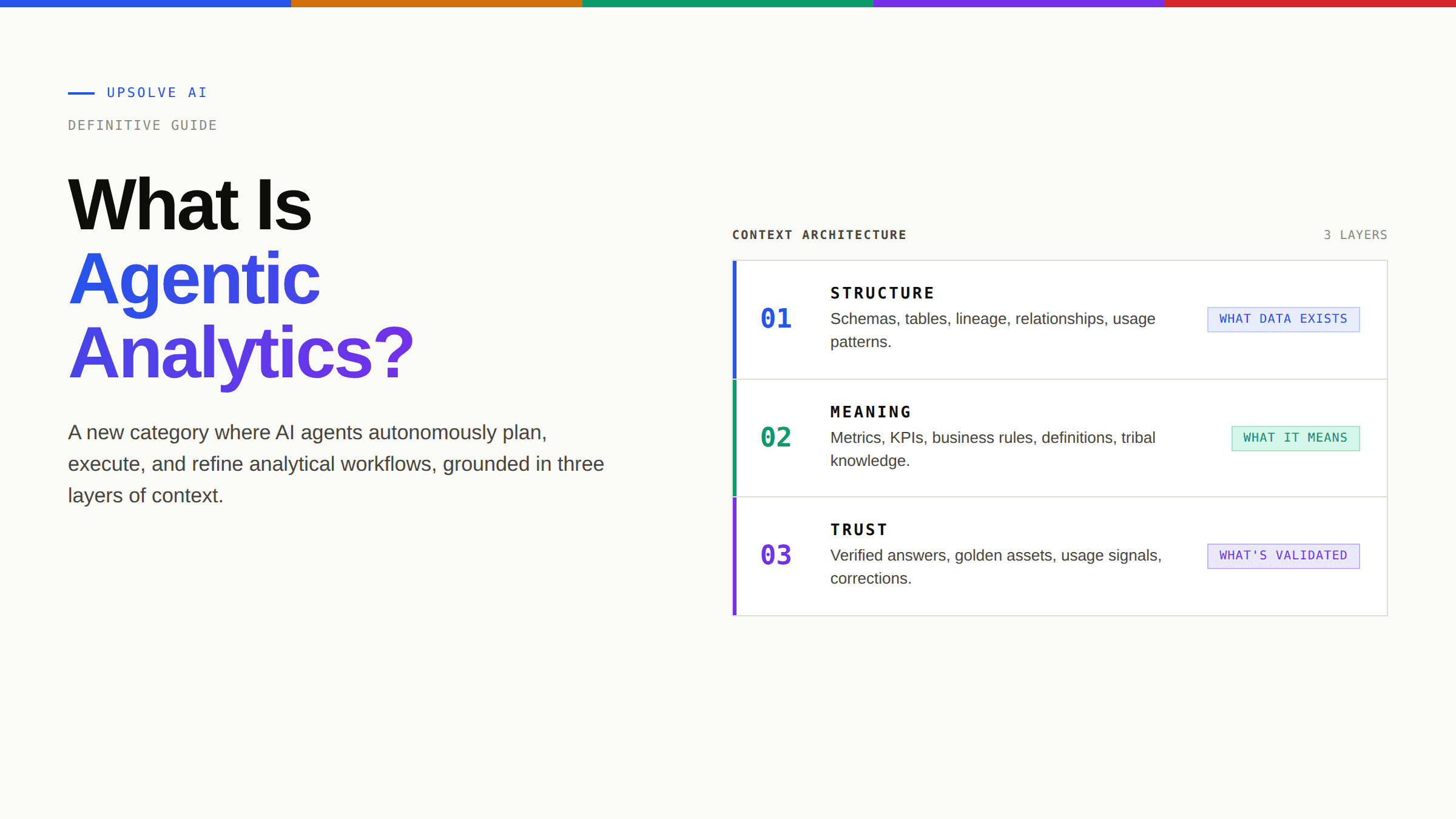
Agentic analytics is a category of data tools in which AI agents autonomously plan, execute, and refine analytical workflows in response to business questions, replacing the manual cycle of building dashboards or filing tickets to an analyst. Instead of asking a colleague to write a query, you ask the agent a question in plain language, and it figures out which data to pull, how to interpret it in the context of your business, and how to present the answer.
This is not a faster dashboard. It is a different category of tool, and the companies adopting it are reorganizing how analytics work inside their teams and inside their products.
Key Takeaways |
|---|
|
What Is Agentic Analytics?
Agentic analytics is the use of AI agents to autonomously perform analytical work that traditionally required a human analyst or a pre-built dashboard. The agent receives a question, retrieves the relevant data, generates the analysis, and either returns the answer or asks a clarifying question.
What separates an agent from a chatbot or a copilot is autonomy. A copilot suggests; an agent acts. A chatbot answers from text; an agent queries a database, validates the result against business rules, and decides whether the answer is trustworthy enough to deliver.
This isn't speculative. According to a16z's analysis of the data agent market, agents that can reliably answer business questions are now considered the next layer of the modern data stack. OpenAI describes its in-house data agent as serving over 3,500 internal users across 600 petabytes of data, built by two engineers in roughly three months.
But what differentiates this category is not the model. It is what the model has access to.
The core idea in one sentence: Agentic analytics is what you get when you stop trying to build dashboards for every question and start encoding the institutional knowledge an agent needs to answer questions on its own.
Why Agentic Analytics Now: The Evolution From Dashboards to Agents
The shift to agentic analytics is not a UX trend. It is a response to a structural problem that BI tools created and never solved.
The Dashboard Era and Its Limits
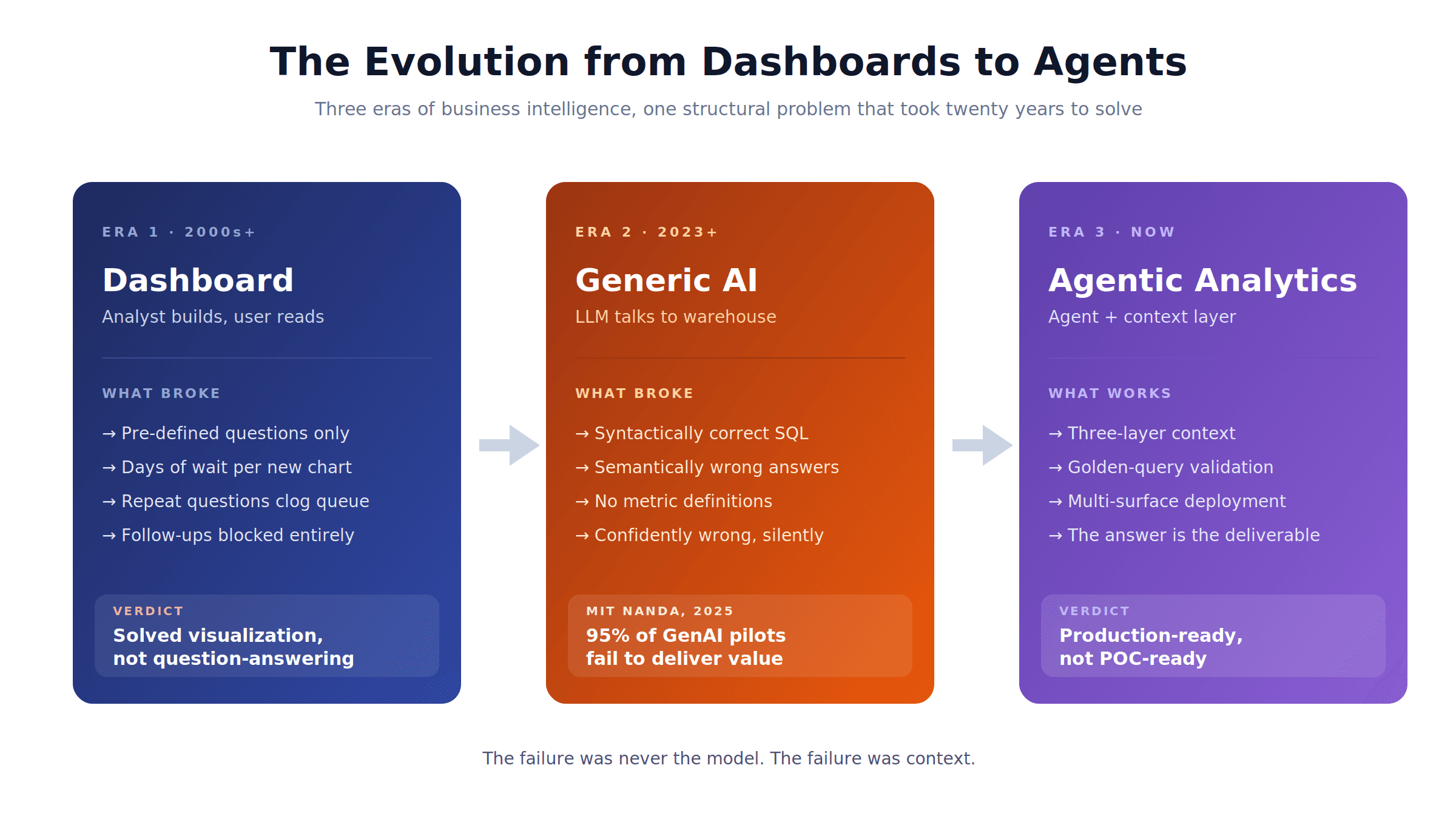
For two decades, business intelligence has meant building dashboards. An analyst translates a stakeholder's question into SQL, designs a visualization, and publishes it. The stakeholder consults the dashboard. If they have a follow-up question, they file a ticket and wait.
This works for questions you can anticipate. It fails everywhere else.
In practice, most enterprise data teams report similar patterns:
Dashboards proliferate but go unused. Research aggregated across BI deployments has long shown that the majority of self-service BI initiatives fall short of adoption targets within a few years.
Stakeholders wait days, sometimes weeks, for ad-hoc answers. As one analyst leader put it bluntly in a recent piece on BI backlog management, "the dashboard requested in January is delivered in March, by which time the business question has changed."
A meaningful share of incoming requests are repeats of questions an analyst has already answered.
Data teams report a majority of their time consumed by reactive work rather than analysis. The same backlog piece notes that "if your best analysts are spending 60% of their week manually refreshing Excel exports or debugging broken SQL queries, you don't need more people, you need better engineering."
The dashboard solved the visualization problem. It did not solve the question-answering problem.
The Generic AI Experiment and Its Failures
When ChatGPT and Claude arrived, the first instinct of many data teams was straightforward: connect the LLM to the warehouse and let business users ask questions in natural language. This is the "text-to-SQL" approach, and on paper it solves the dashboard problem.
In practice, almost every internal build hit the same wall. The model could write syntactically correct SQL. It could not write meaningful SQL.
Consider what happens when a stakeholder asks "What's our revenue this quarter?" The model needs to know which table holds the source of truth. It needs to know how your company defines revenue: gross, net, recognized, ARR, or contracted. It needs to know which fiscal calendar you use. It needs to know whether to exclude internal test accounts and how to handle refunds. None of this is in the schema. All of it lives in tribal knowledge, dbt YAML files, and the head of the analyst who left in 2024.
The numbers on generic AI in production are striking. According to RAND Corporation research published in late 2024 and 2025, more than 80% of AI projects fail to reach production, roughly twice the failure rate of conventional IT projects. For generative AI specifically, the MIT NANDA "GenAI Divide" report covered by Fortune found that 95% of enterprise GenAI pilots delivered no measurable financial impact. Gartner has separately projected that more than 40% of agentic AI projects will be cancelled by the end of 2027.
The diagnosis from people who have looked closely is the same. As a16z framed it, data agents are essentially useless without the right context. OpenAI's data agent writeup attributes the success of its internal agent specifically to the structured context it provides the model.
The failure was not the model. The failure was context. Every serious analysis of agent failure in the past 18 months has arrived at this conclusion independently.
The Agentic Analytics Paradigm
Agentic analytics is the response. It accepts the natural language interface from the generic AI approach but adds the missing pieces: a structured context layer the agent draws from, validation against verified queries, and the ability to plan multi-step analyses rather than single-shot queries.
The end product looks like a conversation. A stakeholder asks a question. The agent retrieves the relevant tables, applies the right metric definitions, generates a result, and shows it. If the question is ambiguous, it asks a follow-up. If the question requires a new chart, it builds the chart. If the answer is uncertain, it says so.
For an introduction to the agent itself, see our piece on what an analytics agent actually does.
How Agentic Analytics Differs From Adjacent Concepts
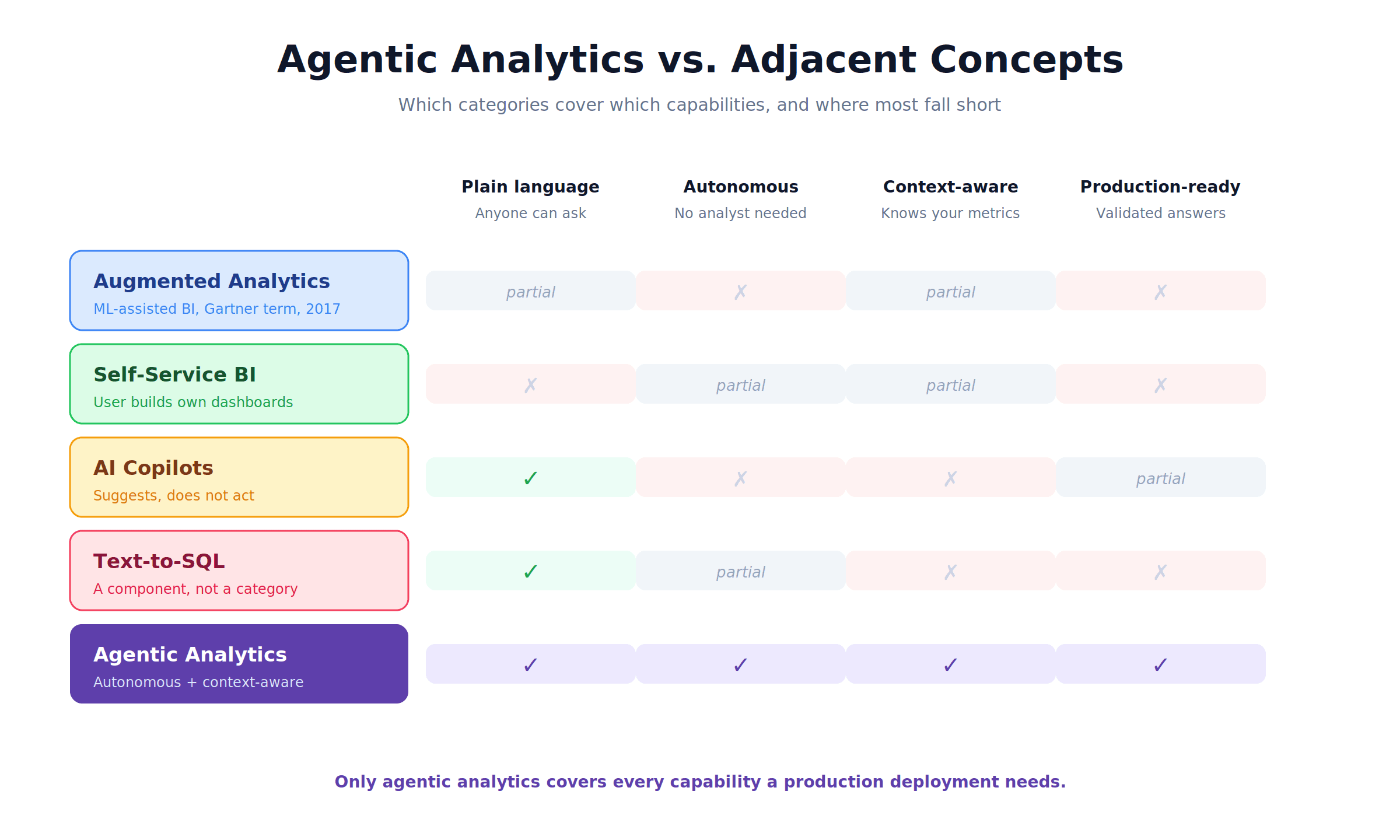
The term "agentic analytics" overlaps with several existing categories. Understanding the differences matters for evaluation.
Augmented Analytics
Augmented analytics, a term Gartner popularized around 2017, refers to BI tools that use machine learning to assist analysts: auto-generating insights, suggesting visualizations, identifying anomalies. The human is still the operator. The system supports their work.
Agentic analytics removes the operator from the loop for routine questions. The agent doesn't suggest a visualization for an analyst to approve. It builds the visualization, returns it to the business user, and learns from the conversation.
Self-Service BI
Self-service BI gave business users the ability to build their own dashboards. The promise was that anyone could answer their own data questions without filing a ticket. In practice, self-service BI requires users to understand the data model, write filters, and know which fields to use. Most don't, so they still file the ticket.
Agentic analytics inverts the model. The user describes what they want in plain language. The agent does the data modeling.
AI Copilots
A copilot is a productivity assistant embedded in an existing tool. Microsoft Copilot, GitHub Copilot, and the various BI copilots (Power BI Copilot, Tableau Pulse) suggest completions, summarize content, and answer narrow questions about the tool's content. They do not act autonomously across systems.
An agent does. Agentic analytics platforms are increasingly built to operate across surfaces: Slack, Teams, Cursor, MCP-compatible IDEs, embedded SDKs, and web interfaces. The agent is the product, not a feature of a dashboard tool.
Text-to-SQL
Text-to-SQL is a component, not a category. A text-to-SQL system translates a natural-language question into a SQL query. An agentic analytics platform uses text-to-SQL as one of many internal capabilities, alongside context retrieval, metric resolution, validation, planning, and follow-up handling. Tools that are only text-to-SQL hit accuracy ceilings quickly in production, for the reasons described above.
The Three-Layer Context Architecture That Makes Agents Work
If the core insight of agentic analytics is that context determines accuracy, the natural question is: what context, exactly?
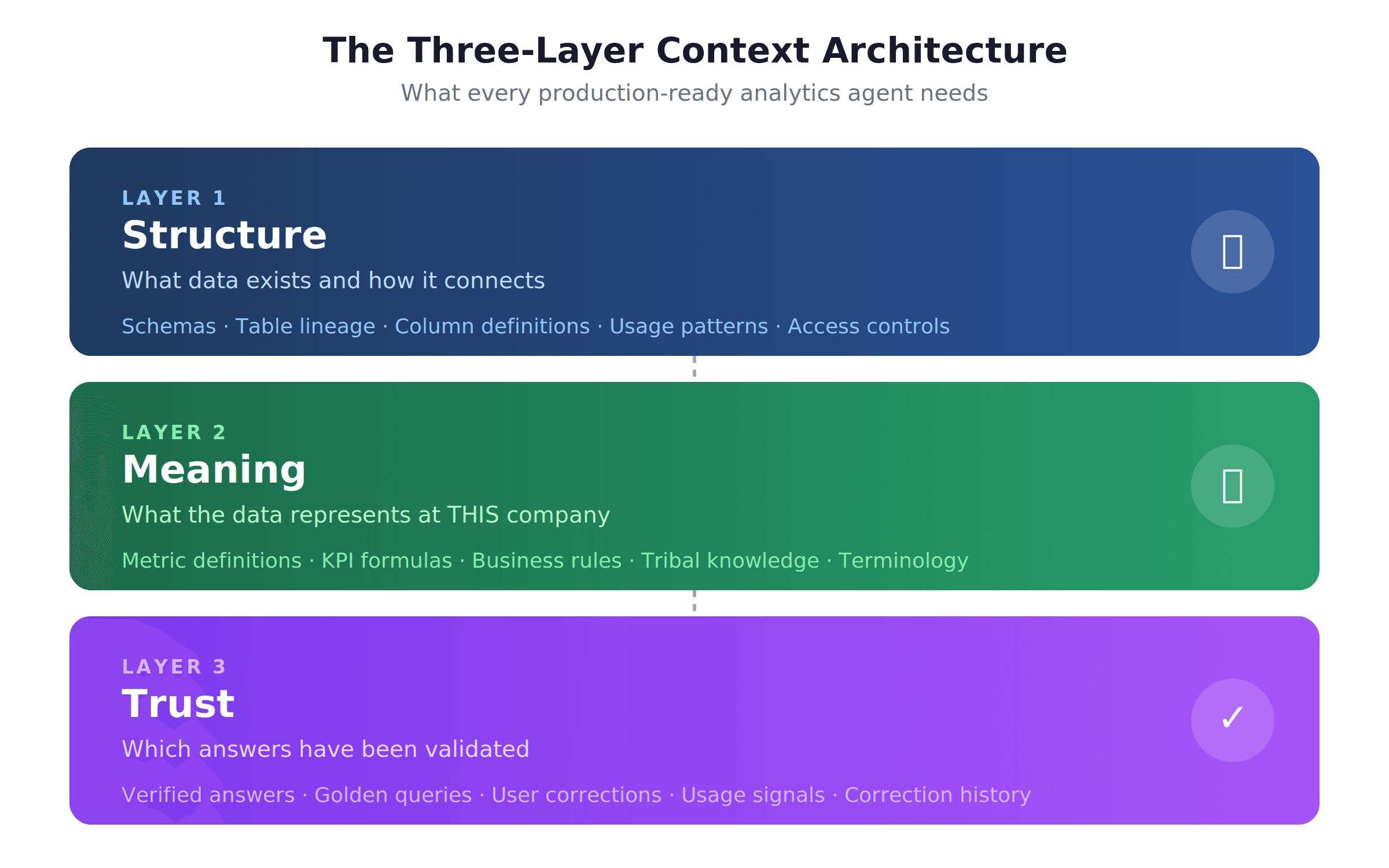
Working through hundreds of production deployments, and looking at the patterns documented by a16z and OpenAI, three categories emerge. We call them Structure, Meaning, and Trust.
Structure: What Data Exists
The Structure layer captures the technical reality of your data:
Schemas and tables: Which tables hold which data, and what types of columns they contain.
Lineage and relationships: How tables connect, which keys are foreign, how facts roll up to dimensions.
Usage patterns: Which tables are actively used versus deprecated, who queries them, how often.
Structure is the layer most existing tools handle reasonably well. Data catalogs (Atlan, Alation), warehouse-native tools (Snowflake's Cortex, Databricks' Unity Catalog), and dbt all contribute structure.
But Structure alone is not enough.
Meaning: What the Data Means at Your Company
The Meaning layer captures the business interpretation of the data:
Metric definitions: What does "revenue" mean here? "Active customer"? "Churn"? Companies define these differently, and most of the disagreement happens inside the company.
Business rules: Exclusions, normalizations, fiscal calendars, segment definitions.
Tribal knowledge: Why this table is preferred over that one. Why this metric has a known caveat. What the data engineer would warn you about if she were in the room.
The Meaning layer is what semantic layers (dbt MetricFlow, Cube, Looker's LookML) attempt to encode. They do this well at varying levels of completeness. Our guide to the semantic layer goes deeper here.
But Meaning alone is still not enough.
Trust: Which Answers Have Been Validated
The Trust layer captures which answers can be relied upon:
Verified queries: Specific question-and-query pairs that have been validated by an analyst.
Golden assets: Canonical dashboards and definitions that are known to be correct.
Usage signals: Which results stakeholders accepted, which they questioned, which they corrected.
Evaluation harnesses: Test suites that check agent accuracy against a benchmark over time.
Trust is the layer most platforms ignore, and it is the layer that determines whether your agent is production-ready or just demo-ready. Without it, an agent can produce a syntactically correct answer that is silently wrong, with no signal to the user that something is off.
This is the gap independent reviewers have flagged repeatedly. The 2025 Stack Overflow Developer Survey, summarized in industry coverage, found that 46% of developers do not trust AI output accuracy, up from 31% the prior year, with the most common complaint being answers that are "almost right, but not quite." That is a Trust-layer problem.
Pro tip for evaluators: Watch how a tool handles uncertainty. A platform that always returns a confident answer regardless of input is missing the Trust layer. A platform that says "I'm not sure, here are two possible interpretations" is showing you that the Trust layer exists.
Why All Three Matter Together
Most platforms in this market solve one or two layers. Warehouse-native agents (Snowflake Cortex, Databricks Genie) are strong on Structure but weak on Meaning and Trust outside their own ecosystem. Semantic-layer-first tools (Cube, Looker) handle Meaning but rarely the Trust layer or the production feedback loop. General-purpose agent builders (CrewAI, AutoGen) handle neither Meaning nor Trust because they are not analytics-specific.
This is the deep reason most agentic analytics pilots fail. The problem is structural, not a bug. For an extended treatment, our piece on why context engineering is the missing piece walks through the full framework.
What Agentic Analytics Looks Like in Production
Definitions aside, the more useful question is: what does this look like when it works?
Internal Use Case: Replacing the Ticket Queue
Inside a typical mid-market or enterprise company, the most visible payoff is the disappearance of the ad-hoc request queue. Business stakeholders who would have filed a ticket and waited days now ask the agent in Slack and get an answer in under a minute.
The data team's role shifts. Instead of answering the same ten questions repeatedly, the team curates the context the agent draws from: validating queries, adding metric definitions, encoding business rules. They become builders of the institutional knowledge layer rather than executors of repetitive queries.
This is the pattern OpenAI describes in its internal agent writeup: a small engineering team enables a much larger user base by investing in the context layer that the agent draws from. Two engineers, three months, 3,500-plus users, hours saved per query.
Customer-Facing Use Case: AI Inside the Product
For B2B SaaS companies, the second use case is embedding the agent into the product itself. Instead of shipping a dashboard for customers to interpret, the product ships an agent that answers the customer's questions in plain language and builds the visualizations they describe.
This has become competitive table stakes fast. Across SaaS, AI-powered analytics inside customer-facing products has shifted in the past 18 months from differentiator to near-universal expectation. Companies that ship it keep customers; the ones that don't lose them to competitors who did.
Multi-Surface Deployment
A defining feature of agentic analytics is that the agent does not live in one place. Modern platforms deploy the same agent across Slack, Microsoft Teams, embedded SDKs (React or iFrame components), web interfaces, MCP-compatible tools, and IDE plug-ins. The reasoning is straightforward: business users already work in Slack and Teams. Forcing them to open a separate BI tool defeats the point.
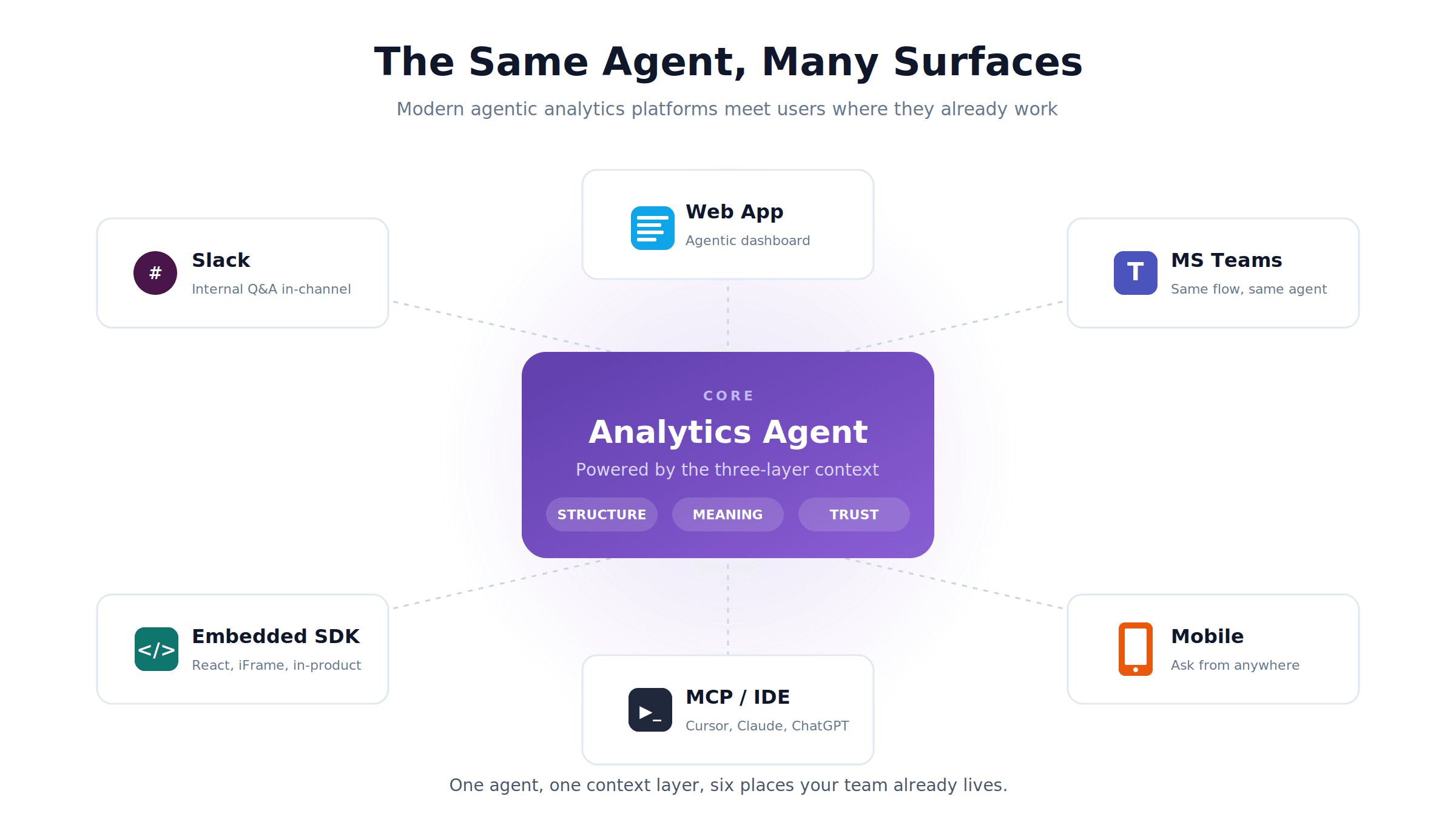
Bottom line on production: The pattern that works is not "AI plus dashboard." It is "agent plus context layer," deployed wherever the user already is.
The Real Constraints: Why Most Agentic Analytics Pilots Still Fail
For all the enthusiasm, the production track record is uneven. Independent reviewers who have tested the current generation of analytics agents have been blunt about the gap between demo and reality.
In her 2026 benchmark of 14 analytics agents, Claire Gouze of The New AI Order found that performance dropped significantly when agents were tested against questions that required interpretation rather than direct retrieval. The technical SQL was correct. The semantic answer was often wrong, because the agent didn't understand what the business meant by the question.
The recurring failure modes are predictable:
Interpretation failures: The agent answers a literal version of the question instead of the intended one.
Framing failures: The agent picks the wrong table or wrong metric definition.
Scope failures: The agent applies a global definition where a segment-specific one was expected.
Silent inaccuracies: The agent produces a confidently wrong answer with no signal of uncertainty.
All four are context problems. None are model problems. This is what our piece on deciding whether to build or buy your agentic analytics stack digs into when weighing the cost of solving these problems internally versus adopting a platform purpose-built for them.
Pro tip: If your evaluation of an agentic analytics tool consists only of a demo, you have not evaluated it. Bring your own ambiguous questions, your own edge cases, and your own validated answers. Compare against them. This is the single biggest predictor of production readiness.
What to Look For in an Agentic Analytics Platform
For teams evaluating the category, the buyer's checklist looks different from the BI checklist of the past decade. The questions that matter are about context, not visualization features.
Does it cover all three context layers? Structure, Meaning, and Trust together, not separately.
Does it work across multiple data sources? Or does it lock you into a single warehouse?
Does it support an evaluation harness? Can you test agent accuracy against a golden query set, and track it over time?
Does it deploy to the surfaces your users already work in? Slack, Teams, your product, your IDE.
Does it serve both internal and customer-facing use cases? Or are you buying two products?
What does the encode-deploy-tune loop look like? How do user conversations improve the context over time?
What are the security and compliance guarantees? SOC 2 Type II and HIPAA matter for regulated industries.
For a structured comparison framework across the major platforms, our evaluation guide for agent builder platforms walks through the trade-offs in detail.
Where to Go Next
Agentic analytics is what comes after the dashboard. It is not a marginal improvement on BI; it is a different way of working with data, where the deliverable is the answer rather than the chart. The technology is real, the production deployments are real, and the limitations are also real. What separates the platforms that work from the ones that demo well is whether they treat context as the product or as a feature.
If you are at the beginning of the evaluation, the next step is understanding the context engineering question in depth. Our guide to why context engineering is the missing piece walks through the three-layer architecture and what each layer requires in practice.
Frequently Asked Questions
What is agentic analytics in simple terms?
Agentic analytics is a category of AI tools where autonomous agents answer business questions about your data, rather than humans building dashboards or analysts answering tickets one at a time. You ask a question in plain language, and the agent retrieves the data, applies your business rules, and returns an answer.
How is agentic analytics different from a BI tool?
A BI tool gives you a canvas to build dashboards. An agentic analytics platform gives you an agent that answers questions directly. The dashboard is no longer the deliverable. The answer is. BI tools are not going away; they are increasingly being used as the visualization layer underneath agentic platforms.
Is agentic analytics the same as text-to-SQL?
No. Text-to-SQL is one component of an agentic analytics system, but it is the easiest part. The hard part is the context the agent draws on: schemas, metric definitions, business rules, and verified answers. Tools that are only text-to-SQL hit accuracy ceilings in production.
What is an agentic analytics platform?
An agentic analytics platform is the infrastructure layer for building, deploying, and tuning analytics agents. It typically includes context management (schemas, metrics, validated queries), an agent runtime, evaluation tooling, and deployment surfaces such as Slack, embedded SDKs, and the web. The category is sometimes called a context infrastructure platform.
Will agentic analytics replace data analysts?
Almost certainly not. What it changes is the work analysts do. Routine question-answering moves to the agent. Analysts shift toward curating the context the agent draws from, validating answers, and tackling the harder analyses that require judgment. Most teams that adopt agentic analytics report being able to take on work they had previously deferred, not reduce headcount.
How accurate are current agentic analytics tools?
It depends heavily on the depth of context the platform supports. Independent benchmarks like Claire Gouze's analytics agent comparison show wide variance. Tools that handle all three context layers (Structure, Meaning, Trust) perform substantially better than tools that handle one. Accuracy also improves over time as more user conversations feed back into the context layer.
What are agentic analytics tools used for?
The two main use cases are internal data answering (replacing the analytics ticket queue) and customer-facing analytics (embedding an agent in a SaaS product so customers can ask questions about their own data). Both run on the same underlying context infrastructure, which is why most serious platforms in this category target both.

Try Upsolve for Embedded Dashboards & AI Insights
Embed dashboards and AI insights directly into your product, with no heavy engineering required.
Fast setup
Built for SaaS products
30‑day free trial