
What the Snowflake semantic layer handles, how it models meaning, and where agents still need more context it does not provide.

Ka Ling Wu
Co-Founder & CEO, Upsolve AI
10 min

Disclosure: This article is published by Upsolve AI. Where our product is mentioned alongside competitors, we aim to provide balanced coverage based on publicly available information. We encourage readers to evaluate all options independently.
A Snowflake semantic layer is a business-friendly translation layer that maps raw tables to the metrics, dimensions, and relationships your organization actually talks about, so both people and AI can query the data without memorizing your schema. In Snowflake, that layer now lives natively inside the warehouse as a schema-level object, and it is quickly becoming the foundation for every AI feature Snowflake ships.
If you are the person responsible for semantic modeling on your team, this is the piece to understand before you commit to an approach. This guide covers how Snowflake handles semantic modeling through Cortex Analyst, semantic views, and semantic models, what you need to set one up, and how a Snowflake semantic layer maps to the three-layer context architecture (Structure, Meaning, Trust) that analytics agents depend on. It is honest about where warehouse-native modeling shines and where it falls short once you put an agent in front of real users.
Key Takeaways |
|---|
|
What a Snowflake Semantic Layer Actually Is
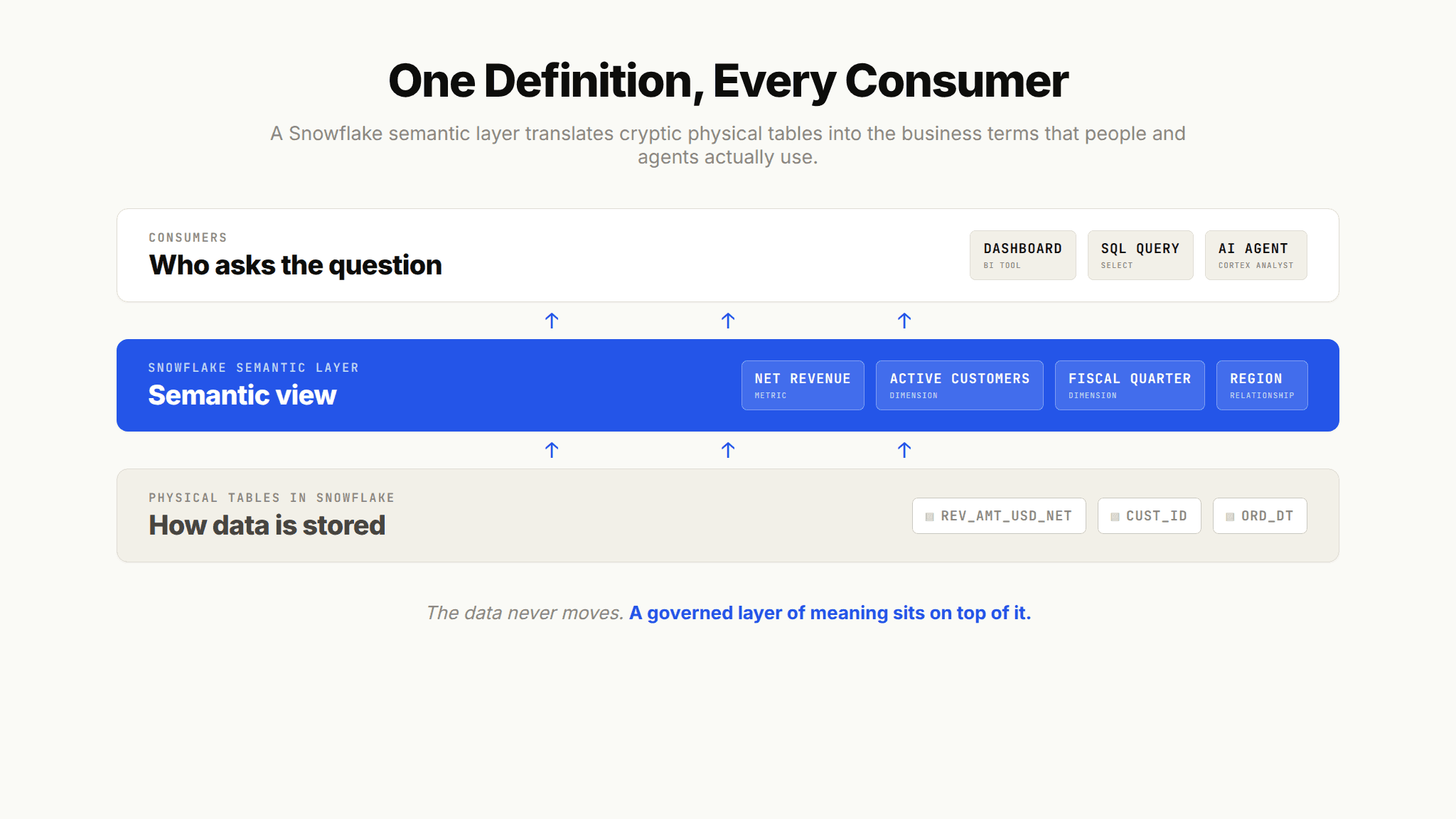
Start with the problem it solves. A physical schema tells a query engine that a column called rev_amt_usd_net exists in a table called fct_ord. It says nothing about the fact that your finance team calls this "net revenue," excludes refunds, and reports it by fiscal quarter. That gap between how data is stored and how the business describes it is exactly what a semantic layer closes. If you want the vendor-neutral version of this concept first, our guide to semantic layer fundamentals walks through the architecture in depth.
Snowflake's take on this is notable for one reason: the semantic definitions sit in the same place as the data. A semantic view is a schema-level object that stores business metrics, dimensions, and entity relationships directly in the database, which means the logic travels with the tables it describes rather than living in a separate BI tool that has to be kept in sync.
The core idea: A Snowflake semantic layer does not move or copy your data. It adds a governed layer of meaning on top of the tables you already have, so the same definition of "active customer" is used whether the question comes from a dashboard, a SQL query, or an AI assistant.
How Snowflake Handles Semantic Modeling
Snowflake actually gives you two overlapping ways to define a semantic layer, plus the engine that consumes it. Knowing which is which prevents a lot of confusion, because the terms sound similar and currently coexist in the product.
Semantic Models: YAML Files on a Stage
The original approach arrived with Cortex Analyst in 2024. A semantic model is a lightweight YAML file, stored on a Snowflake stage, that maps logical tables, dimensions, facts, measures, and relationships to your physical tables. The structure mirrors a database schema, but it carries the extra business meaning a raw schema cannot: friendly names, synonyms, and how each measure is actually calculated. These YAML files are still fully supported for backward compatibility, but Snowflake now points new implementations toward semantic views.
Semantic Views: The Native Schema Object
At Snowflake Summit 2025, Snowflake reached general availability for semantic views, promoting the semantic model from a file on a stage to a first-class object inside a schema. You define one with the CREATE SEMANTIC VIEW DDL, which is organized into five blocks:
TABLES (business entities mapped to physical tables)
RELATIONSHIPS (explicit join paths)
FACTS (row-level quantities)
DIMENSIONS (the attributes you slice by)
METRICS (aggregated KPIs).
Behind the scenes, a semantic view is still backed by the same YAML, and Snowflake keeps the two in sync.
The practical advantage is governance and reuse. Because the definition is an object in the database, you can grant privileges on it, tag it, share it through listings, and even query it directly in a SELECT statement. Standard SQL querying of semantic views reached general availability in March 2026, so the same governed metrics feed both AI and traditional reporting.
Cortex Analyst: The Consumption Engine
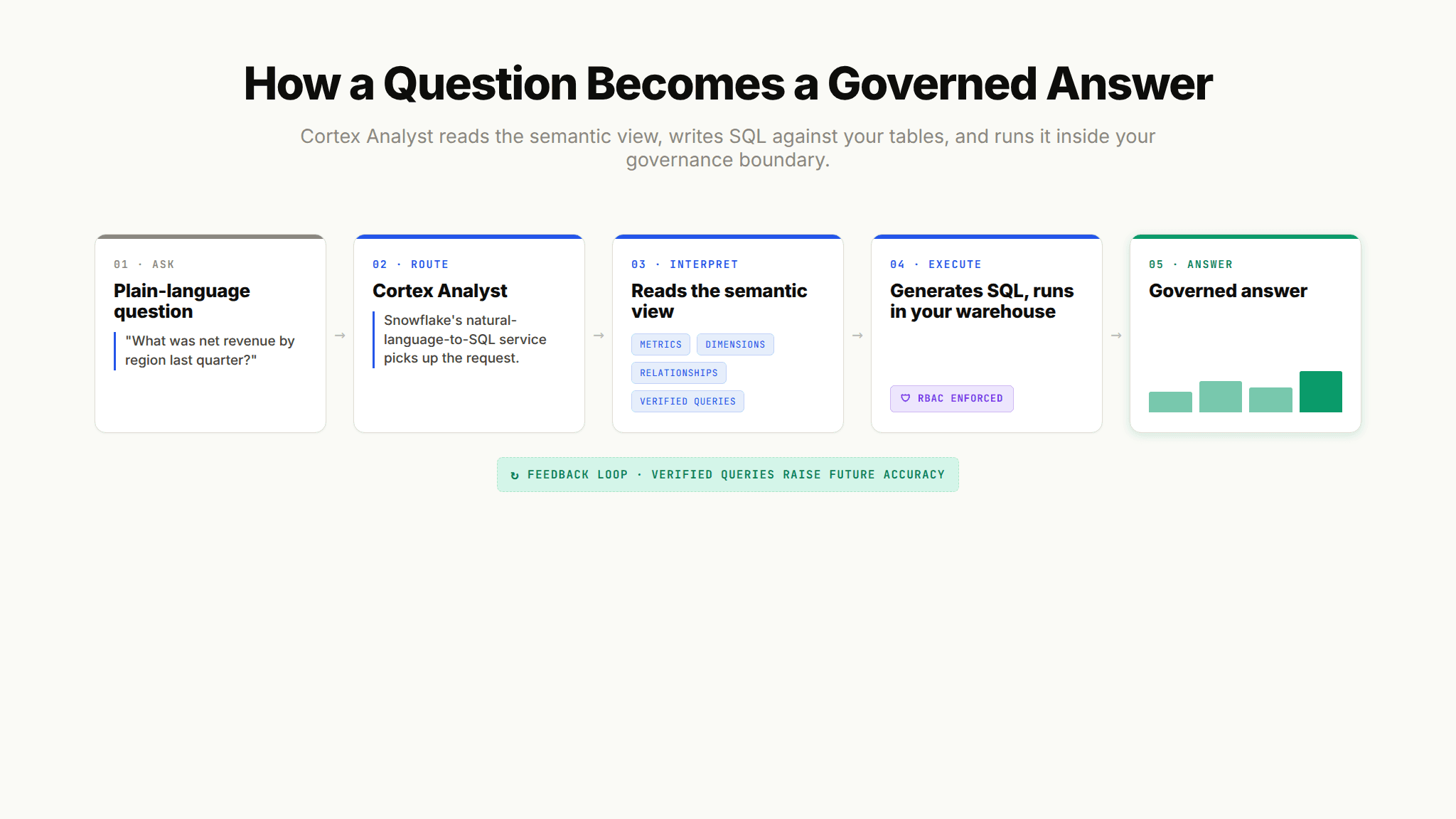
Neither the model nor the view answers questions on its own. That is the job of Cortex Analyst, Snowflake's natural-language-to-SQL service. A business user asks a question in plain language, Cortex Analyst reads the semantic definition, generates SQL against your physical tables, and runs it in your warehouse.
By default it runs on Snowflake-hosted large language models, and it respects your existing role-based access control, so a query only ever returns data the user is already allowed to see and no metadata leaves the platform.
This is the "snowflake cortex semantic layer" that many teams are searching for: the semantic view or model provides the meaning, and Cortex Analyst is the interface that turns questions into governed answers.
Setting Up a Snowflake Semantic Layer: What Data Teams Need to Know
Setting up a Snowflake data model for semantic querying is not a one-click exercise, but the path is well defined. Here is the shape of the work.
Step 1: Design the Business Model on a Clean Star Schema
Before you write any definitions, decide which business entities matter (customers, orders, products) and confirm the underlying tables are query-ready. Snowflake recommends starting from a simple star schema and keeping scope tight, roughly three to five tables and ten to twenty columns each to begin with. The winning pattern, echoed by practitioners, is to model the twenty percent of your data that answers eighty percent of the questions, then expand.
Step 2: Build the Semantic View
You have two routes. Data engineers who want precision can author the CREATE SEMANTIC VIEW DDL directly, defining tables, relationships, facts, dimensions, and metrics. Teams who want speed can use the Snowsight wizard, which walks you through selecting tables, columns, and example questions, and can generate AI-written descriptions from your column names and sample values. Snowflake also ships Semantic View Autopilot, which reduces starter model creation from days to minutes by inspecting your tables and query history.
Pro tip: Autopilot and the wizard give you a draft, not a finished product. The fields that most improve accuracy (synonyms, business-friendly descriptions, and precise metric expressions) are exactly the ones a generator cannot infer from schema alone. Budget time for a subject-matter expert to review them.
Step 3: Add Verified Queries and Custom Instructions
This is where accuracy compounds. The Verified Query Repository lets you store approved question-and-SQL pairs that Cortex Analyst treats as worked examples when it sees a similar question, which steadily raises both accuracy and the trustworthiness of answers. Custom instructions let you steer how SQL is generated and how questions are categorized, which is useful for encoding rules like "always exclude internal test accounts."
Step 4: Wire Up Governance and Access
Grant the appropriate Cortex database role, control who can query each semantic view, and use private access modifiers to hide helper facts that should feed calculations but never surface directly. Because everything runs inside Snowflake's governance boundary, you inherit your existing security posture rather than rebuilding it.
dbt and Snowflake: Where the Semantic Layer Can Live
Many teams already define metrics in dbt and do not want to duplicate that logic inside Snowflake by hand. The good news is these approaches increasingly meet in the middle. Snowflake Labs published a dbt-to-semantic-view package that translates metrics defined in dbt YAML into native Snowflake semantic objects, so you can keep dbt as your source of truth and publish down into the warehouse. If dbt is already central to your stack, our companion guide on using dbt on top of Snowflake covers how MetricFlow definitions feed the meaning layer.
The broader industry is moving the same direction. The Open Semantic Interchange initiative, launched in September 2025 by a coalition of major data and analytics vendors, exists precisely because organizations run multiple tools and need semantic context to travel between them rather than being re-defined in each one.
That effort is a tacit admission of a limitation we will come back to: a warehouse-native semantic layer is powerful inside its walls and awkward outside them.
Mapping a Snowflake Semantic Layer to the Three-Layer Context Architecture
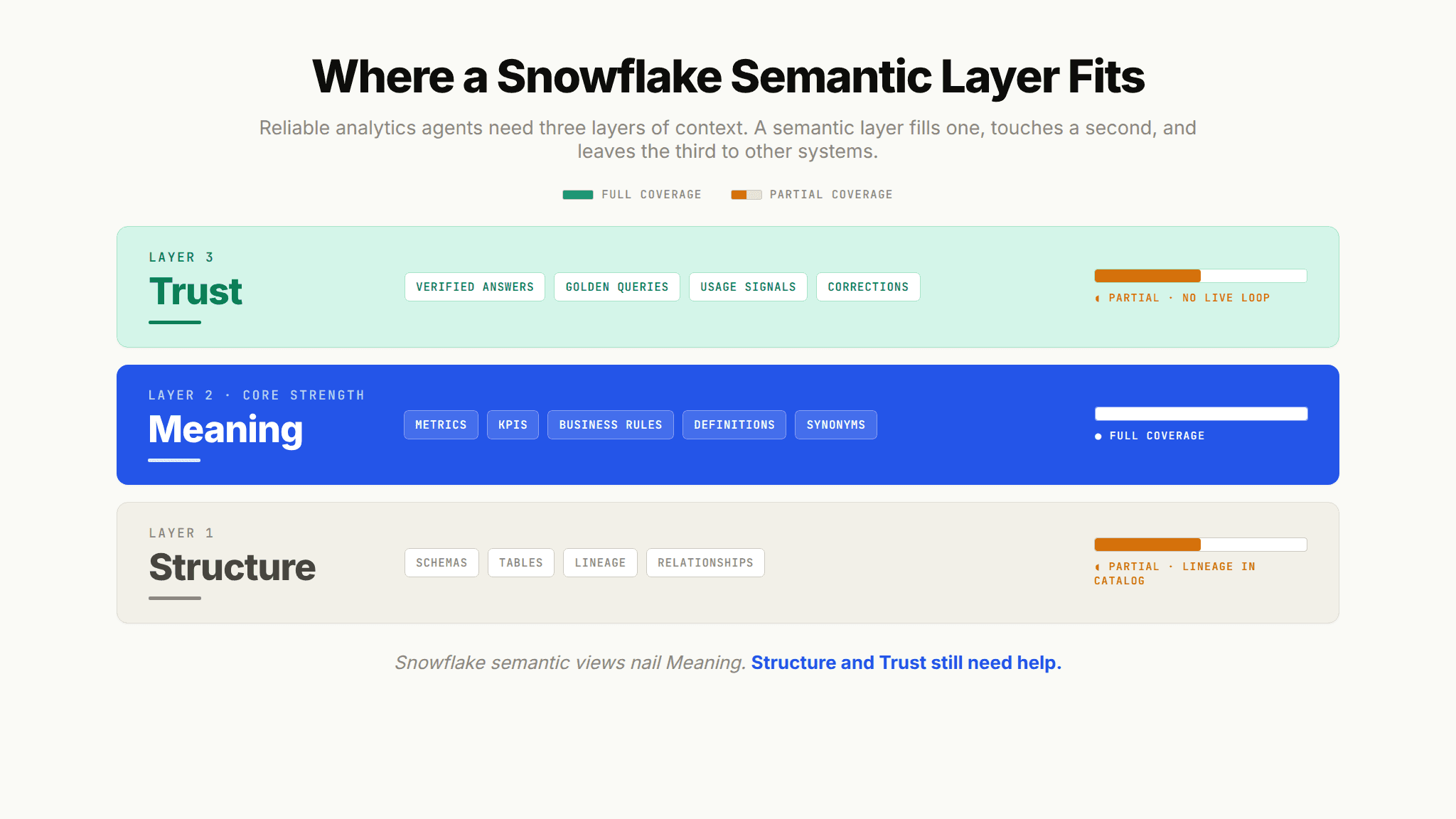
Here is the framing that matters most if your end goal is an analytics agent rather than a dashboard. Reliable agents need three distinct layers of context, and a Snowflake semantic layer fills one of them well, touches a second, and largely leaves the third to other systems. For the full treatment of why this matters, see why context engineering makes or breaks an analytics agent.
Layer | What it contains | Does a Snowflake semantic layer cover it? |
|---|---|---|
Structure | Schemas, tables, lineage, relationships, usage patterns | Partially. Relationships and joins are modeled, but full lineage and usage signals live in the catalog, not the semantic view. |
Meaning | Metrics, KPIs, business rules, definitions, tribal knowledge | Yes. This is the core strength. Metrics, dimensions, synonyms, and custom instructions encode meaning well. |
Trust | Verified answers, golden assets, usage signals, corrections | Partially. Verified queries are a real start, but there is no continuous evaluation-and-correction loop out of the box. |
The Meaning layer is where Snowflake semantic views earn their keep. When you encode that "net revenue" excludes refunds and is reported by fiscal quarter, you are giving the model exactly the institutional knowledge it needs. This is not a small point. Independent research from a16z argues that data agents are effectively useless without this kind of context, and OpenAI's writeup of its own internal data agent makes the same case: high-quality answers depend on rich, accurate context rather than a bigger model. Both pieces are listed in the sources below.
The failure was rarely the model. The failure was the context. A semantic layer that nails the Meaning layer removes the single most common cause of wrong answers: the agent guessing at a definition it was never given.
Where a Snowflake Semantic Layer Helps, and Where It Falls Short for Agents
Being clear-eyed here is more useful than cheerleading, so start with the strengths. Because the definitions live in the same schema as the tables, you get one governed source of truth instead of a copy in every BI tool that quietly drifts out of sync. Cortex Analyst runs inside Snowflake's role-based access control, so users only ever see data they are authorized to see and no metadata leaves the platform, and because it defaults to Snowflake-hosted models, you are not wiring in a separate model provider just to get started. Verified queries even hand you a real head start on trust by turning approved answers into reusable examples.
The boundaries appear the moment you put an agent in front of non-technical users across a real business. These are the ones worth understanding before you commit.
It only reasons over data that lives in Snowflake
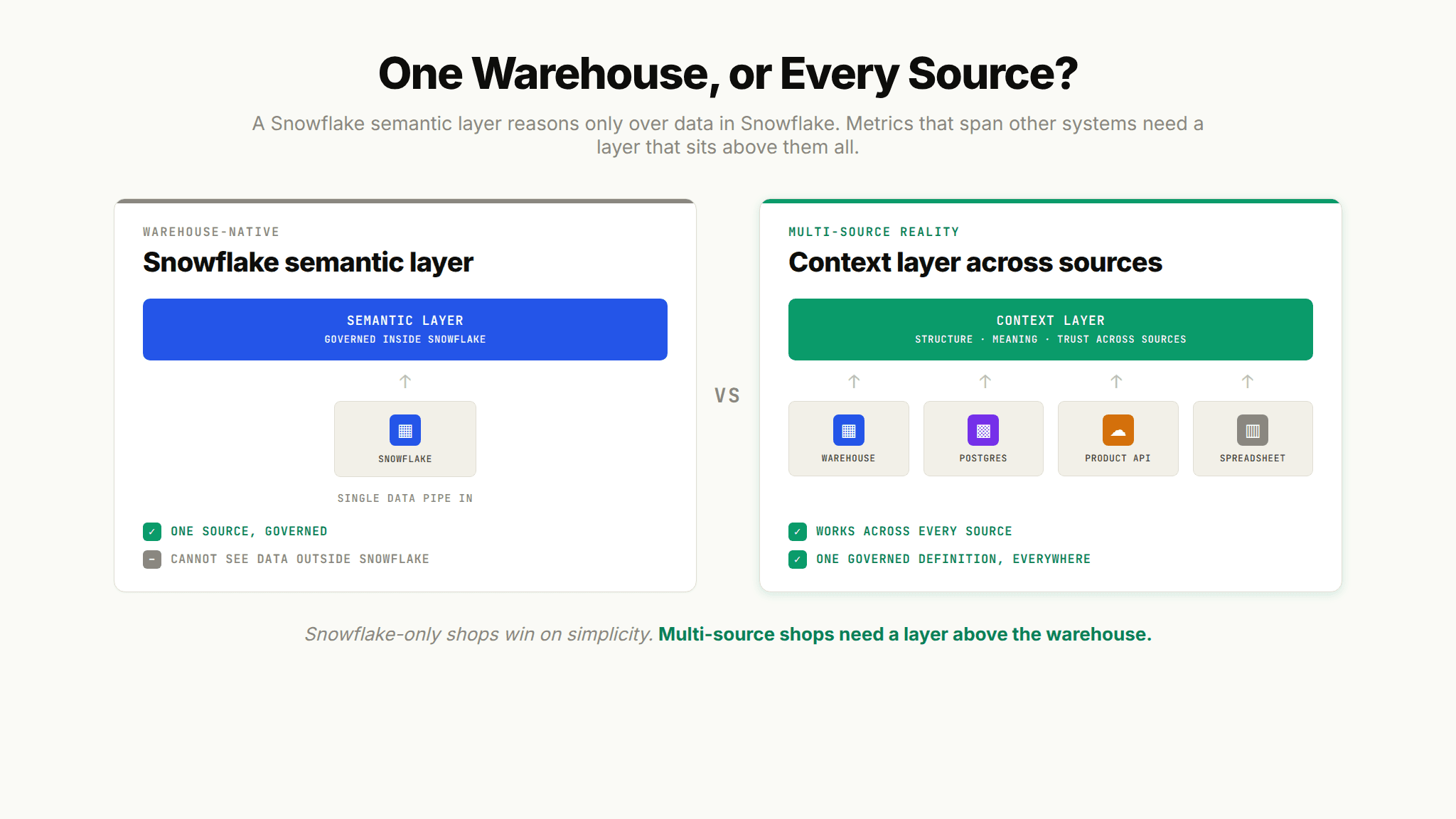
A Snowflake semantic layer can see only what lives in Snowflake. If a core metric depends on a table in Postgres, an event stream, or a second warehouse, the semantic view has no way to reach it. Practitioners tend to say it plainly: Snowflake-only shops win on simplicity, while teams whose data spans multiple systems need dbt or a warehouse-agnostic layer to hold their definitions in one place. For a genuinely single-source business this is a non-issue; for everyone else it is the first wall you hit.
The Trust layer is only half-built
Verified queries are a real start, but they are static. Nothing in the box watches production conversations, flags where the agent answered wrong, and feeds those corrections back into the model. Trust is a process rather than a one-time file, and out of the box you are the one who has to run that process: reviewing logs, spotting drift, and updating definitions by hand. That works at small scale and strains as usage grows.
It presumes a mature modeling investment
Autopilot and the Snowsight wizard shorten the first draft, but a semantic layer people actually trust still depends on curated synonyms, precise metric logic, and expert review. Teams building on a clean, well-modeled warehouse feel this least. Teams sitting on raw or sprawling data feel it most, because the model is only ever as good as the judgment encoded into it, and no generator can infer your business rules from column names alone.
Context does not travel across your stack
Everything here is expressed in Snowflake's own paradigm. The reason cross-vendor efforts like Open Semantic Interchange exist at all is that a single warehouse's semantic layer does not easily serve the other tools and agents in your stack. When your context is locked to one platform, every new surface (a second BI tool, an embedded product experience, an external agent) has to relearn what your metrics mean from scratch.
If your data genuinely lives entirely in Snowflake and your users are comfortable there, a semantic view plus Cortex Analyst is a strong foundation. If your analytics span multiple sources, or you need an agent that answers reliably for customers and internal teams alike, the better move is to evaluate database-agnostic agent platforms that encode Structure, Meaning, and Trust across every source and treat the encode-deploy-refine loop as the product rather than a bolted-on feature.
Deciding Whether a Snowflake Semantic Layer Is Enough
A Snowflake semantic layer is a real and welcome shift: the meaning of your data now lives next to the data itself, governed and reusable, feeding both dashboards and Cortex Analyst from a single definition. For teams whose world is Snowflake, that is a strong place to build.
Just be precise about what you are getting. A semantic layer is the Meaning layer. It answers "what does this metric mean here," and it answers it well. The moment you ask an agent to be trustworthy for real users across every source your business runs on, you are asking for all three layers of context, not one. Knowing which layer you have solved, and which you still need, is the difference between a demo that impresses and an agent that holds up in production.
If you are weighing what it takes to encode Structure, Meaning, and Trust across more than one warehouse, see how a database-agnostic context approach compares before you commit your semantic layer to a single platform.
Frequently Asked Questions
What is a semantic layer in Snowflake?
It is a business-friendly layer that maps raw tables to the metrics, dimensions, and relationships your team uses in conversation. In Snowflake it takes the form of a semantic view (a schema-level object) or a semantic model (a YAML file on a stage), and Cortex Analyst uses it to turn natural language questions into governed SQL.
What is the difference between a semantic view and a semantic model in Snowflake?
A semantic model is the original format: a YAML file stored on a stage. A semantic view is the newer, recommended approach that stores the same definitions as a governed object inside a schema, so you can grant access to it, tag it, and query it with SQL. The two currently coexist, and a semantic view is backed by the same YAML under the hood.
Do I need Cortex Analyst to use a Snowflake semantic layer?
Not strictly. You can query a semantic view directly in a SELECT statement to get consistent metrics inside BI tools. Cortex Analyst is the piece that adds natural language querying on top of that same semantic layer, so business users can ask questions instead of writing SQL.
How long does it take to set up a Snowflake semantic layer?
A starter model can be generated in minutes using the Snowsight wizard or Semantic View Autopilot. Producing something your team actually trusts takes longer, because synonyms, metric logic, verified queries, and expert review are what drive accuracy. Most teams scope tightly to their highest-value questions first, then expand.
Does a Snowflake semantic layer work across multiple data sources?
No. It reasons only over data that lives in Snowflake. If your metrics depend on data outside the warehouse, you need dbt as a shared definition layer or a warehouse-agnostic context layer that can span sources without moving everything into one platform first.
Is a Snowflake semantic layer enough to build a reliable analytics agent?
It covers the Meaning layer well and gives you a start on Trust, which is a meaningful head start. For a production-ready agent, you also need full Structure (lineage and usage signals) and a continuous Trust loop that validates and corrects answers over time, especially once your data or your users extend beyond Snowflake.

Try Upsolve for Embedded Dashboards & AI Insights
Embed dashboards and AI insights directly into your product, with no heavy engineering required.
Fast setup
Built for SaaS products
30‑day free trial