
When every team defines metrics differently, agents break. Learn how a metrics layer sets one source of truth your numbers can share.

Ka Ling Wu
Co-Founder & CEO, Upsolve AI
10 min

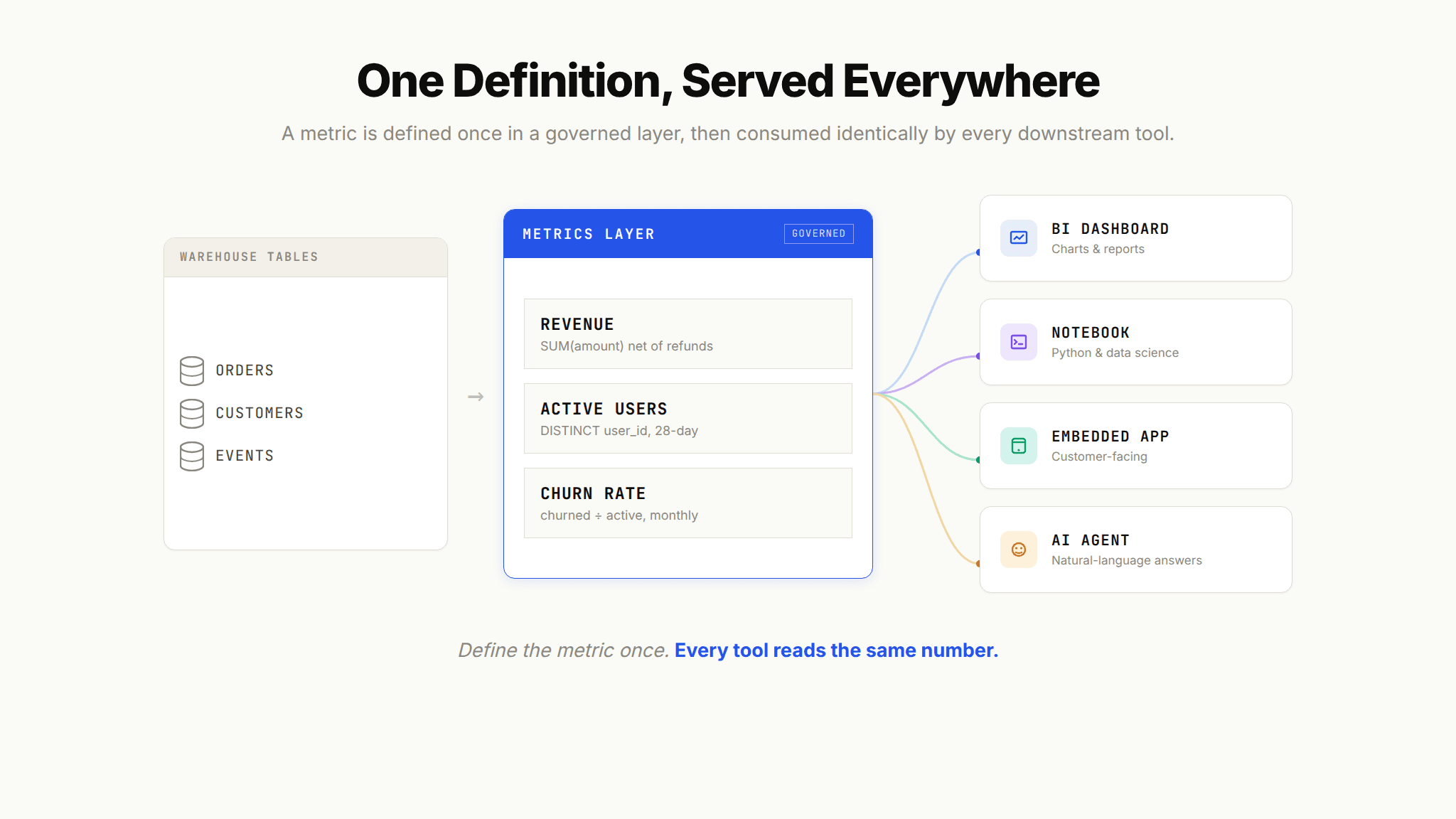
A metrics layer is a centralized place where you define your business metrics (revenue, churn, active users, gross margin) once, as governed code, so that every dashboard, query, notebook, and AI agent returns the same number. Instead of the definition of "revenue" living inside a dozen different SQL queries and BI tools, it lives in one governed location and is served consistently everywhere it is consumed.
If you lead analytics engineering, you already know the failure this solves. Finance reports one revenue figure, the product team reports another, and a leadership meeting turns into a debate about whose dashboard is right instead of what to do next. The metrics layer exists to end that debate. This guide covers what a metrics layer is, why it functions as a single source of truth, how it differs from and relates to the semantic layer, and how those metric definitions become the fuel that makes analytics agents accurate.
Key Takeaways
A metrics layer is the single definition of each KPI: Instead of every tool recalculating a metric like revenue its own way, the calculation lives in one governed place and is served consistently everywhere, which is what earns it the title of single source of truth.
It is part of the semantic layer, not a competing choice: The semantic layer models what your data means and how it connects; the metrics layer governs the specific calculations inside it. Seeing the relationship clearly stops you from treating one as a substitute for the other.
Consistency is a governance discipline, not a feature you buy: A metrics layer only holds its authority when definitions have owners, live as reviewable code, and stay maintained. Left untended, drift creeps back in through side-channel queries.
Your metric definitions are what make analytics agents trustworthy: For an AI agent, the metrics layer supplies the meaning it needs to interpret a question correctly, though reliable answers still depend on knowing which data is authoritative and which results have been validated.
What Is a Metrics Layer?
A metrics layer is an abstraction that stores the definition and calculation logic for your organization's key metrics in a single, governed location, separate from any individual report or BI tool. When a dashboard, an application, or an agent needs the value of "monthly recurring revenue," it requests that metric from the layer rather than recalculating it from raw tables.
Think of it like a shared dictionary for your business. Before a metrics layer, the definition of "active user" might be written differently in a Tableau workbook, a Python notebook, and three separate SQL views, each one technically valid but subtly different. The metrics layer replaces those scattered definitions with one authoritative entry that everyone reads from.
What lives inside a metric definition
A well-formed metric definition captures more than a formula. It records the components that make the number reproducible and auditable:
The measure: The underlying aggregation, such as the sum of an amount column or a distinct count of user IDs.
The dimensions: The attributes you are allowed to slice by, like region, plan tier, or fiscal month.
The metric type: MetricFlow, for example, supports simple, ratio, cumulative, derived, and conversion metric types, each with its own construction rules.
The grain and time logic: How the metric aggregates across day, month, or year, and how it handles period comparisons.
Ownership and documentation: Who is responsible for the definition and what business rule it encodes.
Because these live as code, they can be version-controlled, reviewed in a pull request, and audited over time. That is the shift the metrics layer represents: metrics as code rather than metrics as tribal knowledge scattered across tools.
Why the Metrics Layer Is Your Single Source of Truth
The single source of truth idea sounds abstract until you have sat through the meeting it prevents. Different teams report different numbers for the same business metric, and instead of discussing strategy, everyone relitigates the data.
These inconsistencies are structural, not careless. As Acceldata notes, conflicting analytics reports usually stem from inconsistent data definitions, fragmented pipelines, duplicate datasets, and a lack of standardized governance, which means the fix requires governance rather than correcting one dashboard. When the same term means different things to different teams, Sigma points out that ambiguous definitions create conflicting reports and make the data hard to trust.
The real cost of conflicting definitions
The damage compounds in three ways. First, decision velocity drops because leadership second-guesses every figure. Second, your data team loses time investigating discrepancies instead of building. Third, and most corrosive, trust erodes, and once a dashboard is used to defend positions rather than inform decisions, it has stopped doing its job.
The instinct when numbers disagree is almost always to build another report. Stacking more dashboards on top of misaligned definitions does not add confidence; it adds more versions of the same number and more friction.
A metrics layer breaks this cycle at the root. By defining the metric in one governed place and exposing it to every tool, you remove the opportunity for drift. dbt Labs describes this as codifying metrics centrally so teams get the same number, and the same context around that number, wherever they consume data.
Define once, serve everywhere
The practical payoff is reuse. A single definition answers a BI dashboard query, a data science script, an embedded customer report, and a natural language question, all from the same logic. You are not duplicating the calculation in each tool, so there is nothing to fall out of sync. One customer using the dbt Semantic Layer, Bilt Rewards, reported decreasing data costs by 80% and increasing reliability by centralizing entity relationships rather than rebuilding logic per tool.
Metrics Layer vs Semantic Layer: What Is the Difference?
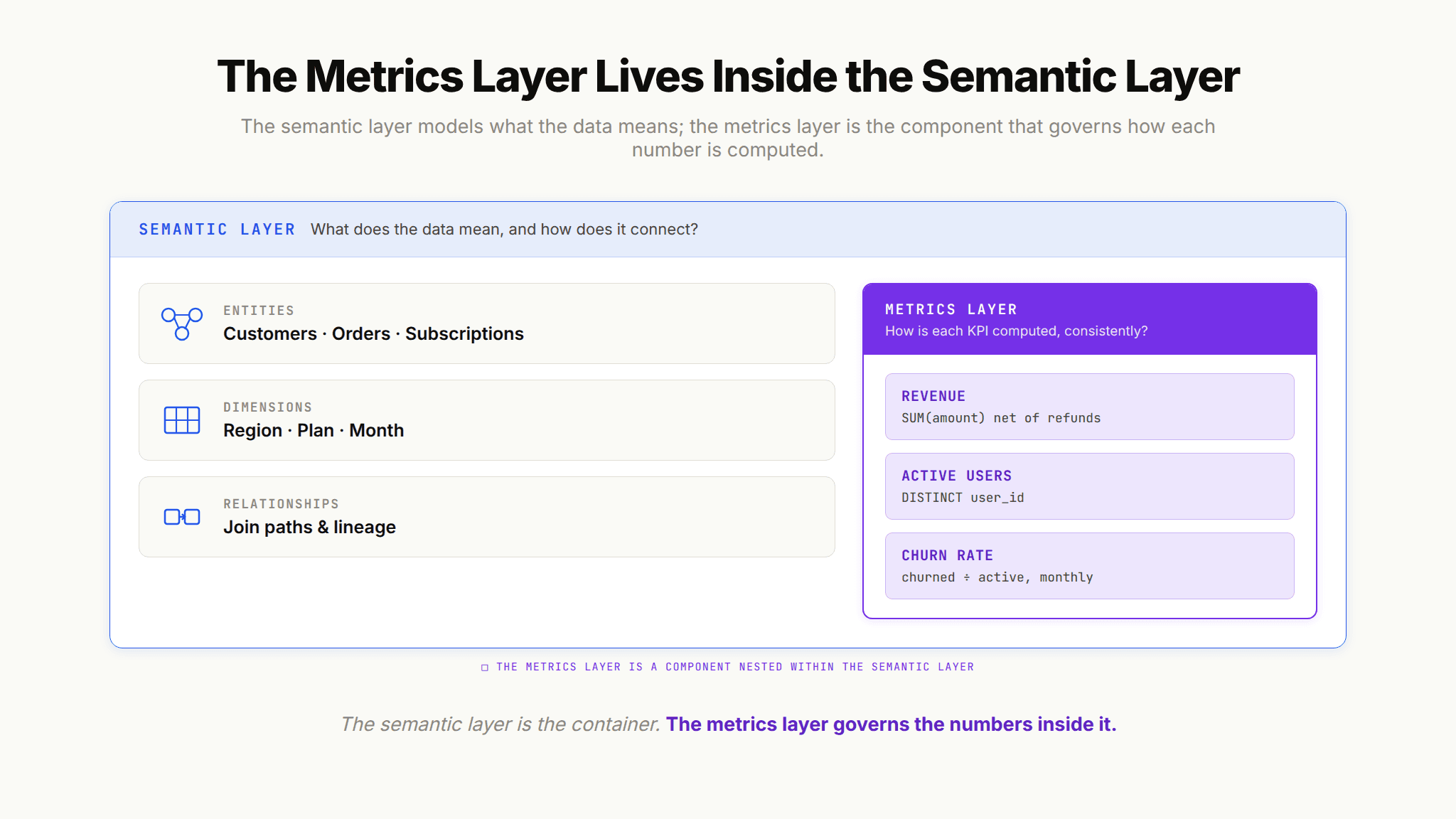
This is the question that trips up most teams, and the short answer is that they are related but not identical. The semantic layer is the broader concept; the metrics layer is a specialized part of it.
The semantic layer is the full translation layer between raw data and business meaning. It models your entities (customers, orders, subscriptions), the dimensions you can group by, the relationships and join paths between tables, and the business vocabulary that maps human language to physical columns. It answers the question "what does this data mean and how does it connect?"
The metrics layer sits within that structure and governs the calculations specifically. It answers a narrower question: "how exactly is each KPI computed, and what is the one correct way to compute it?" You can think of the metrics layer as the part of the semantic layer that owns the numbers.
Dimension | Semantic Layer | Metrics Layer |
|---|---|---|
Scope | Entities, dimensions, relationships, join logic, business vocabulary | Metric definitions, calculation logic, aggregation rules |
Core question | What does the data mean and how does it connect? | How is each KPI calculated, consistently? |
Primary output | A queryable model of the business | A governed set of trustworthy metric values |
Relationship | The container | A component inside the container |
Example concern | "How do orders relate to customers?" | "Is revenue net of refunds or gross?" |
In many modern stacks the two are unified in one framework. MetricFlow is a good illustration: it uses a semantic graph of semantic models (the entities and dimensions) and then defines metrics on top of that graph, so the metrics layer and the semantic layer ship together rather than as separate products. For the full picture of how the container works, see our guide to what a semantic layer is.
The dbt Metrics Layer and MetricFlow
For most analytics engineering teams, "metrics layer" in practice means the dbt metrics layer, powered by MetricFlow. It is worth understanding how it works because it defines the pattern most other tools follow.
MetricFlow lets you define metrics in your dbt project using YAML abstractions, then compiles those definitions into optimized, warehouse-specific SQL at query time. Rather than pre-building one giant table per metric, it constructs the necessary joins dynamically based on the semantic graph, an approach dbt favors because it keeps the metric logic centralized and avoids duplicating calculations across marts.
The mechanics matter for governance. Metric definitions live as code, which means they are version-controlled, lineage-aware, and reviewable. When you change how "revenue" is calculated, the update propagates to every connected tool through the dbt Semantic Layer's APIs rather than requiring you to hunt down and edit each dashboard. In October 2025, dbt Labs open-sourced MetricFlow under the Apache 2.0 license, positioning it as a shared engine that lets AI agents leverage trusted metric definitions for governed analytics, according to the company's announcement.
For the full implementation details, including setup and metric types, see our deep dive on the dbt semantic layer and MetricFlow.

Not every metrics layer works the same way
dbt's approach is metrics-as-code compiled to warehouse SQL, but it is not the only model. Cube, for instance, uses a pre-aggregation and caching strategy tuned for high-concurrency, sub-second queries, which suits embedded and customer-facing workloads. The trade-off is different: dbt leans on your warehouse's native performance and centralizes logic in the dbt project, while Cube maintains its own caching layer for speed. For a closer look at how Cube handles metrics, see our breakdown of Cube's metrics approach.
The choice depends on your stack, but the principle is constant. Whichever tool you pick, the value of the metrics layer is the single governed definition, not the specific engine underneath it.
How Metric Definitions Feed Analytics Agent Context
Here is where the metrics layer stops being a governance nicety and becomes infrastructure for the next wave of analytics. When you point an AI agent at your data, the metric definitions in your metrics layer become part of what the agent needs to know to answer questions correctly.
Consider a simple question: "What was our revenue last quarter?" A generic model can write plausible SQL, but it has no idea whether revenue at your company is net of refunds, whether it uses booking date or recognition date, or which fiscal calendar applies. Those are not modeling failures; they are context failures. As a16z argues, data and analytics agents are essentially useless without the right context. OpenAI's writeup on its internal data agent reinforces the point: high-quality answers depend on rich, accurate context, and the team that built it treated context as the central engineering problem rather than the model.
The metrics layer is the Meaning layer
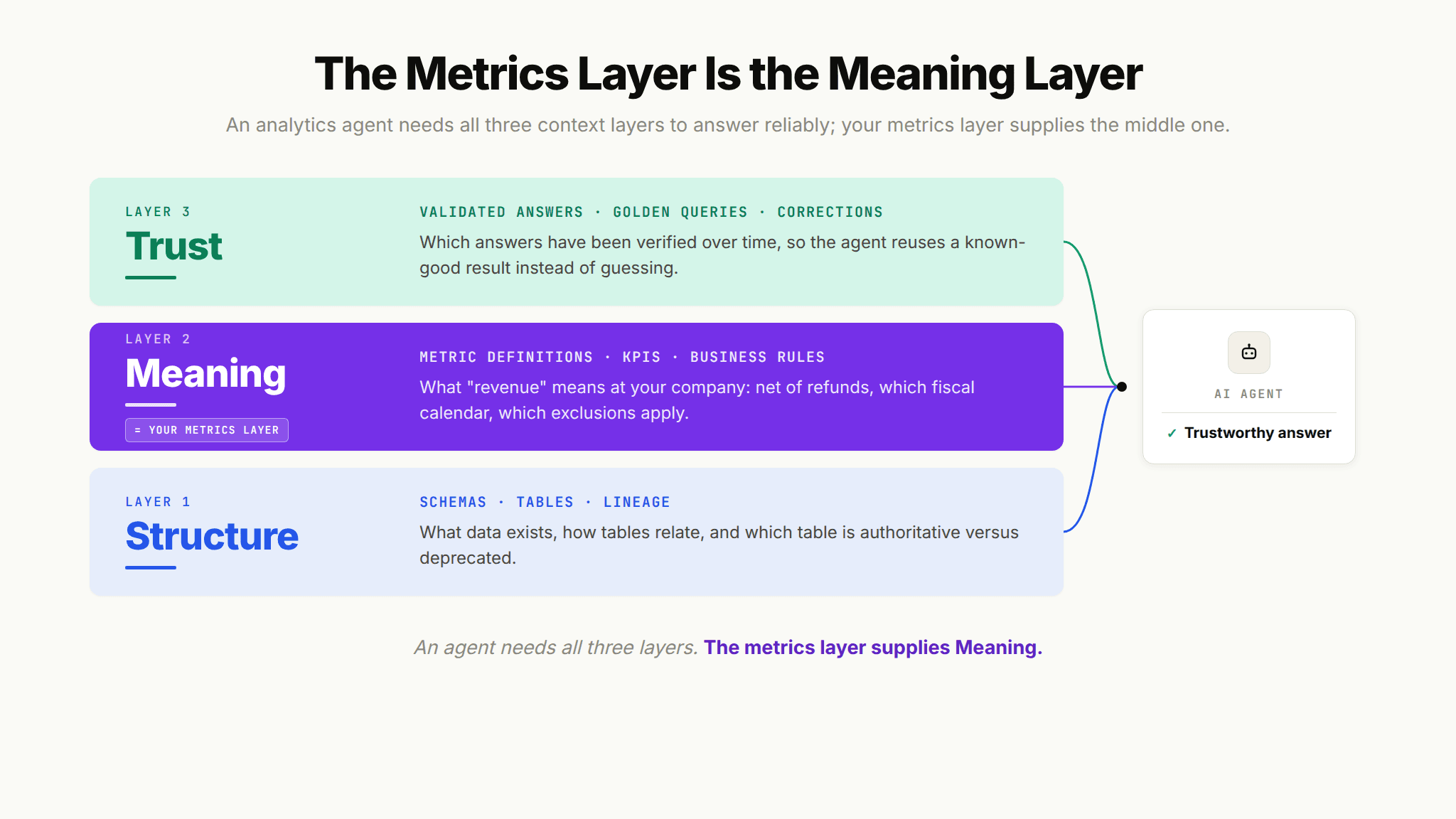
This is where the metrics layer maps directly onto the three-layer context architecture that reliable agents require:
Structure: What data exists, how tables relate, and the lineage between them. This is the schema and join knowledge, closer to the broader semantic layer.
Meaning: What the data means at your specific company, including metric definitions, KPIs, and business rules. This is precisely what a metrics layer encodes.
Trust: Which answers have been validated, which queries are golden, and which corrections have been applied over time.
Your metrics layer is the Meaning layer. It is how an agent learns that "revenue" carries your company's specific definition rather than a generic guess. This is why a governed metrics layer is not just good hygiene for BI; it is a prerequisite for trustworthy agent answers.
Why a metrics layer alone is not enough for agents
Encoding your metrics is necessary but not sufficient. An agent with perfect metric definitions can still fail if it does not know which table is authoritative (Structure) or whether a given answer has been verified before (Trust). Most agent projects that stall in production have solved one layer and assumed the others would follow.
This is the gap Upsolve's Agent Studio is built to close. It lets data teams encode institutional knowledge across all three layers, not just the metrics, so agents produce production-ready answers rather than impressive demos.
If you already maintain a dbt metrics layer or a semantic model, that becomes your Meaning layer input; Agent Studio adds the Structure and Trust that turn definitions into reliable answers. Notably, an existing semantic model is not a prerequisite to get started, which matters because many teams do not have one that is fully maintained.
Where Metrics Layers Lose Their Authority
A metrics layer is only as trustworthy as the discipline around it. Once teams stop treating it as the single source of truth, the old inconsistencies return. These are the patterns that quietly strip a metrics layer of its authority.
Letting definitions go unowned and unmaintained
A metrics layer decays if no one is accountable for it. Business rules change, new metrics appear, and definitions need owners. The moment governance lapses, drift creeps back in through side-channel SQL, and you are back to reconciling numbers in meetings. Assign an owner to each metric and treat definitions like the code they are, with reviews and version history.
Chasing coverage instead of authority
Comprehensiveness is not the goal; authority is. A bloated metrics layer full of speculative or near-duplicate definitions recreates the exact confusion it was meant to end, because now there are three plausible versions of "active users" again, just in a nicer format. Start with the KPIs that drive real decisions and expand deliberately.
Expecting the metrics layer to be all the context an agent needs
Metric definitions are the Meaning layer, and only the Meaning layer. Teams that point an agent at their metrics and expect accuracy are often surprised when it stumbles over which table is canonical or whether a given answer has ever been validated. A metrics layer is a prerequisite for trustworthy agent answers, not the whole solution; plan for Structure and Trust alongside it.
Turning Metric Definitions Into Trustworthy Agent Answers
A metrics layer solves the problem that has haunted BI for a decade: everyone finally reads from the same definition. But as analytics shifts toward agents that answer questions in natural language, that governed definition becomes an input to something larger. Your metric definitions are the Meaning layer of agent context, and the teams that treat them that way are the ones whose agents work in production instead of the demo.
If your metrics are already defined in dbt or a semantic model, you are further along than most. The next step is layering in Structure and Trust so an agent can act on those definitions reliably. Upsolve's Agent Studio is designed to encode context across all three layers, so the institutional knowledge in your metrics layer becomes trustworthy answers your business users can act on. You can start with a warehouse and a handful of validated queries; a fully maintained semantic layer is helpful but not required.
Frequently Asked Questions
What is a metrics layer?
A metrics layer is a centralized, governed location where your business metrics are defined once as code and served consistently to every downstream tool, including dashboards, notebooks, embedded apps, and AI agents. It ensures that a metric like revenue returns the same value regardless of where it is queried, which makes it your single source of truth for KPIs.
What is the difference between a metrics layer and a semantic layer?
The semantic layer is the broader framework that models entities, dimensions, and relationships, answering "what does this data mean and how does it connect." The metrics layer is a component within it that governs the specific calculations, answering "how is each KPI computed, consistently." In tools like dbt's MetricFlow, the two ship together, with metrics defined on top of the semantic graph.
Is dbt a metrics layer?
dbt provides a metrics layer through MetricFlow, which powers the dbt Semantic Layer. You define metrics in YAML, and MetricFlow compiles them into optimized SQL at query time. It supports multiple metric types (simple, ratio, cumulative, derived, and conversion) and was open-sourced under the Apache 2.0 license in late 2025.
Do I need a metrics layer to use AI or analytics agents?
You need governed metric definitions for an agent to answer accurately, and a metrics layer is the cleanest way to provide them. It becomes the Meaning layer in an agent's context. However, a metrics layer alone will not make an agent reliable; the agent also needs Structure (which data exists) and Trust (which answers are validated) to reach production quality.
Is a metrics layer the same as a metrics store?
The terms are often used interchangeably. Both describe a central repository for metric definitions that serves consistent values to downstream consumers. "Metrics layer" tends to emphasize the abstraction within the analytics stack, while "metrics store" emphasizes the repository itself. Functionally, they solve the same single-source-of-truth problem.
How do I build a metrics layer?
Most teams start by choosing a framework (dbt MetricFlow and Cube are common), then encoding their highest-priority KPIs as definitions with clear measures, dimensions, and ownership. From there, you connect downstream tools to consume metrics through the layer's API rather than recreating logic. Governance matters more than coverage, so prioritize the metrics that drive decisions and expand deliberately.

Try Upsolve for Embedded Dashboards & AI Insights
Embed dashboards and AI insights directly into your product, with no heavy engineering required.
Fast setup
Built for SaaS products
30‑day free trial