
Cube nails the Meaning layer but leaves the Trust layer to you. Learn what it does well, and the upfront modeling work it asks of you.

Ka Ling Wu
Co-Founder & CEO, Upsolve AI
10 min

Disclosure: This article is published by Upsolve AI. Where our product is mentioned alongside competitors, we aim to provide balanced coverage based on publicly available information. We encourage readers to evaluate all options independently.
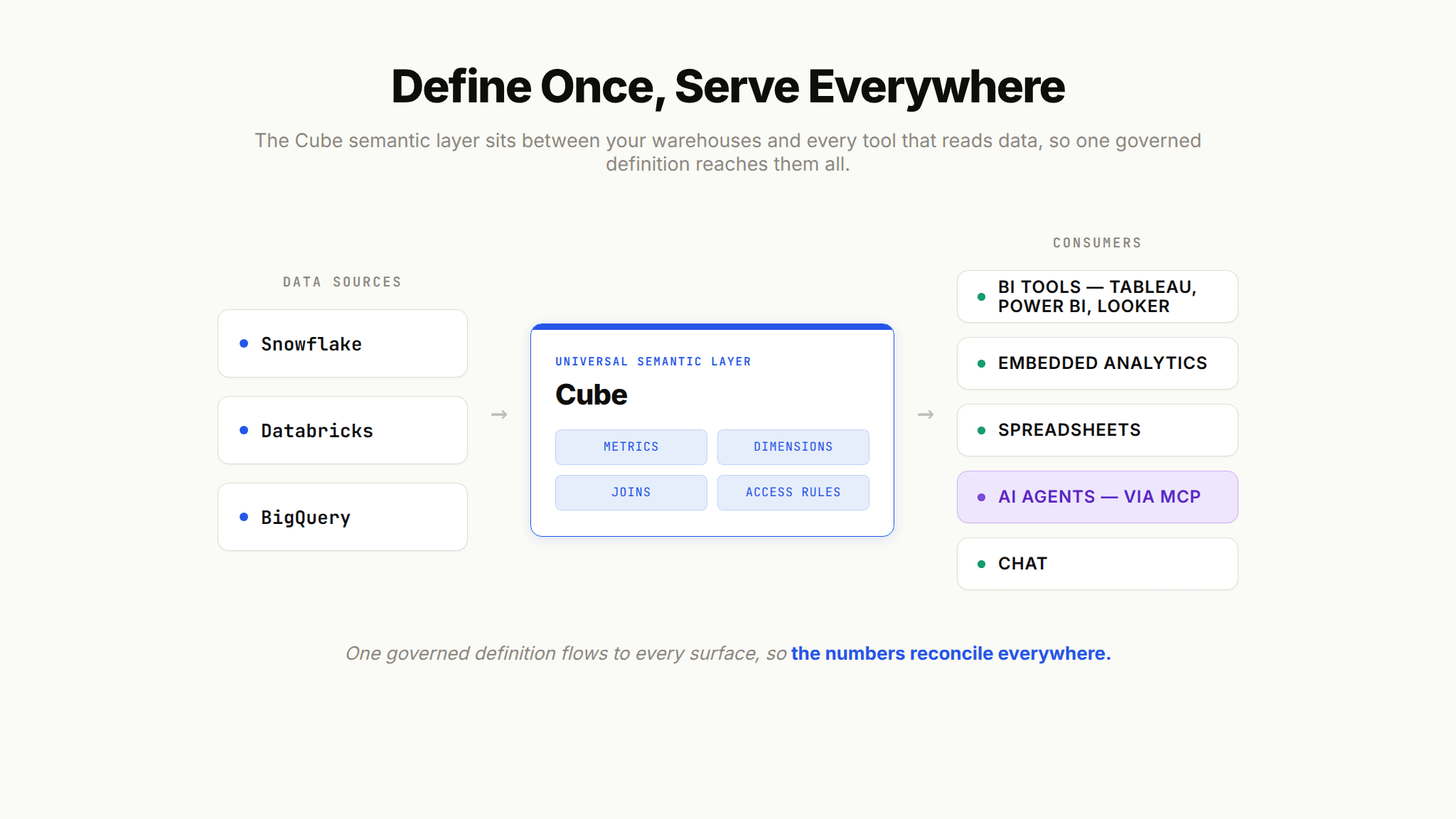
The Cube semantic layer is a universal, code-first modeling layer that defines your metrics, dimensions, joins, and access rules once, then serves them consistently to every downstream tool: BI dashboards, embedded analytics, spreadsheets, and, increasingly, AI agents. If you lead an analytics engineering team and you are trying to figure out how to feed reliable context to an analytics agent, Cube is one of the most mature options on the market. In 2026 the company has repositioned itself squarely around that use case, describing itself as an agentic analytics platform built on a semantic layer.
This is a genuine deep dive, not a hype piece. We will look at how the Cube semantic layer actually works, what its D3 agentic product does, where it is strong, and where it leaves gaps that an analytics engineering lead needs to plan around. Cube deserves real credit for seeing the semantic layer as the foundation for AI agents years before it was fashionable. It also has real limitations, and the honest read is that Cube solves one layer of the context problem very well while asking a lot of upfront modeling work in return.
Key Takeaways |
|---|
|
What Is the Cube Semantic Layer?
The Cube semantic layer is a governed abstraction that sits between your data sources and everything that consumes data. Instead of every dashboard, report, and query re-deriving what "revenue" or "active customer" means, you define those concepts once in Cube. Every downstream tool then inherits the same definition and calculation logic. As Alcon's global head of data science put it in a customer story, without a shared model analysts might write twenty different queries for one core metric; with Cube, that metric is defined once and reused everywhere.
Cube calls this a universal semantic layer because it is designed to serve any consumer: business intelligence tools like Tableau, Power BI, and Looker; spreadsheets; embedded analytics inside a product; and AI agents. The model itself is authored in code, using YAML, JavaScript, or Python, which lets data teams apply software engineering practices such as version control, testing, and CI/CD to their metric definitions.
Where Cube Came From
Cube did not start as an AI product. Founders Artyom Keydunov and Pavel Tiunov built the first version around 2019, and the open-source project took off quickly on HackerNews, crossing 10,000 GitHub stars within months. The commercial product, Cube Cloud, followed. In June 2024 the company raised a $25 million round led by Databricks Ventures, bringing its cumulative funding to $48 million across three rounds. By that point Cube reported being installed on 90,000 servers with 4.9 million users, including roughly 20% of the Fortune 1000.
That history matters for an evaluation. Cube has spent years on the unglamorous, hard problems of semantic modeling: schema mapping, join logic, pre-aggregations, caching, and governance. When LLMs arrived, Cube already had the foundation that AI agents turned out to need.
How Cube Became an Agentic Analytics Pioneer
Cube's central argument is one that Upsolve agrees with completely: an LLM pointed at raw tables does not know what your business means. A table named orders does not tell a model whether revenue is gross or net, whether it includes tax, or whether it is recognized at order time or ship time. Cube frames the semantic layer as the missing layer of understanding that closes this gap, and that framing is correct.
In June 2025 Cube shipped D3 (short for "data in cube"), which it describes as the first agentic analytics platform built on a universal semantic layer. Rather than bolting a chatbot onto a dashboard tool, D3 was designed agent-native from the start. The agents query the semantic layer, not the warehouse directly, which means every answer traces back to governed definitions instead of being improvised from raw schema.
This positioning has earned Cube recognition in the 2026 Gartner Market Guide for Agentic Analytics and a growing roster of named customers, including Brex, Webflow, and Drata. For a category that barely existed two years ago, that is a real head start.
Semantic SQL: The Query Language for the Layer
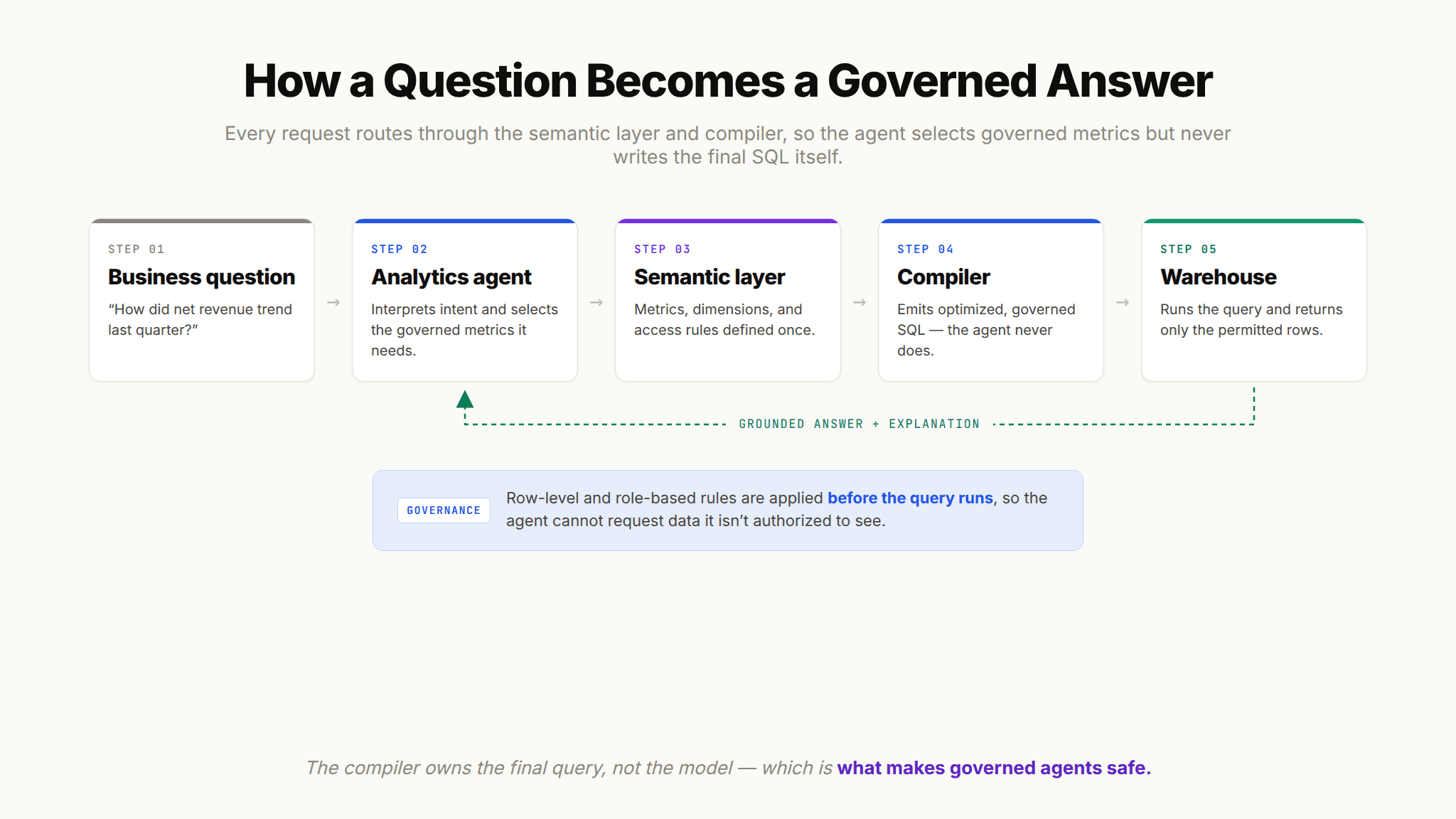
One of Cube's more thoughtful design decisions is what it calls Semantic SQL. The team's reasoning is that AI needs a query language for the semantic layer, not just access to metric definitions. Feeding an agent a list of definitions and hoping it writes correct SQL is where accuracy breaks down. Instead, D3 agents query semantic objects directly and can create ad-hoc dimensions and measures on the fly, while a compiler translates the request into optimized, governed SQL.
This is a meaningful distinction from pure text-to-SQL and where its accuracy tends to break down. The compiler, not the model, owns the final query, which sharply reduces the risk of a subtly wrong join or an unauthorized column appearing in results.
Inside the Cube AI API and D3 Agents.
For teams searching for the cube ai api, here is what actually sits under the hood. Cube exposes an Analytics Chat API that is agent-to-agent capable via the Model Context Protocol and integrates natively with Anthropic's Claude models, with support for bring-your-own-LLM configurations. Underneath, Cube has described building a retrieval augmented generation architecture on top of the semantic layer to surface the most relevant context to the model.
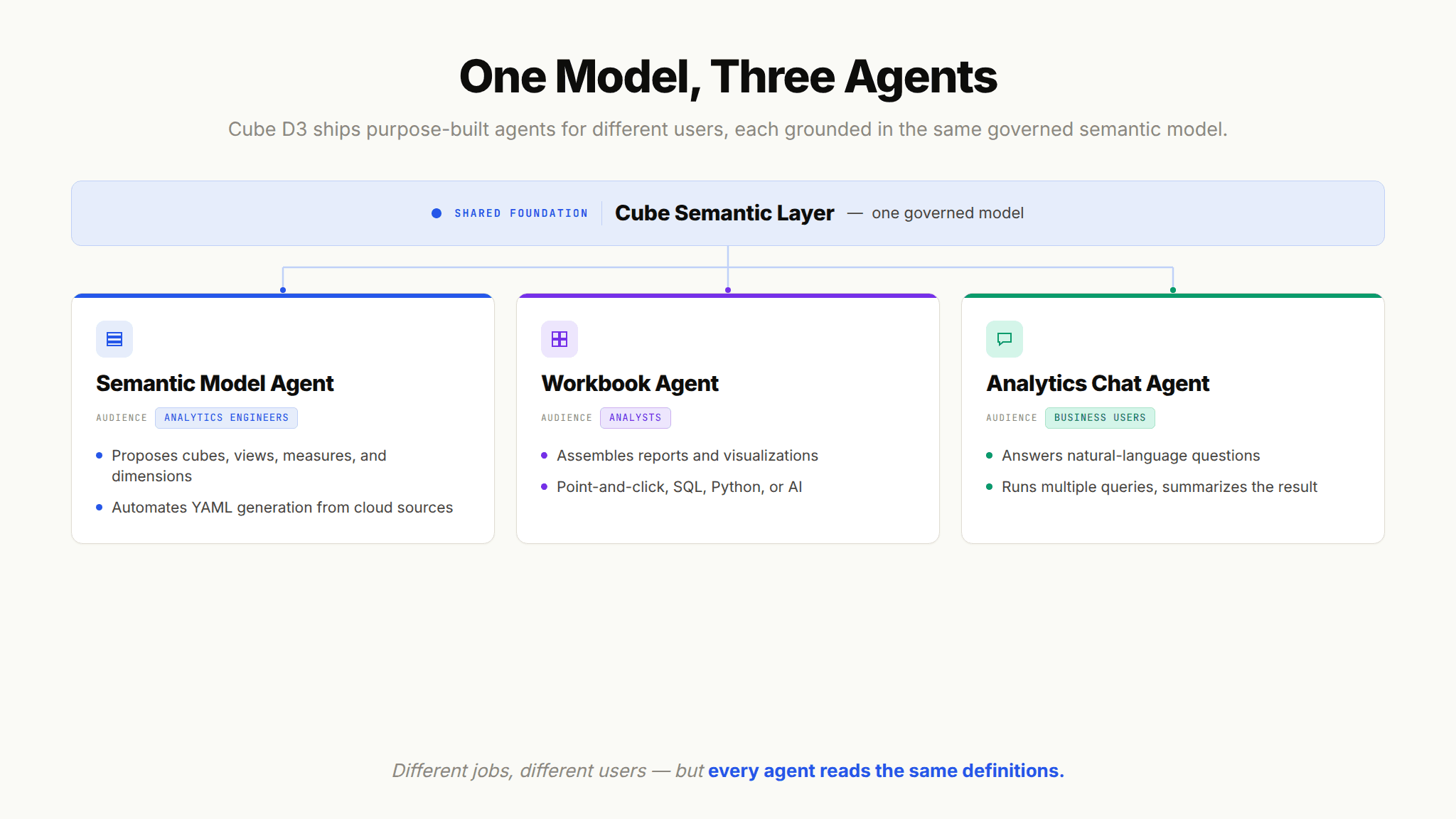
D3 itself ships a small suite of purpose-built agents. Understanding what each one does helps clarify who Cube is really built for.
The Semantic Model Agent
This agent helps data teams build and extend the semantic model itself. It proposes and edits cubes, views, measures, and dimensions, and can automate YAML generation from cloud data sources. This is aimed at the analytics engineer, not the business user.
The Workbook Agent
The Workbook Agent assembles reports and visualizations inside Cube's Workbooks surface. It sits alongside point-and-click, SQL, and Python paths, so an analyst can move between manual and AI-assisted building without leaving the workflow.
The Analytics Chat Agent
This is the natural-language entry point for business users. It answers questions in plain language, runs multiple queries against the semantic layer, and summarizes the result. Cube also groups these capabilities as an AI Data Analyst (for data consumers) and an AI Data Engineer (for automating model development).
Where Cube Excels
Let's talk about the strengths, because they are substantial. Cube earned its pioneer status.
Governance enforced at query-compile time: Because row-level and role-based rules are applied before SQL is emitted, an agent acting for one tenant cannot construct a query that returns another tenant's rows. The security boundary is the compiler, which the agent does not control. This makes governed agents genuinely safe to put in front of external customers.
True multi-surface delivery: The same model feeds BI tools, spreadsheets, embedded apps, and external agents over MCP. Define once, deliver anywhere is not marketing here; it is the architecture.
Open-source flexibility: Cube Core is open source, which reduces lock-in and gives engineering teams full control. This is a real advantage for teams that want to own their infrastructure.
Metric consistency at scale: When your AI assistant, your dashboards, and your embedded product all read from the same model, the numbers reconcile. For a data team tired of arguing about whose revenue figure is right, this is the whole point.
For an analytics engineering lead who already values governance and code-first workflows, Cube feels like it was built by people who share your priorities. To go deeper on the foundational concepts, our guide to semantic layer fundamentals covers why this abstraction matters regardless of which vendor you choose.
How Cube Handles the Metrics Layer
Cube's metrics handling is one of its most refined areas. Metrics are first-class objects: you define a measure once, attach its calculation logic and access rules, and every consumer inherits it. This is what keeps a KPI consistent whether it appears in a board deck, a customer-facing dashboard, or an agent's chat reply.
That said, the metrics layer and the semantic layer are related but not identical concepts, and the distinction affects how you evaluate any tool in this space. If you want to understand exactly how metric definitions differ from the broader model and why that matters for agent accuracy, see our breakdown of Cube's approach to the metrics layer and where the two ideas overlap.
The Three-Layer Lens: Where Cube Fits
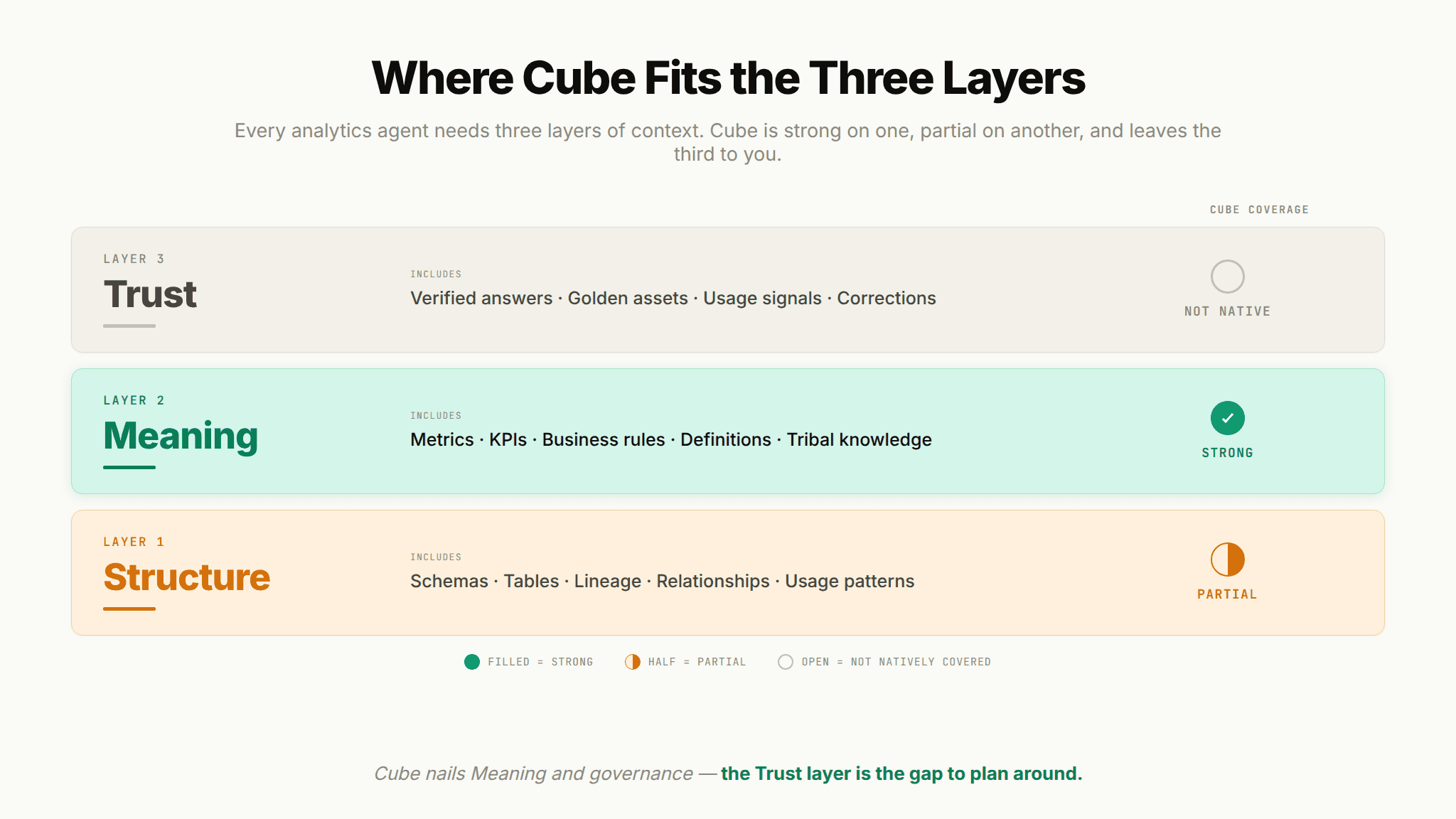
Here is where an honest evaluation gets specific. Every analytics agent needs three layers of context to produce trustworthy answers, and mapping any tool against those layers is the clearest way to see what it does and does not cover.
Structure is what data exists: schemas, tables, lineage, relationships, and usage patterns.
Meaning is what the data means at your company: metrics, KPIs, business rules, definitions, and tribal knowledge.
Trust is which answers have been validated: verified answers, golden assets, usage signals, and corrections that compound over time.
Cube is excellent at the Meaning layer. That is its heritage and its core strength. It also touches Structure, since the model encodes relationships and joins. What Cube does not natively provide is the Trust layer: a systematic loop that verifies which specific answers can be trusted, promotes them to golden assets, learns from real user conversations, and detects when context has drifted or gone stale.
This is not a knock on Cube's engineering. It is a difference in scope. Cube was designed as a semantic layer first, and the Trust layer is a distinct problem that requires its own workflow: evaluation suites, golden query testing, and human-in-the-loop refinement based on how business users actually interact with the agent. For a full treatment of how all three layers fit together, see where Cube fits in the three-layer architecture and why solving one layer is not the same as solving all three.
The Upfront Modeling Question
The second consideration is practical rather than architectural: Cube expects you to bring or build a semantic model. The Semantic Model Agent can accelerate this, and automating YAML generation from cloud sources is a genuine help. But the underlying assumption remains that a hand-authored, well-maintained model is the starting point.
For teams that already run a disciplined semantic layer, this is a feature, not a cost. Your investment pays off immediately. For the many organizations that do not have a well-maintained model, or whose dbt YAML was last meaningfully updated years ago, the upfront modeling work becomes the project before the project. You cannot get value from the agent until the model is in good shape.
This is worth naming plainly because it shapes your timeline. If your data team's reality is a sprawl of undocumented tables and definitions that live in people's heads and Slack threads, the honest question is not "which agent is smartest" but "how much modeling work stands between us and a reliable answer." This is where design philosophy matters more than any feature list.
Some platforms, including Upsolve, are built to start encoding context without a complete pre-existing semantic model, and to treat the Trust layer (verified answers and continuous correction) as part of the core workflow rather than something you bolt on later.
For a team without a mature model, that can be the deciding factor. It is not a knock on Cube; it is a reason to make context coverage and modeling burden explicit criteria before you commit.
Cube vs. What to Look For: An Evaluation Snapshot
If you are comparing Cube against other approaches, it helps to score any option against the capabilities that actually determine agent reliability rather than against feature checklists.
Capability | 📄 What to Check | Where Cube Lands |
|---|---|---|
Structure (schema, lineage) | Does it model relationships and joins? | Strong |
Meaning (metrics, rules) | Are definitions governed and reused everywhere? | Very strong |
Trust (verified answers) | Is there a loop for golden assets and validation? | Not native |
Upfront modeling required | Can you start without a complete model? | Significant model expected |
Governance | Enforced before query execution? | Strong, compile-time |
Deployment surfaces | BI, embedded, chat, external agents? | Broad, multi-surface |
Open source | Can you self-host the core? | Yes, Cube Core |
The pattern here is consistent: Cube is a top-tier answer for the Meaning layer and governance, and it is genuinely open. The areas to plan around are the Trust layer and the modeling investment. Neither is a dealbreaker, but both decide how much work stands between you and a reliable agent, so surface them early rather than after a build stalls. When you reach the platform-selection stage, our guide to evaluating analytics agent builder platforms lays out the full evaluation criteria for analytics-specific agent builders.
What a Cube Evaluation Should Pressure-Test
The strongest evaluations do not ask whether Cube is good, because it is. They ask where it fits your team's reality and where you will have to fill gaps yourself. Three points are worth stress-testing before you commit.
A Semantic Layer Alone Does Not Guarantee Accuracy
A semantic layer is necessary for reliable agents, but it is not sufficient on its own. The Meaning layer answers "what does this metric mean," yet it does not answer "has this specific answer been verified and trusted." It is tempting to assume that once definitions are governed, accuracy is solved, but in practice accuracy also depends on validation and continuous correction. As a16z argued in its analysis, data agents are essentially useless without the right context, and context is broader than definitions alone. Evaluate all three layers, not just the one a given tool leads with.
The Modeling Effort Is Easy to Underestimate
Because D3 demos are impressive, it is easy to assume the path to production is short. The demo runs on a clean, well-authored model, and your production reality may not. Before committing, audit the honest state of your existing model and budget for the modeling work Cube expects. That work, rather than the agent's intelligence, is usually what determines your time to value.
Accuracy Drifts Without a Trust and Refinement Loop
An agent that is accurate on day one can drift as data, definitions, and business rules change. Without a loop that captures corrections and promotes verified answers, quality erodes quietly and no one notices until a stakeholder does. Ask specifically how a platform handles verified answers, golden query testing, and improvement from real user conversations, and plan to build that layer yourself if the tool does not provide it.
Where the Cube Semantic Layer Fits, and Where It Does Not
Cube earned its reputation as an agentic analytics pioneer. It saw the semantic layer as the foundation for AI agents early, built a mature open-source core, and shipped a thoughtful agent-native product in D3. For analytics engineering leads who value governance, open source, and code-first workflows, and who already maintain a disciplined semantic model, Cube is a serious and credible option.
The two things to plan around are the Trust layer, which Cube does not natively close, and the upfront modeling investment it expects. Neither should disqualify Cube. But if your team does not already run a disciplined semantic model, or if verified and self-correcting answers are non-negotiable, weigh those requirements deliberately and compare how each platform, Cube included, covers all three layers rather than one.
If you are further along and comparing platforms head to head, the clearest next step is to evaluate every option against the three layers of context that determine whether an agent actually works in production. See how agent platforms compare to Cube for a structured way to run that comparison across governance, context coverage, and production readiness.
Frequently Asked Questions
What is the Cube semantic layer?
The Cube semantic layer is a universal, code-first modeling layer that defines metrics, dimensions, joins, and access rules once and serves them consistently to BI tools, embedded analytics, spreadsheets, and AI agents. It acts as a single source of truth so every downstream tool uses the same definitions.
Is Cube open source?
Yes. Cube's core, known as Cube Core, is open source and has grown to roughly 17,000 GitHub stars. Cube also offers a commercial product, Cube Cloud, which adds managed hosting, governance features, and the D3 agentic analytics platform.
What is Cube D3?
Cube D3 (short for "data in cube") is Cube's agentic analytics platform, launched in June 2025. It layers AI agents directly on the semantic layer so that answers stay grounded in governed definitions rather than being improvised from raw database schema.
Does the Cube AI API support natural language and MCP?
Yes. Cube's Analytics Chat API is agent-to-agent capable via the Model Context Protocol and integrates natively with Claude models, with support for bringing your own LLM. Underneath, Cube uses a retrieval augmented generation architecture on top of the semantic layer.
Do I need an existing semantic model to use Cube?
Cube is designed around a hand-authored semantic model. Its Semantic Model Agent can automate parts of model creation, but the platform generally expects a well-maintained model as the starting point. Teams without one should budget for the upfront modeling work before agents become reliable.
Where does Cube fall short for analytics agents?
Cube is strong at the Meaning layer (governed metrics and definitions) but does not natively provide the Trust layer: a systematic loop for verified answers, golden assets, and continuous accuracy improvement from real user conversations. It also requires significant upfront semantic modeling, which can slow time to value for teams without an existing model.

Try Upsolve for Embedded Dashboards & AI Insights
Embed dashboards and AI insights directly into your product, with no heavy engineering required.
Fast setup
Built for SaaS products
30‑day free trial