
The lessons from OpenAI's in-house data agent: why context made it work, and how the same ideas can scale to your own data team.

Ka Ling Wu
Co-Founder & CEO, Upsolve AI
10 min

The OpenAI data agent is an internal AI system that lets any employee ask a data question in plain language and get a validated answer in minutes instead of days. In a January 2026 engineering writeup, OpenAI explained how it built the agent, what makes it reliable at massive scale, and the single factor that separated it from every generic AI tool: context.
If you lead a data team and you have watched an impressive agent demo collapse the moment real users touched it, OpenAI's account is the most useful blueprint published so far, and it points directly at why your own attempts may have stalled.
Key Takeaways |
|---|
|
What Is the OpenAI Data Agent?
The OpenAI data agent is a bespoke, internal-only tool that explores and reasons over OpenAI's own data platform. It is not a product you can buy. OpenAI built it for its own teams and then published how it works to show what agentic data analysis looks like when it is done well.
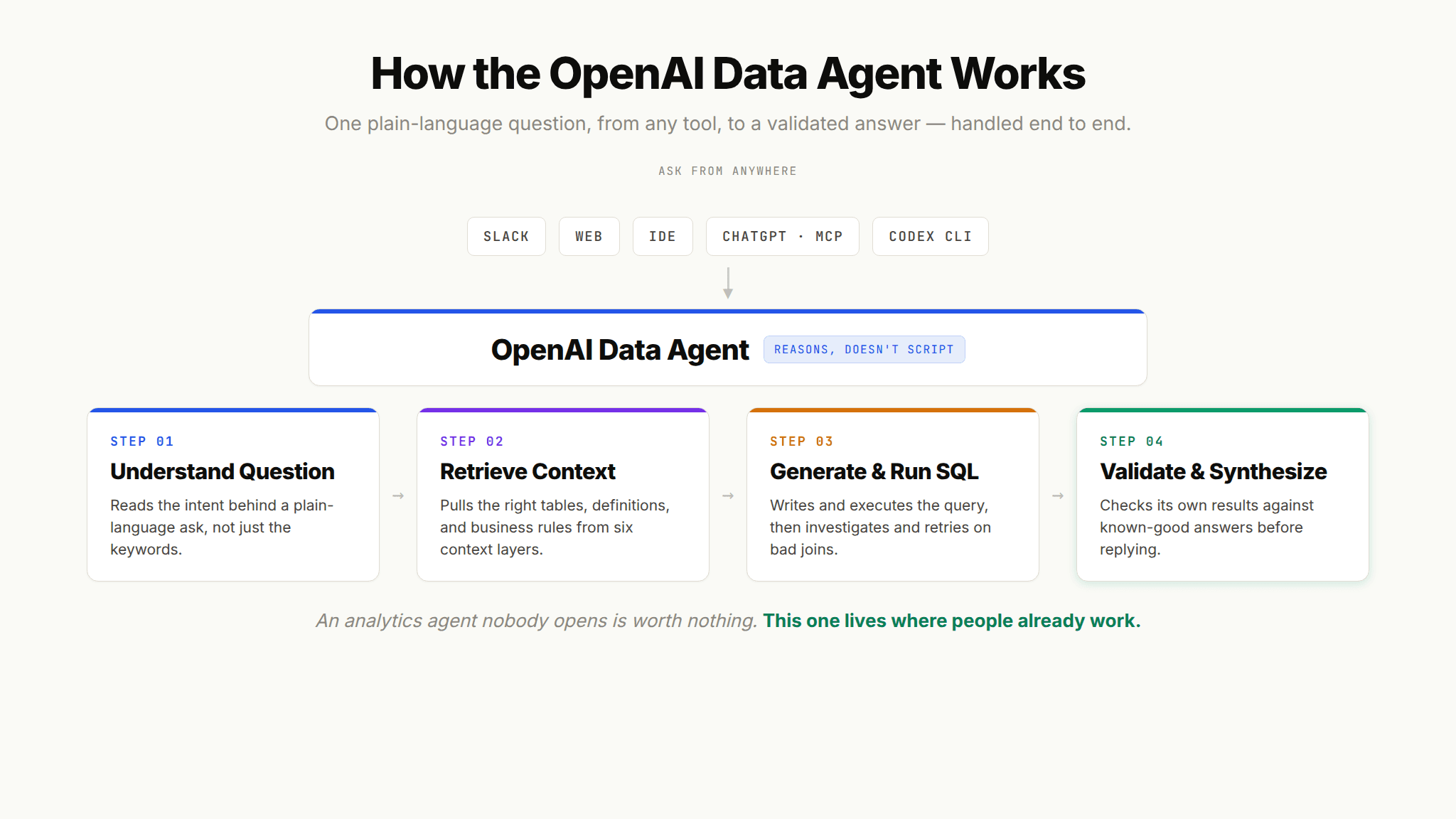
Functionally, it behaves like an always-on analyst. An employee in Finance, Go-To-Market, Engineering, or Research types a question, and the agent handles the whole job end to end: understanding the intent, finding the right tables, writing and running SQL, checking its own intermediate results, and synthesizing an answer. OpenAI describes it as reasoning through a problem rather than following a fixed script, which means that when an intermediate query returns zero rows because of a bad join, the agent investigates, adjusts, and tries again on its own.
Crucially, it lives where people already work. The agent is available as a Slack app, through a web interface, inside IDEs, and through MCP connectors into OpenAI's internal ChatGPT and Codex CLI. That distribution detail matters, because an analytics agent nobody opens is worth nothing, no matter how accurate it is.
The Scale Behind the OpenAI Data Agent
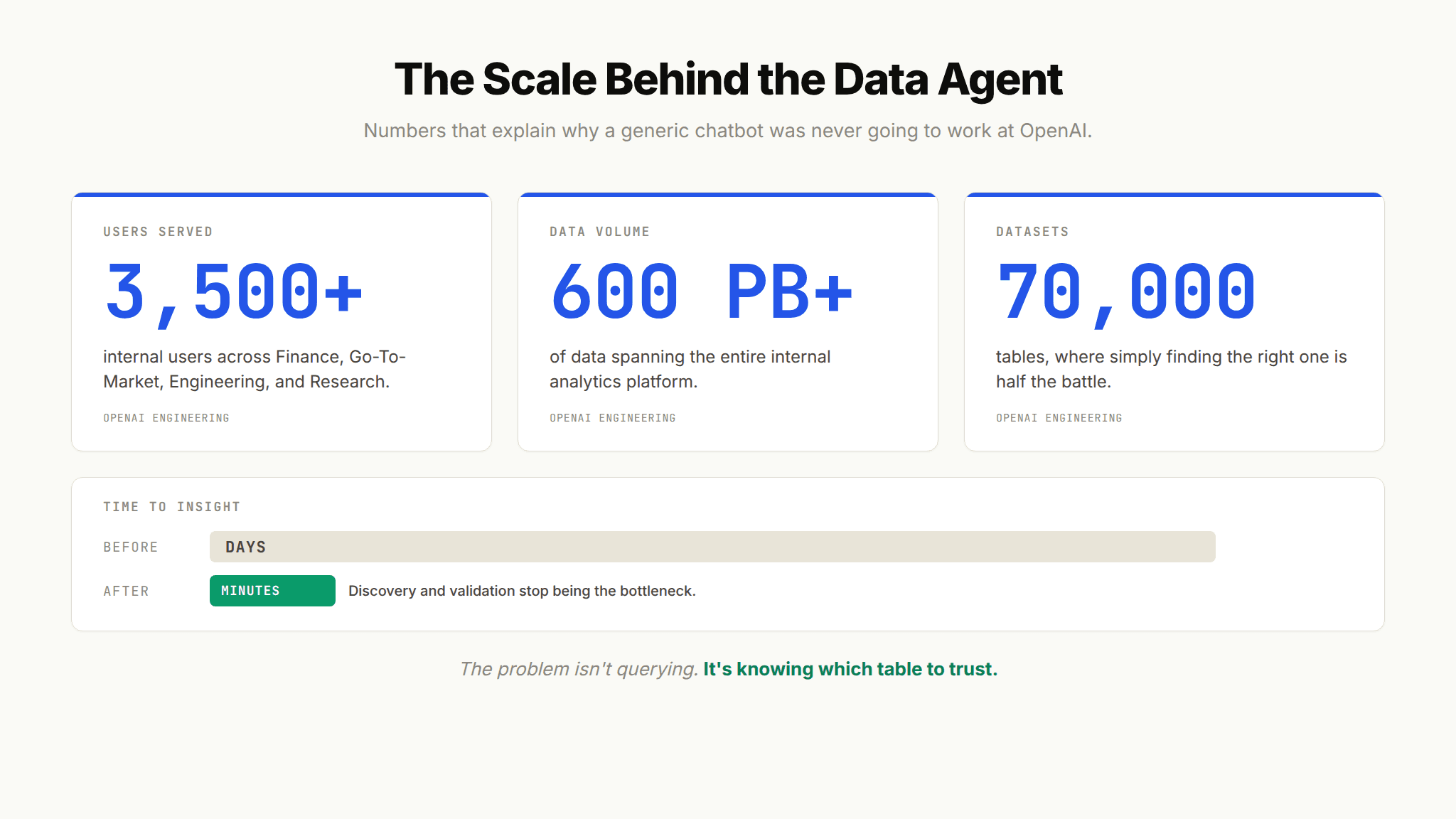
Numbers explain why OpenAI could not solve this with a generic chatbot. According to the engineering writeup, the data platform serves more than 3,500 internal users, spans over 600 petabytes of data, and holds roughly 70,000 datasets. At that size, OpenAI notes that simply finding the correct table becomes one of the most time-consuming parts of any analysis.
This is the part that translates directly to your environment. You almost certainly have fewer than 70,000 tables, but the shape of the problem is identical. Analysts burn hours deciding which of several near-duplicate tables to trust: which one includes logged-out users, which fields overlap, which is authoritative this quarter. OpenAI quotes an internal user describing exactly that frustration, and it is the same complaint you hear from your own team.
The payoff OpenAI reports is a shift from days to minutes. When the bottleneck is discovery and validation rather than raw querying, an agent that already knows the terrain removes most of the wait. That is the outcome buyers actually want: not a smarter SQL generator, but a shorter path from question to trustworthy answer.
Why OpenAI Built It: The Table-Finding Problem
Finding the right table is only half the battle. Even with the correct tables selected, producing correct results is hard, because analysts have to reason about relationships and transformations to avoid silent errors.
The writeup lists the usual suspects: many-to-many joins, filter pushdown errors, and unhandled nulls. Each one can quietly invalidate a result while the query still runs cleanly and returns a plausible-looking number. This is the trust failure at the heart of every stalled analytics agent. The SQL executes, a chart appears, and nobody notices the answer is wrong until a decision has already been made on it.
OpenAI's framing is worth internalizing: analysts should not spend their time debugging SQL semantics. Their job is defining metrics, validating assumptions, and making decisions. An agent earns its place only when it removes the debugging and leaves the judgment to humans. That distinction, mechanical correctness versus meaningful correctness, is the thread that runs through everything OpenAI built next.
Context Is Everything: OpenAI's Six Layers
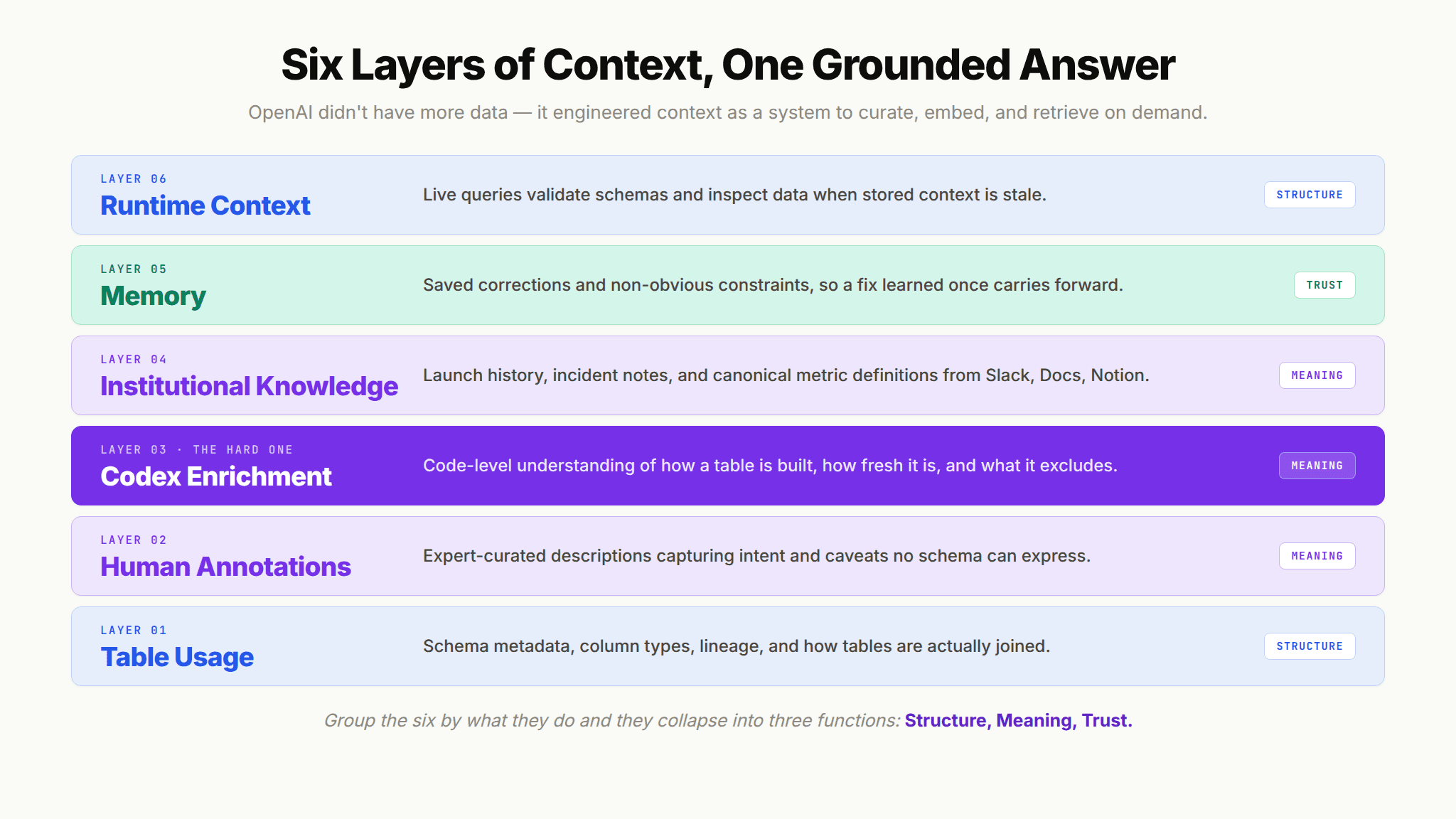
The root cause is context. Strip away rich, accurate context and even a strong model will misjudge basic figures or misread internal terminology. It is the same conclusion a16z reached in its analysis of why data agents need context. So rather than pointing a model at a warehouse and hoping, OpenAI grounded the agent in six distinct layers of context.
The six layers, as OpenAI describes them:
Table Usage: schema metadata, column types, table lineage, and historical query patterns that show how tables are actually joined.
Human Annotations: curated descriptions from domain experts capturing intent, business meaning, and caveats that no schema can express.
Codex Enrichment: code-level understanding derived by crawling the codebase, so the agent knows how a table is built, how fresh it is, and what it excludes.
Institutional Knowledge: context pulled from Slack, Google Docs, and Notion, including launch history, incident notes, internal codenames, and canonical metric definitions.
Memory: saved corrections and non-obvious constraints, so a fix the agent learns once carries forward instead of recurring.
Runtime Context: live queries against the warehouse to validate schemas and inspect data when stored context is missing or stale.
The insight is not that OpenAI had more data. It is that they treated context as a system to be engineered, curated, embedded, and retrieved on demand, rather than a prompt to be stuffed. This is the difference between an agent that demos well and one that survives production.
How OpenAI's Six Layers Map to the Three-Layer Context Architecture
OpenAI's six layers are not arbitrary. Group them by what they actually do for the agent and they collapse into three functions that every reliable analytics agent needs: the three-layer context architecture of Structure, Meaning, and Trust. OpenAI's writeup is essentially an independent confirmation of it.
Context function | What it answers | OpenAI layers that provide it |
|---|---|---|
Structure | What data exists and how it connects | Table Usage, Runtime Context |
Meaning | What the data means at this specific company | Human Annotations, Codex Enrichment, Institutional Knowledge |
Trust | Which answers have been validated | Memory, plus golden-SQL evaluation |
Structure is the map: schemas, lineage, and usage patterns telling the agent what exists. Meaning is where OpenAI spent the most effort, because a metric like "active user" or "revenue" is defined by business rules and code that live nowhere in the schema. Trust is the layer most teams forget entirely: memory that retains corrections, and an evaluation suite that verifies answers against known-good results.
The reason this mapping matters for your team is simple. Most tools solve one or two of these functions and quietly ignore the third. A semantic layer handles Meaning. A warehouse handles Structure. Almost nothing handles Trust. OpenAI succeeded because it engineered all three. To see why that completeness is the whole game, and how to build it deliberately rather than by accident, read the deeper treatment of why context engineering makes or breaks an analytics agent.
Three Design Choices That Made the Agent Reliable
OpenAI closed the writeup by naming what actually moved the needle. Each choice doubles as a direct instruction for anyone building or buying an analytics agent.
Fewer tools beat a sprawling toolset
OpenAI first handed the agent its full set of tools and ran into reliability problems from overlapping, redundant functionality. Complexity a human navigates easily confuses an agent. Consolidating and restricting the available tool calls improved accuracy, which reframes behavioral guardrails as a feature rather than a limitation.
Give the agent a goal, not a script
Highly prescriptive prompting made results worse. Rigid step-by-step instructions pushed the agent down the wrong path, because real questions vary far more than any script can anticipate. Handing the agent a clear goal and trusting its reasoning to find the route worked better. This is exactly why context beats scripting: you cannot hand-write a path for every possible question, but you can give the agent the context to choose its own.
A table's real meaning lives in its pipeline, not its schema
This was the most consequential finding. A table's true definition is not captured by its schema or its query history. It lives in the code that produces it: the assumptions baked in, the freshness guarantees, the business intent. By reading the codebase directly, the agent could answer not just what a table contains but when it is actually safe to use. For your team, that is the argument for encoding the institutional knowledge that currently lives in people's heads, in a dbt YAML file last touched years ago, and in a Slack thread nobody can find.
Why You Cannot Just Copy OpenAI
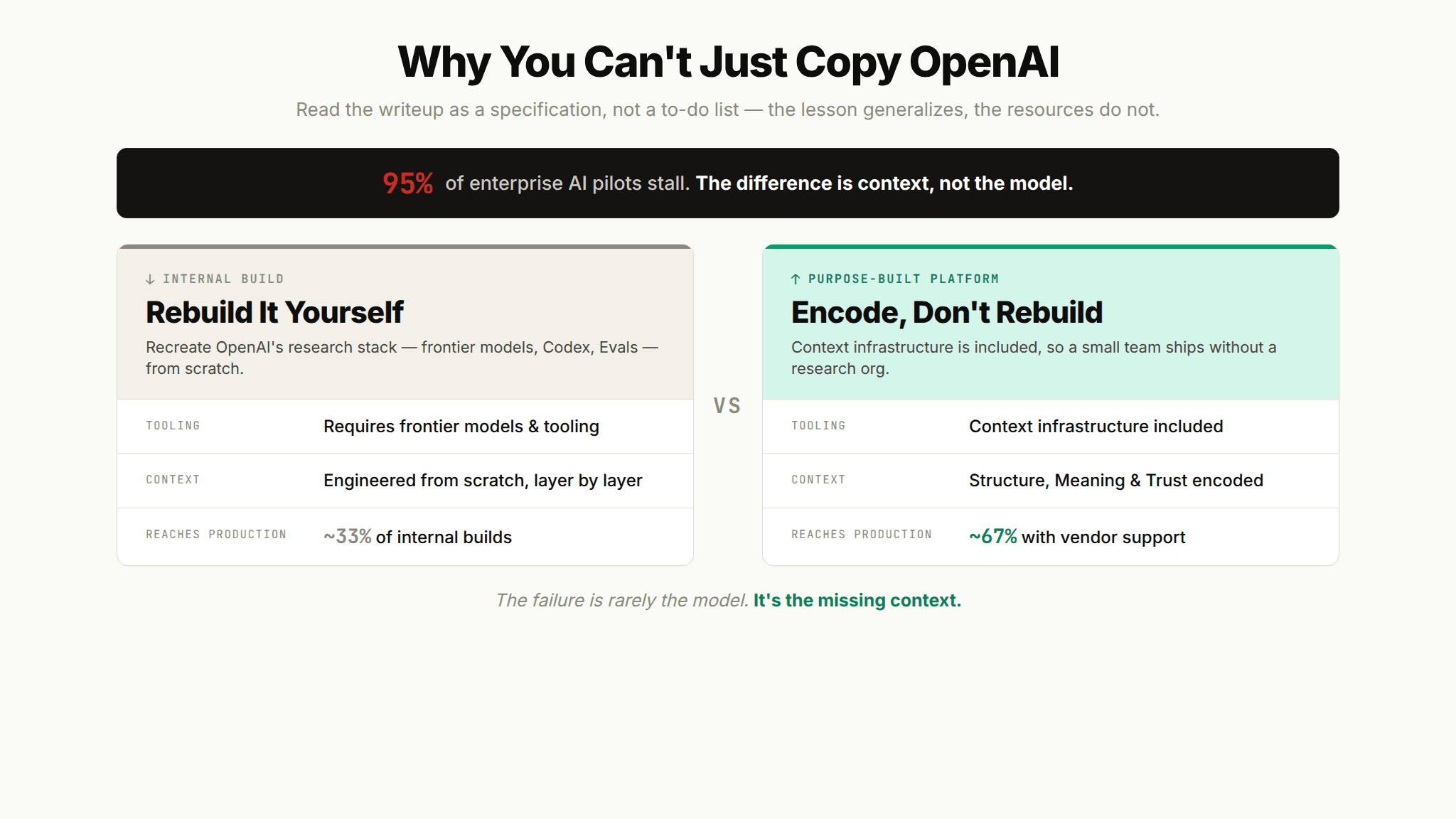
Here is the uncomfortable part. OpenAI built this with unusual advantages: frontier models, the Codex and Evals tooling they ship to developers, and an engineering team fluent in all of it. Most data teams have none of that. This is why the OpenAI writeup should be read as a specification, not a to-do list.
The context is sobering. MIT's State of AI in Business 2025 found that roughly 95% of enterprise generative AI pilots deliver no measurable business impact. The same research found that AI tools built by external vendors succeed about twice as often as internal builds, roughly 67% versus 33%. The failure is rarely the model. It is the missing context and the systematic engineering required to encode it.
Independent testing tells the same story. When analyst Claire Gouze benchmarked more than a dozen analytics agents, accuracy varied wildly, and the differentiator was consistently how well each tool handled business context rather than raw query generation. OpenAI's agent is a case study in that same principle: it succeeded because it treated context as core infrastructure, the discipline that teams stuck in that 95% tend to skip. For a full diagnosis of the failure modes, see why AI data agents fail in production.
Applying OpenAI's Blueprint Without OpenAI's Resources
So what do you actually do with this? The practical answer is to replicate OpenAI's context system, the six layers grouped into Structure, Meaning, and Trust, without rebuilding OpenAI's tooling. That means solving three problems in order.
First, encode Structure: give the agent reliable knowledge of what data exists, how tables relate, and how they are typically queried. Second, encode Meaning: capture metric definitions, business rules, and the tribal knowledge that explains what "revenue" means at your company this quarter. Third, build Trust: retain corrections as memory and validate answers against golden queries, the same unit-test approach OpenAI uses in its evaluation pipeline.
This is the exact job a context infrastructure platform exists to do. Upsolve's Agent Studio is built around the same three-layer context architecture OpenAI arrived at independently, so a small team can encode institutional knowledge and ship production-ready analytics agents without a research org behind them. Notably, you do not need a mature semantic layer to start, which removes the largest blocker most teams hit on day one.
The Real Lesson: Context Is the Product
The point of studying OpenAI's agent is not to admire it. It is to recognize what they proved: context, not the model, is what makes an analytics agent trustworthy, and the teams that encode their context deliberately are the ones whose agents will still be running a year from now. If your team would rather encode that context than rebuild OpenAI's research stack, see how Agent Studio implements the three-layer architecture, or upload a CSV and start asking your own data questions.
Frequently Asked Questions
What is the OpenAI data agent?
It is OpenAI's internal, bespoke AI system that lets employees ask data questions in natural language and receive validated answers in minutes. It reasons over OpenAI's own data platform, writes and runs its own SQL, and checks its own results. It is an internal tool, not a commercial product you can purchase.
Can you buy or use the OpenAI data agent?
No. OpenAI built it specifically around its own data, permissions, and workflows, and describes it as internal-only. The underlying tools it was built with, including GPT-5, Codex, the Evals API, and the Embeddings API, are available to developers, and the architecture principles are documented publicly for anyone to apply.
How does the OpenAI data agent stay accurate at scale?
It grounds every answer in six layers of context: table usage, human annotations, code-level enrichment through Codex, institutional knowledge from tools like Slack and Notion, memory of past corrections, and live runtime queries. OpenAI concluded that answer quality depends almost entirely on how rich and accurate that context is, which is why the agent invests so heavily in it rather than leaning on the model alone.
Why do most companies' data agents fail when OpenAI's succeeded?
MIT research found that around 95% of enterprise AI pilots deliver no measurable impact, and the gap is usually context, not model quality. OpenAI succeeded because it engineered context systematically across structure, meaning, and trust. Most internal builds solve one layer and skip the others, which is why the demo works but production breaks.
Why isn't a database schema enough for an AI agent?
Because a table's real definition is not in its schema. It lives in the pipeline code that produces it, including the assumptions, freshness rules, and business logic that shaped it. The context an agent needs is scattered across code, documentation, and people's heads, and it has to be encoded deliberately before the agent can be trusted.
How long does it take to build a production analytics agent?
There is no single answer, but the MIT data shows internal builds succeed only about a third as often as vendor-supported ones, and enterprises often take nine months or more. Purpose-built context infrastructure shortens this considerably by handling the encoding of structure, meaning, and trust that a team would otherwise build from scratch.

Try Upsolve for Embedded Dashboards & AI Insights
Embed dashboards and AI insights directly into your product, with no heavy engineering required.
Fast setup
Built for SaaS products
30‑day free trial