
Choosing between Hex Context Studio and Upsolve Agent Studio? Learn how they differ on context depth, workflow, and customer-facing use.

Ka Ling Wu
Co-Founder & CEO, Upsolve AI
10 min

Disclosure: This article is published by Upsolve AI. Where our product is mentioned alongside competitors, we aim to provide balanced coverage based on publicly available information. We encourage readers to evaluate all options independently.
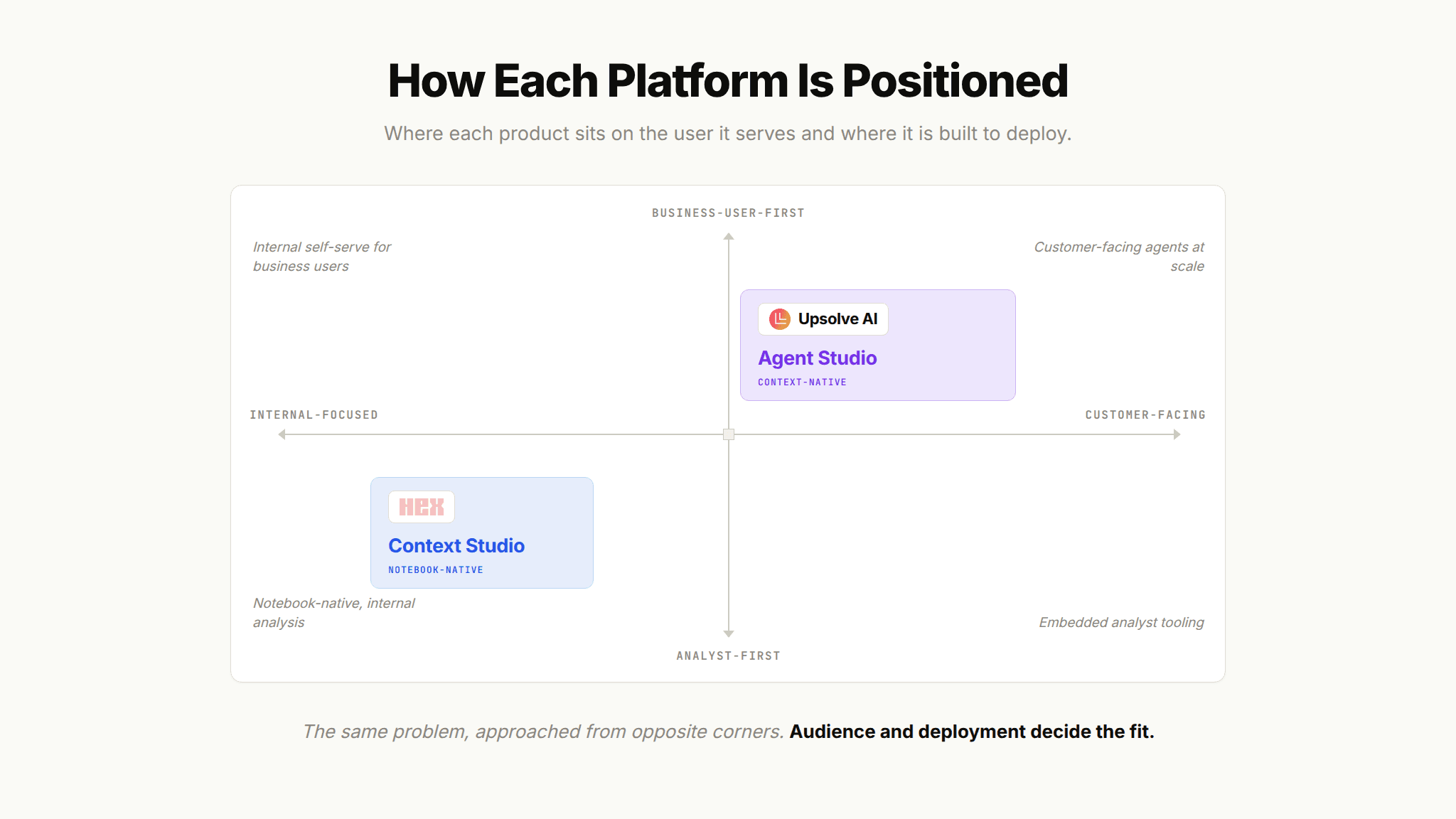
If you are weighing Hex Context Studio vs Upsolve Agent Studio, you have almost certainly moved past "should we use AI for analytics" and landed on the harder question: which platform gives an analytics agent enough context to answer real business questions accurately. Both products are built for exactly that problem, and both are serious contenders. What separates them is not a feature checklist so much as where each one started and who each one is really built to serve.
Hex arrived at context from the world of collaborative notebooks, the tool your data scientists already love. Upsolve arrived at it from the opposite direction, treating context infrastructure as the whole product rather than a layer added to something else. That difference in origin shows up in almost every decision that matters for a platform purchase. This comparison lays out where each is strong, where each has gaps, and which situations point clearly to one or the other.
Key Takeaways |
|---|
|
The Two Starting Points That Shape Everything
To compare these platforms fairly, you have to understand why they look different under the hood. The whole industry has converged on one diagnosis. In March 2026, a16z argued that data and analytics agents are essentially useless without the right context, and OpenAI reached a similar conclusion while building its own internal agent, noting that high-quality answers depend on rich, accurate context. The disagreement is not about the destination. It is about the road each vendor took to get there.
Hex started as a collaborative data workspace. It built a reputation for elegant notebooks that combine SQL, Python, and no-code charting, and it earned strong backing along the way, including a Series B led by Andreessen Horowitz alongside Snowflake and Databricks, followed by a $70 million Series C in 2025. Context Studio, launched at the end of January 2026, is the layer Hex added so that the agents living inside those notebooks could be observed, governed, and trusted.
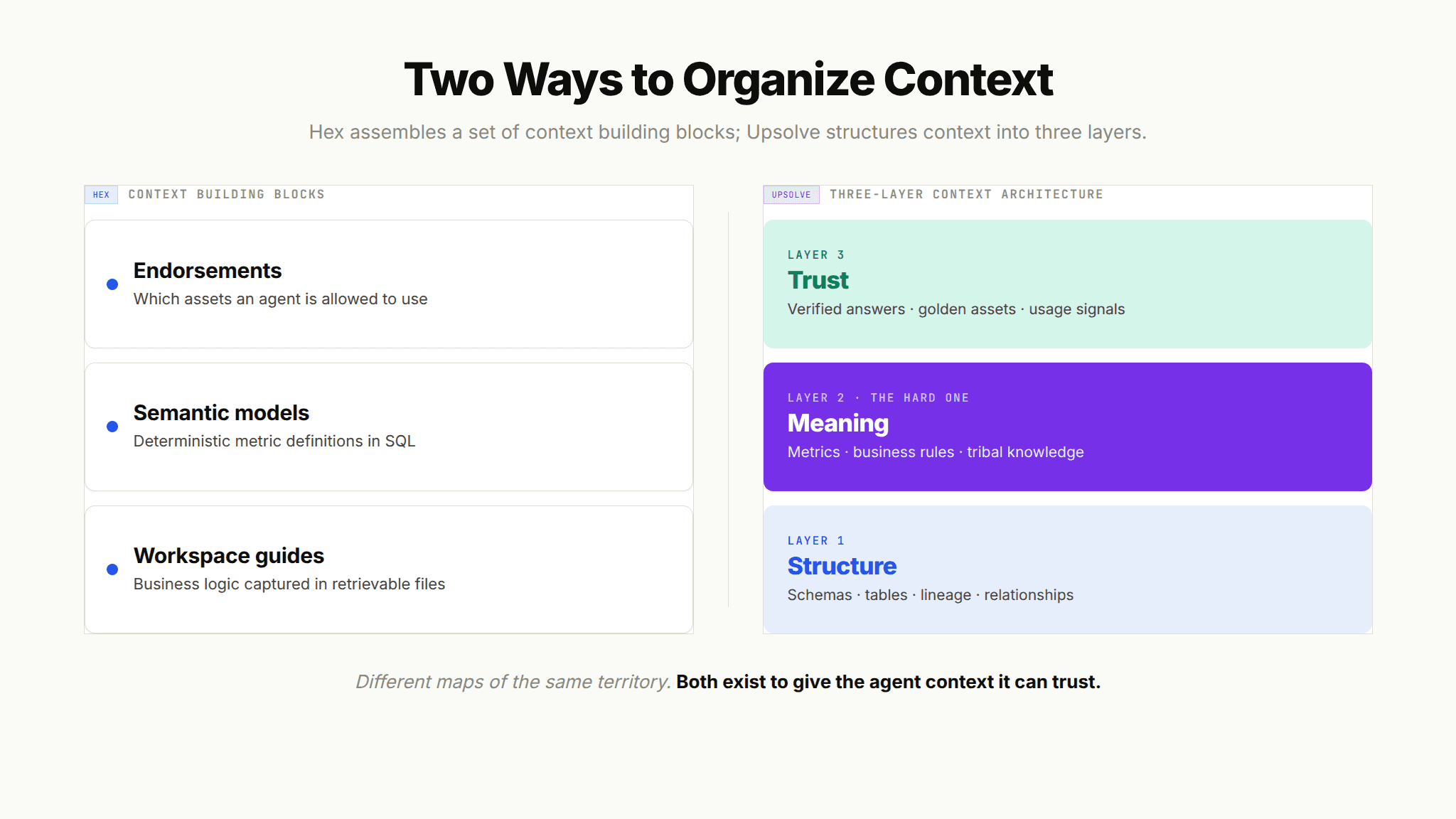
Upsolve started at the other end. Rather than adding context management to an analysis tool, it built context infrastructure first and designed the end-user experience around it. The mechanism is the three-layer context architecture: Structure (what data exists and how it connects), Meaning (what metrics and business rules mean at your company), and Trust (which answers have been validated). This is the difference this entire comparison keeps returning to, and it is worth reading more on why context is a feature for some platforms and the core product for others.
Quick Comparison: Hex Context Studio vs Upsolve Agent Studio
The table below summarizes the practical differences. It is descriptive rather than a scorecard, because the right pick depends heavily on your situation.
Factor | Hex Context Studio | Upsolve Agent Studio |
|---|---|---|
Product origin | Collaborative analytics notebook | Purpose-built context infrastructure |
How context is treated | A governance and observability layer added to the notebook | The three-layer context architecture is the core product |
Context building blocks | Endorsements, semantic models, workspace guides | Structure, Meaning, Trust across structured and unstructured data |
Primary user | Data team and analysts doing analysis | Business user getting an answer |
Deployment focus | Internal, via Slack, MCP, and embedded apps | Internal and customer-facing, including multi-tenant and white-label |
Semantic model to start | Works best with an existing model; strong integrations | No existing semantic model required to begin |
Improvement loop | Context Suggestions and a Review Agent that learn from Threads | Encode, deploy, tune loop with golden query testing |
Notable backing | a16z, Snowflake, Databricks; roughly $172M raised | YC W24, ex-Palantir founding team |
For a broader field beyond these two, our full agent platform comparison walks through the evaluation criteria that apply across every vendor in the category.
Hex Context Studio: What It Does Well
Hex's strengths are substantial, and any fair comparison has to account for them.
A mature notebook foundation
Hex did not bolt an agent onto a thin product. Analysts have trusted its notebook for years, and that maturity shows in the polish of the workflow. If your data team lives in notebooks and wants agents that operate inside that same environment, Hex offers a smoothness that newer entrants have to work hard to match. The Notebook Agent and Threads features grew out of a product people already used daily, which lowers the adoption friction for technical users.
Context management brought into one place
Context Studio consolidates three kinds of context that used to be scattered. Hex describes them as endorsements, semantic models, and workspace guides: endorsements guardrail which assets an agent may use, semantic models define metrics with deterministic SQL, and workspace guides capture business logic in unstructured files the agent can retrieve. Pulling these into a single workflow, instead of leaving them in wikis and config files, is a genuine improvement over the status quo.
Observability and a learning loop
Context Studio pairs context management with observability. Data teams can watch how agents behave across surfaces, inspect individual Threads, and see topics and warnings that flag where an agent got confused. Hex also ships Context Suggestions, which mine real conversations to propose context improvements automatically through a Review Agent. That closes an important gap: the agent gets better as people use it, rather than staying frozen at launch.
Strong integrations and backing
Hex integrates with dbt MetricFlow, Cube, Snowflake Semantic Views, and Databricks Metric Views, and it deploys through Slack, MCP, and embedded apps with pass-through authentication and row-level security. Its investor roster, which includes a16z, Snowflake, and Databricks, signals durability and access to the modern data stack. For a Head of Data who values ecosystem gravity, that matters.
Upsolve Agent Studio: What It Does Well
Upsolve's strengths cluster around treating context as infrastructure rather than as a feature.
Context as the whole product
The clearest architectural distinction is that Upsolve's three-layer context architecture is the product, not a module within a larger analysis tool. A semantic layer, valuable as it is, mostly covers the Meaning layer. Upsolve's design assumes you also need Structure and Trust, and it builds the encoding, evaluation, and validation tooling around all three. This is a philosophical bet: that reliability at scale comes from purpose-built context infrastructure, not from good context features attached to a notebook.
Built for the business user, not just the analyst
Where Hex's center of gravity is the analyst in the notebook, Upsolve's primary surface is the business user asking a question and getting a trustworthy answer, plus an agentic dashboard where a user can describe the charts they want and the agent builds them. Both approaches are legitimate. They simply optimize for different people. If your goal is to take load off a data team by letting non-technical stakeholders self-serve, the surface a platform optimizes for is a decisive factor.
Internal and customer-facing deployment
Upsolve is designed to run both internally and as an embedded, customer-facing experience inside a software product, with multi-tenant and white-label support. Hex supports embedding too, but its embedded story is oriented around its apps and notebooks. For a B2B SaaS team that wants to ship analytics agents to its own customers, this is a meaningful difference worth testing directly.
The encode, deploy, tune loop and no semantic-model prerequisite
Upsolve frames its workflow as encode, deploy, tune: you encode institutional knowledge, deploy the agent, then tune accuracy using golden query testing (effectively unit tests for agent answers). Crucially, a maintained semantic model is not a prerequisite to start. Many organizations do not have a well-kept semantic layer, and their definitions live in Slack threads and analysts' heads. Removing that prerequisite lowers the barrier to a first production agent. It is also worth being candid about the trade-off: Upsolve is a younger company than Hex, with a shorter public track record, and a team standardized on notebooks may find Hex's environment more familiar on day one.
Where the Two Platforms Genuinely Diverge
Context as a feature versus context as the core product
This is the fault line. Hex's Context Studio is an impressive answer to "how do we govern the agents in our notebook product." Upsolve's answer is "context infrastructure is the product, and the agent experience is built on top of it." Neither framing is automatically superior. The question for you is whether you are buying an analytics platform that now has strong context governance, or a context platform that surfaces analytics. If context reliability is the single thing keeping your agents out of production, the platform where context is the core product deserves a close look. If your team's daily work is notebook analysis and you want agents woven into that, Hex's framing fits more naturally.
Who the product is built for
Hex optimizes for the person building the analysis. Upsolve optimizes for the person consuming the answer. A useful test during a trial: have a non-technical stakeholder, not a data analyst, ask five real questions and try to build a chart, on each platform. Whichever experience feels native to that person is telling you who the product was designed for. That single exercise often clarifies the decision faster than any feature matrix.
Internal only versus internal and customer-facing
If your only use case is internal self-serve, both platforms are in play. If you also need to embed analytics agents into a product your customers use, weigh the multi-tenant and white-label depth carefully. This is an area where Upsolve's design intent points squarely at customer-facing deployment, while Hex's embedding is a strong but more internally oriented capability. Run a real embedded scenario during evaluation rather than trusting the marketing on either side.
The semantic layer requirement
Hex's integrations with dbt MetricFlow, Cube, and warehouse semantic views are a genuine strength when you already invest in a semantic model. That same strength becomes a starting cost when you do not. Upsolve's position is that you should be able to reach a production-ready agent without first standing up and maintaining a semantic layer, and our semantic layer integration comparison breaks down how the two approaches treat that dependency. If your organization has a mature, trusted semantic model, Hex's approach rewards that investment. If you do not, treat that prerequisite as a real cost when you plan your timeline.
The improvement loop
Both platforms learn from usage, which is encouraging, because static systems are exactly what MIT's 2025 research flagged as the ones that stall. Hex's Review Agent and Context Suggestions parse Threads to propose improvements. Upsolve's encode, deploy, tune loop leans on golden query testing to validate accuracy against a known-good set before and after changes. The practical question is how much of the loop is automated proposal versus human-validated regression testing, and how each fits your governance appetite. Ask each vendor to demonstrate the loop on a question their agent initially gets wrong, then show how it gets fixed and stays fixed.
Where Hex Is the Stronger Choice
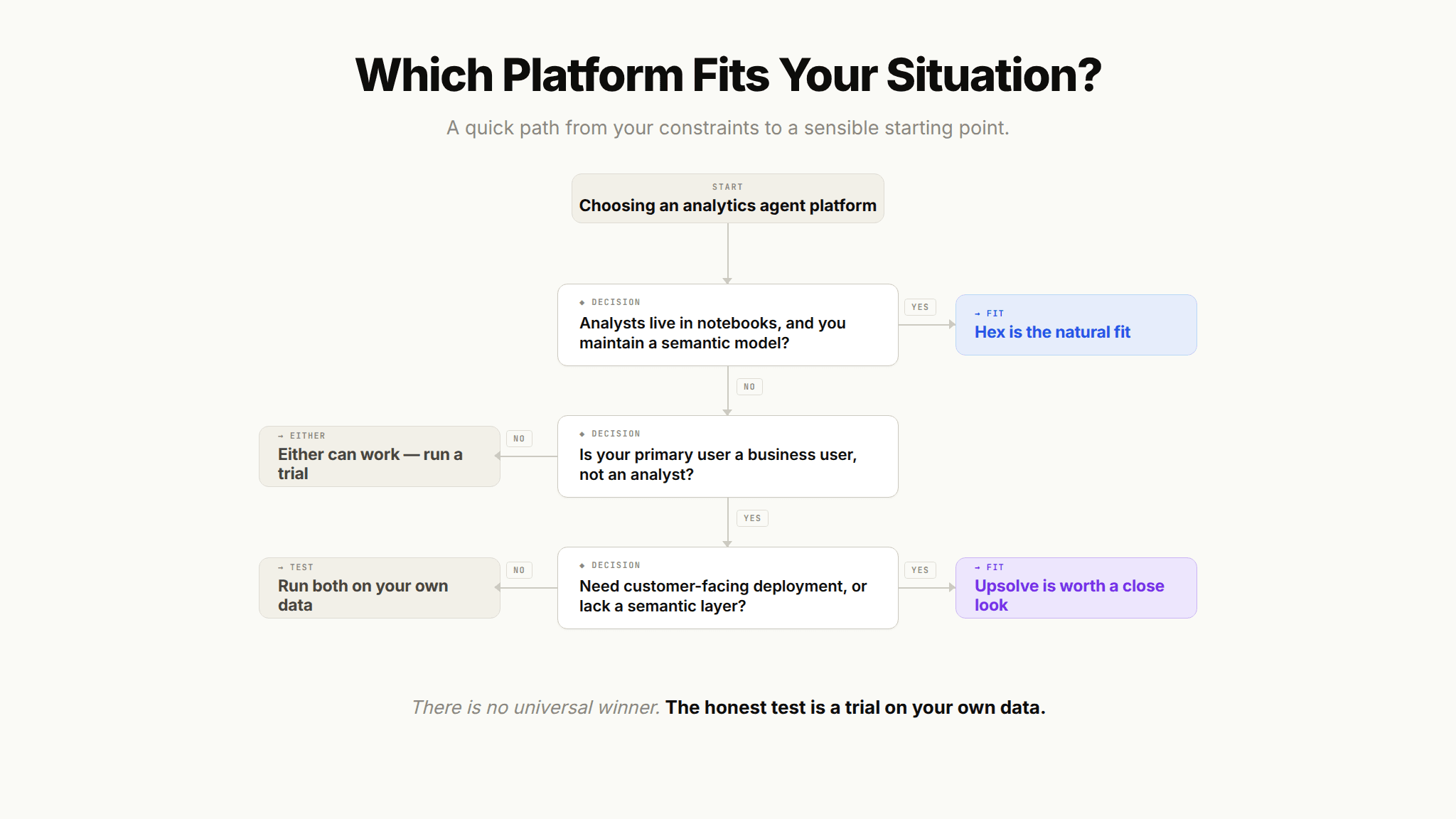
Hex is the stronger choice in these situations:
Your data team lives in notebooks. If SQL and Python notebooks are the daily habit of your analysts, agents that operate inside that environment reduce friction and win adoption.
You already maintain a semantic model. dbt MetricFlow, Cube, or Snowflake Semantic Views investments are directly rewarded by Hex's integrations.
You value ecosystem gravity and track record. A longer product history and backing from a16z, Snowflake, and Databricks are real signals of durability.
Your use case is primarily internal analysis. For internal self-serve driven by a technical team, Hex's notebook-plus-Context-Studio combination is a coherent, mature package.
Where Upsolve Is the Stronger Choice
Upsolve is the stronger choice in these situations:
The business user is your target, not the analyst. If success means non-technical stakeholders get trustworthy answers without waiting on the data team, an experience built around that user fits better.
You need customer-facing analytics. Embedding agents into your own product, with multi-tenant and white-label support, is a design goal rather than an add-on.
You do not have a maintained semantic layer. Not requiring an existing semantic model removes a common blocker to a first production agent.
Context reliability is your bottleneck. If failed accuracy is what has kept your agents in POC purgatory, a platform where the three-layer context architecture is the core product is worth serious evaluation.
Choosing Between Hex Context Studio and Upsolve
Both are credible answers to the same problem, and the shared premise that context, not the model, is what breaks analytics agents means each is chasing the right thing. The decision comes down to origin and audience. Hex is the stronger fit when your data team lives in notebooks, you already maintain a semantic model, and your use case is primarily internal.
Upsolve is the stronger fit when the business user is your target, you need customer-facing deployment, you lack a maintained semantic layer, or context reliability is the specific wall your agents keep hitting. Either way, the move is the same: run both against your own data, your own questions, and your own users, because a short trial with real institutional knowledge will tell you more than any comparison table, including this one.
Frequently Asked Questions
What is the main difference between Hex Context Studio and Upsolve Agent Studio?
Hex Context Studio is a governance and observability layer built on top of a mature analytics notebook, so context management is a strong feature within a larger analysis product. Upsolve Agent Studio treats the three-layer context architecture (Structure, Meaning, Trust) as the core product and builds the agent experience on top of it. The practical result is that Hex centers on the analyst and Upsolve centers on the business user getting an answer.
Is Hex or Upsolve better for a data team?
It depends on what "better" means for your team. If your analysts already work in notebooks and you maintain a semantic model, Hex fits that workflow naturally and rewards your existing investment. If your goal is to take request load off the data team by letting business users self-serve trustworthy answers, Upsolve's business-user surface is designed for that outcome. Neither is universally better; the right answer follows your primary user.
Do I need a semantic layer to use these platforms?
Hex works best when you already have a semantic model, and it integrates with dbt MetricFlow, Cube, and warehouse semantic views to use it. Upsolve does not require an existing semantic model to begin, which is relevant if your metric definitions currently live in Slack threads and analysts' heads rather than in maintained configuration. Your current data maturity is the deciding factor here.
Can both platforms be embedded into a customer-facing product?
Both support embedding, but with different emphasis. Hex offers embedded apps with pass-through authentication and row-level security, oriented mainly around internal analysis surfaced outward. Upsolve is designed for customer-facing deployment as a first-class use case, including multi-tenant and white-label scenarios. If embedding agents for your own customers is central to your plan, test a real embedded scenario on each before deciding.
Why do analytics agents fail, and how do these platforms address it?
Independent research points to context, not model quality, as the core issue: pilots stall when systems cannot retain feedback or adapt to the way a business actually works. Both Hex and Upsolve respond by adding context management and a learning loop, so agents improve from real usage rather than staying frozen after launch. The difference is whether that context capability is a layer on a notebook or the core of the platform.
How should I evaluate Hex Context Studio vs Upsolve for my company?
Run a structured trial. Pick ten real business questions, encode your actual definitions on each platform, and have a non-technical stakeholder (not an analyst) ask the questions and try to build a chart. Then ask each vendor to fix a question the agent gets wrong and show that the fix holds. Weigh the results against your primary user, your embedding needs, and whether you already maintain a semantic layer.

Try Upsolve for Embedded Dashboards & AI Insights
Embed dashboards and AI insights directly into your product, with no heavy engineering required.
Fast setup
Built for SaaS products
30‑day free trial