
Thinking about Genie for your Databricks stack? We cover what it does well, what it can't, and the context limits worth knowing up front.

Ka Ling Wu
Co-Founder & CEO, Upsolve AI
10 min

Disclosure: This article is published by Upsolve AI. Where our product is mentioned alongside competitors, we aim to provide balanced coverage based on publicly available information. We encourage readers to evaluate all options independently.
Databricks AI/BI Genie is a natural-language interface to the Databricks lakehouse: business users ask questions in plain language, and Genie generates SQL, runs it against Unity Catalog data, and returns a table, a chart, and its reasoning. It works by grounding a language model in the metadata and business context you curate inside Databricks, which means its accuracy tracks directly with how much of that context you have encoded.
This review walks through how Genie actually works, where it is genuinely strong, what independent testing found, and where its limits start to bite when you push past a demo. If you run Databricks and you are weighing whether Genie can serve your business users, the goal here is to give you a clear-eyed picture you can act on.
Key Takeaways |
|---|
|
What Databricks AI/BI Genie Is
Genie is the conversational analytics layer of the Databricks Data Intelligence Platform. A data team curates a focused workspace, historically called a Genie Space and now referred to as a Genie Agent, by selecting a tight set of tables from Unity Catalog, writing plain-language instructions, and adding example queries the team trusts. Business users then ask questions against that curated scope through a chat interface and receive results with visualizations.
The design inverts the traditional BI workflow. Instead of analysts pre-building dashboards that users navigate, users ask questions directly and the system constructs the answer on demand. According to Databricks documentation on Genie, each agent is configured with datasets registered to Unity Catalog, example SQL queries, SQL expressions for business semantics, and text instructions tailored to the organization's terminology. That curation step is the whole game: Genie does not read your business meaning by magic, it reads what you encode.
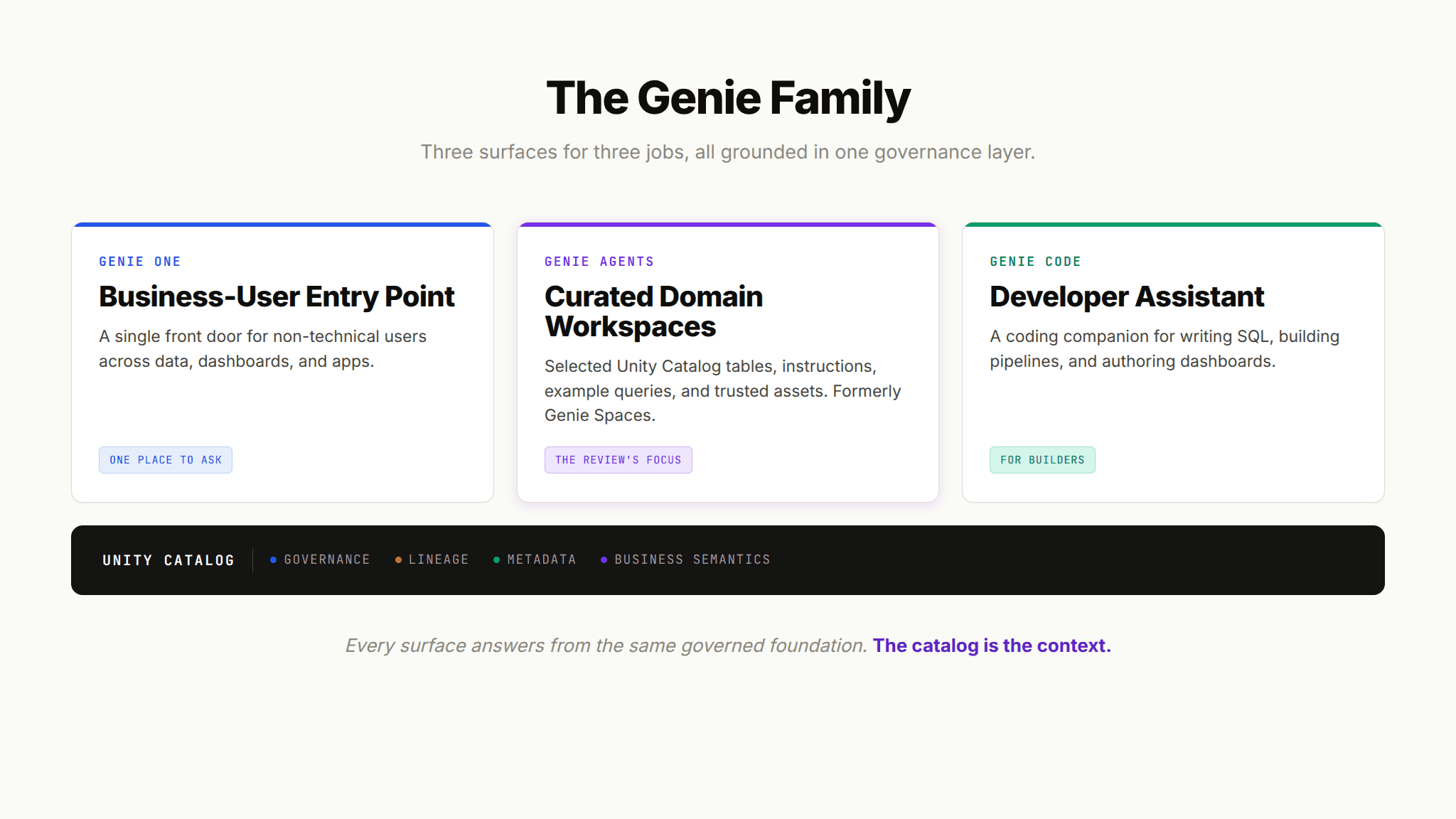
It helps to place Genie inside the broader Genie family. Databricks now separates the business-user chat experience (Genie One as the single entry point across data, dashboards, and apps), the curated domain agents that answer questions over specific data (Genie Agents), and a developer-focused assistant for writing code and building pipelines (Genie Code). For a Head of Data evaluating natural-language analytics for non-technical users, the Genie Agents surface is the relevant one, and that is the focus of this review.
How Genie Works: From Question to Answer
When a user opens a Genie Agent and asks a question, several things happen in sequence. Genie loads the relevant Unity Catalog context for that workspace: the tables and columns in scope, their comments and descriptions, the example queries an analyst marked as good, and the natural-language instructions that explain company-specific terms. That bundle grounds the model. The language model then interprets the question against the loaded context, identifies which tables and columns are relevant, maps a business term to the right physical column, and works out the filters and aggregations the question implies.
From there, Genie produces a SQL query, validates it against the schema to catch obvious errors before execution, and surfaces it to the user for review when the question is ambiguous or the SQL is novel. The generated query then runs against a Databricks SQL warehouse using the user's own Unity Catalog permissions. Follow-up questions build on the conversation, so "now show that by month" understands "that" from the previous turn.
This conversational continuity is one of the reasons Genie feels natural to business users exploring data.

The three grounding inputs you actually control
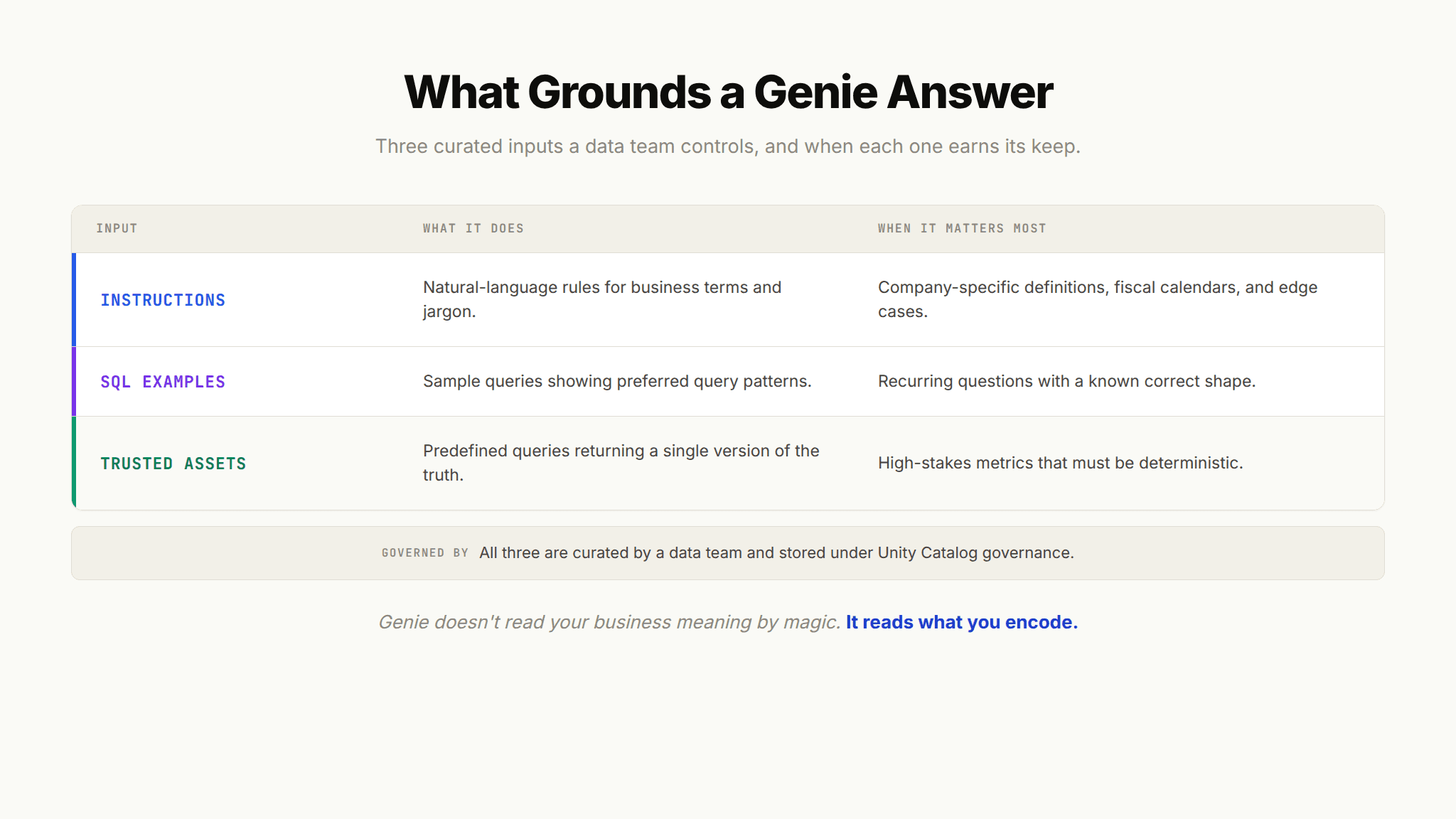
Genie's accuracy is not a black box you hope works. It is a function of three inputs a data team curates, and knowing them is the difference between a Genie deployment that survives contact with real users and one that quietly loses trust.
Instructions transfer business-specific information in natural language, guiding the model on company jargon and domain concepts. The canonical Databricks example: a fiscal year that starts in February rather than January, which the model must be told so it aggregates periods correctly.
SQL examples show Genie how your team queries the data for common and recurring questions, steering it toward patterns you already trust.
Trusted assets (also described as verified or certified queries) are predefined queries that return a single, deterministic version of the truth for specific questions, often registered behind a function so the answer is locked in.
Per the Databricks setup documentation for Genie Agents, each agent can include up to 30 tables or views and requires a pro or serverless SQL warehouse, and the agent's compute credentials process queries for all its users. That 30-table ceiling is worth internalizing early: Genie rewards a tight, well-documented scope, and it is not designed to reason across a sprawling, undocumented catalog.
Access control comes from Unity Catalog, not from Genie
One design choice sets Genie apart from naive text-to-SQL systems: it runs every query with the asking user's Unity Catalog permissions. Row-level security, column masking, and access policies apply exactly as they do elsewhere in the platform, so Genie cannot return data a user is not entitled to see, even if the user asks for it directly. For a Head of Data who has to bring security and compliance along on any rollout, this shortens the conversation considerably, because it extends permissions the team already set rather than introducing a new access layer to audit.
Where Genie Is Genuinely Strong
Genie earns real credit in a few areas, and any fair review should name them plainly.
Proximity to the data. Genie runs where your lakehouse data already lives. There is no ingestion step, no copy, no separate serving layer to keep in sync. For a Databricks-centric shop, that closeness removes an entire class of pipeline and freshness problems that plague tools sitting outside the warehouse.
Governance and lineage inherited from Unity Catalog. Because Genie reads Unity Catalog metadata, it inherits the governance work you have already done: table and column comments, lineage, ownership, and access policies. That inheritance is a genuine differentiator. Many natural-language tools bolt an LLM onto a schema and hope; Genie starts from a governed metadata foundation.
Grounding on governed metric definitions. Databricks Metric Views are the platform's semantic modeling layer, and they can serve as a source for Genie. As the Unity Catalog metric views documentation describes, a metric view separates measure definitions from the dimensions used to group and filter them, so you define a metric like revenue once and query it across any dimension at runtime, with the engine generating the correct computation. When Genie answers from a metric view, conversational queries and dashboards read from the same governed logic, which is exactly the consistency you want when different tools keep returning different numbers for the same KPI. Databricks has continued to invest here: at its 2026 Data + AI Summit the company introduced a Genie Ontology and expanded Unity Catalog semantics, including a business glossary and richer metric modeling that feed directly into Genie's context.
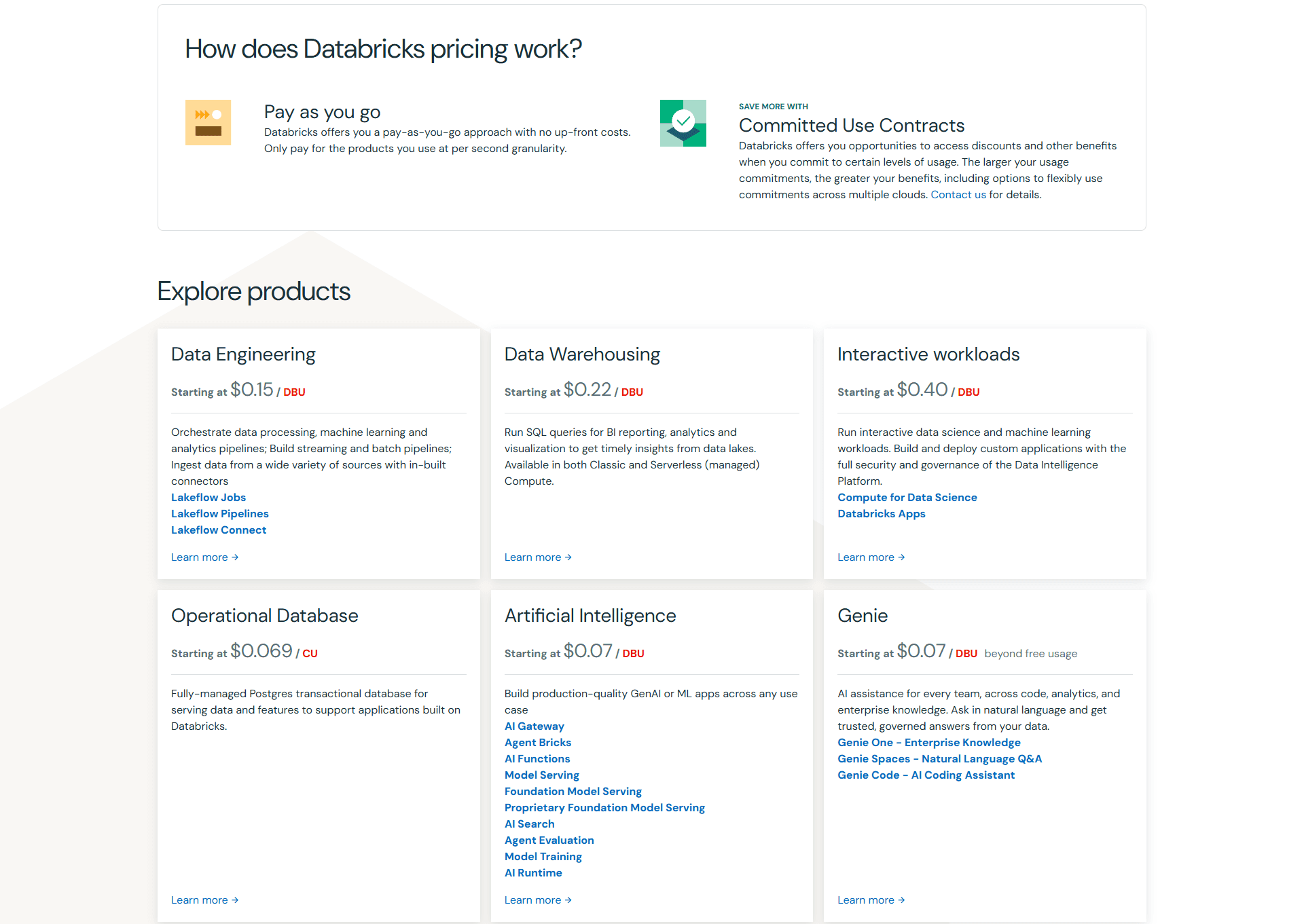
No per-seat license. There is no Genie license to buy. Genie's costs are folded into the Databricks consumption model, and the queries it generates run on your SQL warehouse and are billed as DBUs on that warehouse. The pricing picture did shift recently: as of a July 2026 change, Genie's LLM usage beyond a monthly free allowance per identified user moved to pay-as-you-go, billed in DBUs, while the Databricks Genie budgets documentation confirms that the compute used to run queries is billed separately and is not included in Genie's LLM budgets. For typical interactive human use, the warehouse compute is usually the larger line item. The caveat worth flagging: automation running through service principals gets no free allowance and is billed from the first request, so programmatic usage is where cost surprises tend to show up.
What Independent Testing Found
For an outside read, the most useful reference point is data leader Claire Gouze's 2026 benchmark, in which she tested a range of analytics agents on real data using a deliberately tricky question: the percentage of users who churned last month, where the answer required joining several subscription tables and comparing against the prior month's paying base.
Genie came out of that test looking good on the dimensions that matter most for trust. Gouze highlighted the clarity of its evaluation and monitoring framework and the quality of its research agent, noting that Genie was one of the few tools that returned the correct answer to her question. She also described the chat experience as fast and appreciated that it shows its reasoning. That is a meaningful result: getting a genuinely hard analytical question right, with a visible evaluation loop, is not something every tool in the category managed.
The same review flagged the flip side, which lines up with the limits discussed below. Gouze found Genie easy to set up but limited in its context options at the time of testing, with no link to dbt or an external semantic layer. In other words, the accuracy was there for a well-scoped question, but the breadth of context you could wire in was narrower than some alternatives.
Where Genie's Limits Actually Bite
No tool is right for every team, and Genie's constraints are specific enough that you can check them against your own situation before committing. These are the areas where a demo that felt effortless can turn into friction at scale.
The curation burden lands on your data team
Genie's greatest strength is also its standing cost. Because answer quality is bounded by the quality of the metadata, instructions, and verified queries behind a space, someone has to do that encoding work and keep doing it. A common failure pattern is well documented: a team stands up a space, tries a few questions manually, gets answers that look right, and rolls it out, then a stakeholder asks something the space was never tested on, gets a strange result, and trust evaporates. Genie is not a tool you switch on; it is a tool you curate, evaluate, and maintain. Teams that have already invested in business glossaries, certified definitions, and clean access policies will find it a natural fit, while teams that have not will find Genie a fast and sometimes uncomfortable diagnostic of what their metadata estate actually looks like.
Context customization is narrower than dedicated platforms
Genie's context comes primarily through Unity Catalog: table and column metadata, instructions, SQL examples, trusted assets, and metric views. That is a solid foundation, but it is a Databricks-shaped foundation. If your metric definitions live in dbt, Genie does not consume them through a native two-way dbt integration the way some BI tools do; the governed path is to model or import those definitions into Unity Catalog metric views. Analysts who expect code-based modeling, branch-based workflows, or direct semantic-layer syncing will find the customization surface more constrained than a purpose-built context platform. This is the practical meaning of "context options are limited." Before you assume Genie will simply absorb your existing definitions, it is worth reviewing how the platform models business meaning, which we walk through in Databricks Unity Catalog explained.
The single-source center of gravity
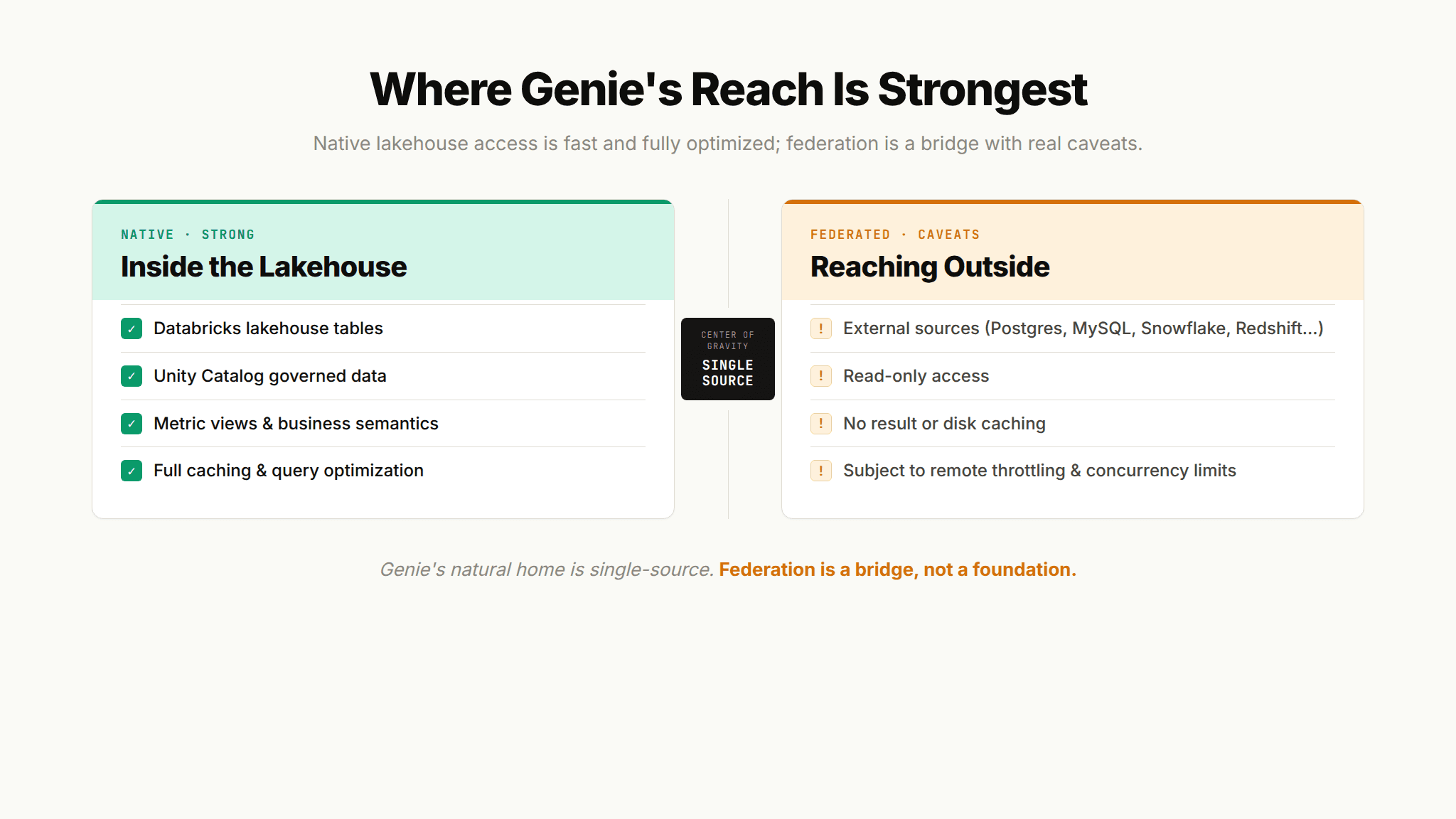
This is the limitation to weigh most heavily. Genie is strongest when the data it needs lives in Databricks. When it does not, your options are to federate the external source into the lakehouse first or to reach for a tool that queries multiple sources directly.
Databricks Lakehouse Federation does let Genie reach external systems, but with real caveats: as the Databricks query federation documentation makes clear, federated queries are read-only, and Databricks result and disk caching are not supported for them, so repeated federated queries do not benefit from caching the way native queries do. Federated query performance is also subject to the concurrency limits and throttling of the external system, and Databricks' own performance recommendations for federation describe the tuning required to push work down to the remote engine efficiently.
The net effect is that Genie's natural home is single-source. Federation is a bridge, not a foundation, and if a meaningful share of your questions span a transactional database, object storage, and the lakehouse at once, that architectural reality will shape your experience more than any single feature. This is the crux of why warehouse-native agents hit context limits: the agent's reach is defined by where the platform's gravity pulls it.
It is an internal analytics surface, not a full BI or embedded product
Genie is built for internal business users querying governed data. It is not a drop-in replacement for a full BI tool, and it was not designed for customer-facing, multi-tenant deployment. As Omni's 2026 analysis of BI tools for Databricks teams lays out, Genie lacks multi-tenant embedded analytics for customer-facing SaaS products and per-tenant theming, and its dashboard authoring breadth trails a dedicated BI tool.
If you are a product team looking to embed analytics for external customers under your own brand, Genie is usually one component running alongside other tools rather than the whole solution.
Genie Through the Three-Layer Context Lens
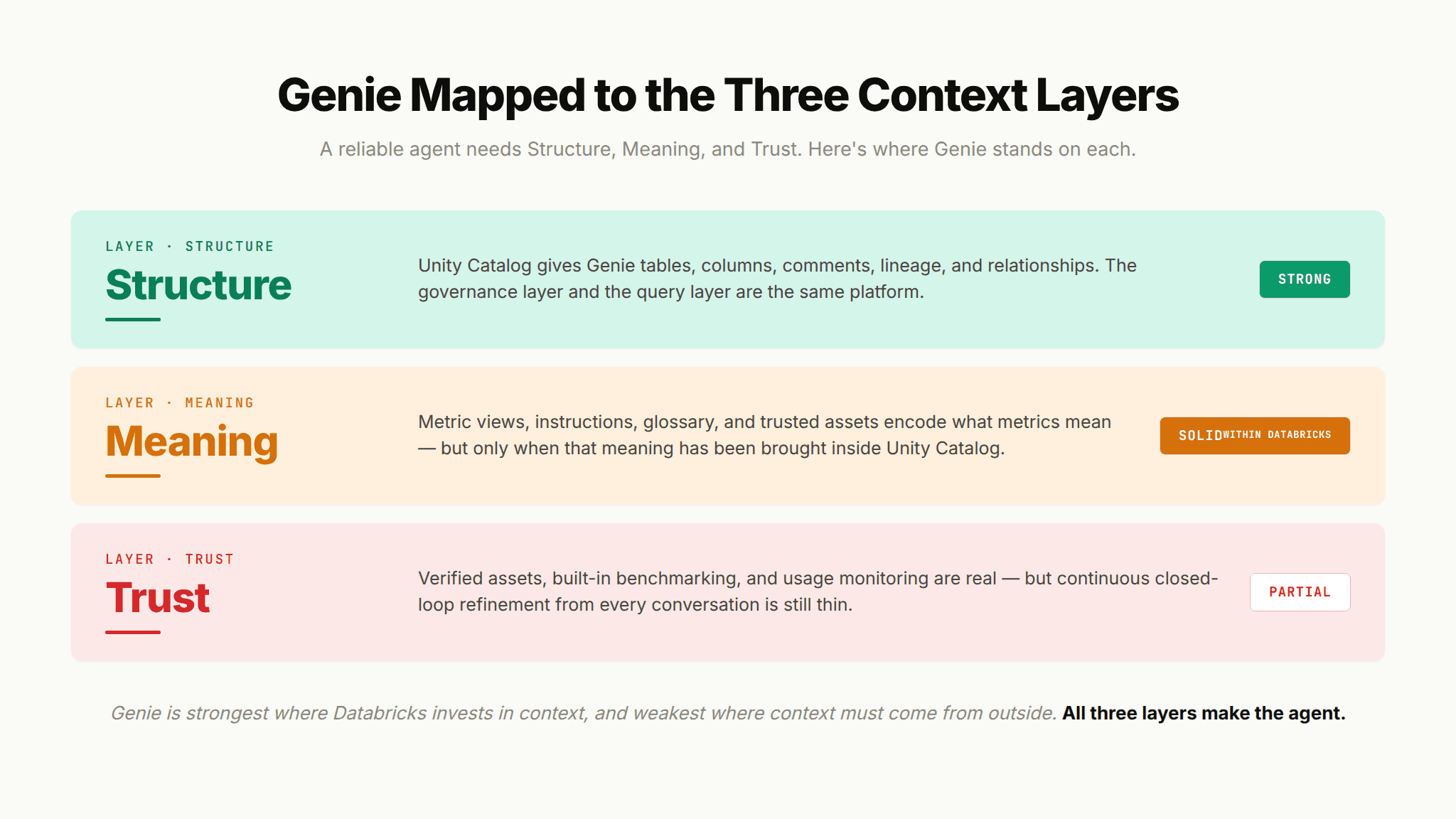
A useful way to evaluate any analytics agent is to ask which layers of context it actually covers. A reliable agent needs three: Structure (what data exists and how it connects), Meaning (what the data means at this specific company), and Trust (which answers have been validated). Mapping Genie against those three layers turns a feature list into a clear picture of fit.
Structure: strong
This is Genie's home turf. Through Unity Catalog, Genie has a rich account of the tables, columns, comments, relationships, and lineage in scope. Few tools inherit structural context this cleanly, because the governance layer and the query layer are the same platform. Recent additions like column-level popularity signals feeding the Genie Ontology only deepen this.
Meaning: solid, within the Databricks boundary
Metric views, instructions, business glossaries, and trusted assets give Genie a genuine grasp of what your metrics mean, provided that meaning has been encoded inside Unity Catalog. The constraint is the boundary: institutional knowledge that lives in dbt, in external semantic layers, in Slack threads, or in an analyst's head is not automatically available to Genie unless you bring it into the platform. The Meaning layer is real, but it is Databricks-shaped.
Trust: partial
Genie offers meaningful trust tooling, including verified or trusted assets, a built-in benchmarking capability, and monitoring of question quality over time. That is more than many competitors ship, and the benchmark results reflect it.
What is thinner is the continuous, closed-loop refinement that turns every real user conversation into an improvement to the context, and the depth of validation across the full range of questions users will actually ask. Trust is present, but it is not yet a complete, self-reinforcing system.
This is also where the industry conversation is pointing. As venture firm a16z argued in its widely cited piece, data agents are essentially useless without the right context, and the practical work of building a reliable agent is largely the work of assembling Structure, Meaning, and Trust.
Genie is a strong illustration of that thesis: it is strongest exactly where Databricks has invested in context, and it is weakest exactly where context has to come from outside the platform.
The Genie Verdict: A Strong Internal Agent for Databricks-Centric Teams
Genie is one of the more operationally credible natural-language analytics tools available, and the reason is consistent throughout this review: it grounds itself in governed metadata rather than trying to be schema-agnostic.
If your data lives in Databricks, your Unity Catalog governance is in reasonable shape, and you have a data team willing to curate and maintain focused spaces, Genie can put fast, governed, conversational analytics in front of business users with less new infrastructure than almost any alternative. Its evaluation and monitoring tooling is a real advantage, and independent testing confirms it can get hard questions right.
The boundaries are equally clear, and they are worth stating plainly. Genie is a curation product whose accuracy tracks your metadata investment. Its context surface is Databricks-shaped, so dbt-native and external semantic definitions need to be brought in rather than simply connected. Its center of gravity is single-source, with federation available but caveated. And it is an internal analytics surface, not a customer-facing or multi-tenant embedded product. None of these are flaws so much as scope: they tell you when Genie is the right call and when you should pair it with, or evaluate it against, something else.
If you are running a broader platform search, it is worth using a consistent rubric to compare agent builder platforms for analytics across exactly these dimensions of context, reach, and trust.
Frequently Asked Questions
What is Databricks Genie and what does it do?
Databricks AI/BI Genie is a natural-language interface to the Databricks lakehouse. Business users type questions in plain language, and Genie generates SQL grounded in Unity Catalog metadata and business context, runs it against a SQL warehouse, and returns a result table, a chart, and its reasoning. Data teams curate each Genie Agent by selecting a focused set of tables and adding instructions, example queries, and trusted assets so the answers reflect how the business actually defines its metrics.
How much does Databricks Genie cost?
There is no separate Genie license or per-seat fee. Genie's costs are part of the Databricks consumption model: the SQL queries it generates run on a pro or serverless SQL warehouse and are billed as DBUs on that warehouse. As of a July 2026 pricing change, Genie's LLM usage beyond a monthly free allowance per identified user is billed pay-as-you-go in DBUs, while warehouse compute is billed separately from that LLM budget. For typical interactive human use the warehouse compute is usually the larger line item, and automation running through service principals is billed from the first request with no free allowance.
Does Databricks Genie work with data outside Databricks?
Genie is strongest when the data lives in Databricks. It can reach external sources through Lakehouse Federation, but those federated queries are read-only, do not benefit from Databricks result or disk caching, and are subject to the concurrency limits and throttling of the remote system. If a large share of your questions span multiple sources at once, Genie's single-source center of gravity will shape your experience, and federating everything into the lakehouse first is often the more reliable pattern.
How accurate is Databricks Genie?
Accuracy depends heavily on how much context you encode. In an independent 2026 benchmark, Genie was one of the few tools that correctly answered a deliberately tricky churn question and was praised for its evaluation and monitoring framework. In practice, a well-curated space with good instructions, verified queries, and clean metadata produces reliable answers, while a thinly documented space produces guesses. Genie also validates its generated SQL against the schema and surfaces queries for review when a question is ambiguous.
Does Databricks Genie integrate with dbt or an external semantic layer?
Genie's context comes primarily through Unity Catalog, including metric views, instructions, and trusted assets, rather than through a native two-way dbt integration. If your metric definitions live in dbt or another external semantic layer, the governed path is to model or import those definitions into Unity Catalog metric views so Genie can ground on them. Teams that expect direct semantic-layer syncing or code-based modeling should plan for that translation step.
Is Databricks Genie a replacement for a BI tool?
Not exactly. Genie is an internal conversational analytics surface for governed data, and it pairs with AI/BI Dashboards for visualization. It does not replace the full breadth of a dedicated BI tool, and it was not designed for customer-facing, multi-tenant embedded analytics with per-tenant branding. For internal self-service on Databricks data it can stand largely on its own; for embedded or external-facing use cases it is typically one component of a larger stack.

Try Upsolve for Embedded Dashboards & AI Insights
Embed dashboards and AI insights directly into your product, with no heavy engineering required.
Fast setup
Built for SaaS products
30‑day free trial