
Vibe analytics turns plain-English questions into fast data exploration, but context decides whether the answers can be trusted.

Ka Ling Wu
Co-Founder & CEO, Upsolve AI
10 min
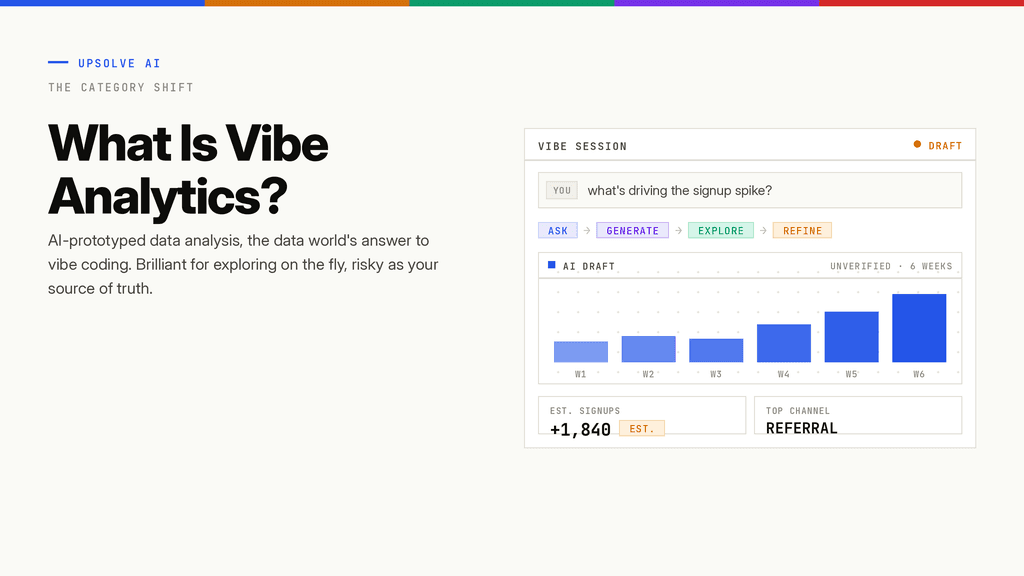
Type a question in plain English and get a chart back in seconds. No ticket, no SQL, no three-day wait on the data team. That is the promise of vibe analytics, and right now it is one of the most exciting ideas in data, and quietly one of the most dangerous.
Vibe analytics is the practice of exploring data through improvised, natural-language conversation with an AI model, instead of building queries, reports, and dashboards by hand. You say what you want to know, the model does the wrangling, and you follow wherever the answer leads. It is the data world's answer to "vibe coding," it is barely a year old, and it is already everywhere, which is exactly why it pays to separate what it is from what everyone hopes it is. It is also one visible edge of a deeper change in how people get answers from their data.
Where the Phrase Came From
The phrase rides on vibe coding, the term former Tesla AI director and OpenAI cofounder Andrej Karpathy coined in early 2025 for a loose, intuition-led way of building software where you lean on the model and stop sweating the syntax. It spread fast because it named something developers were already doing.
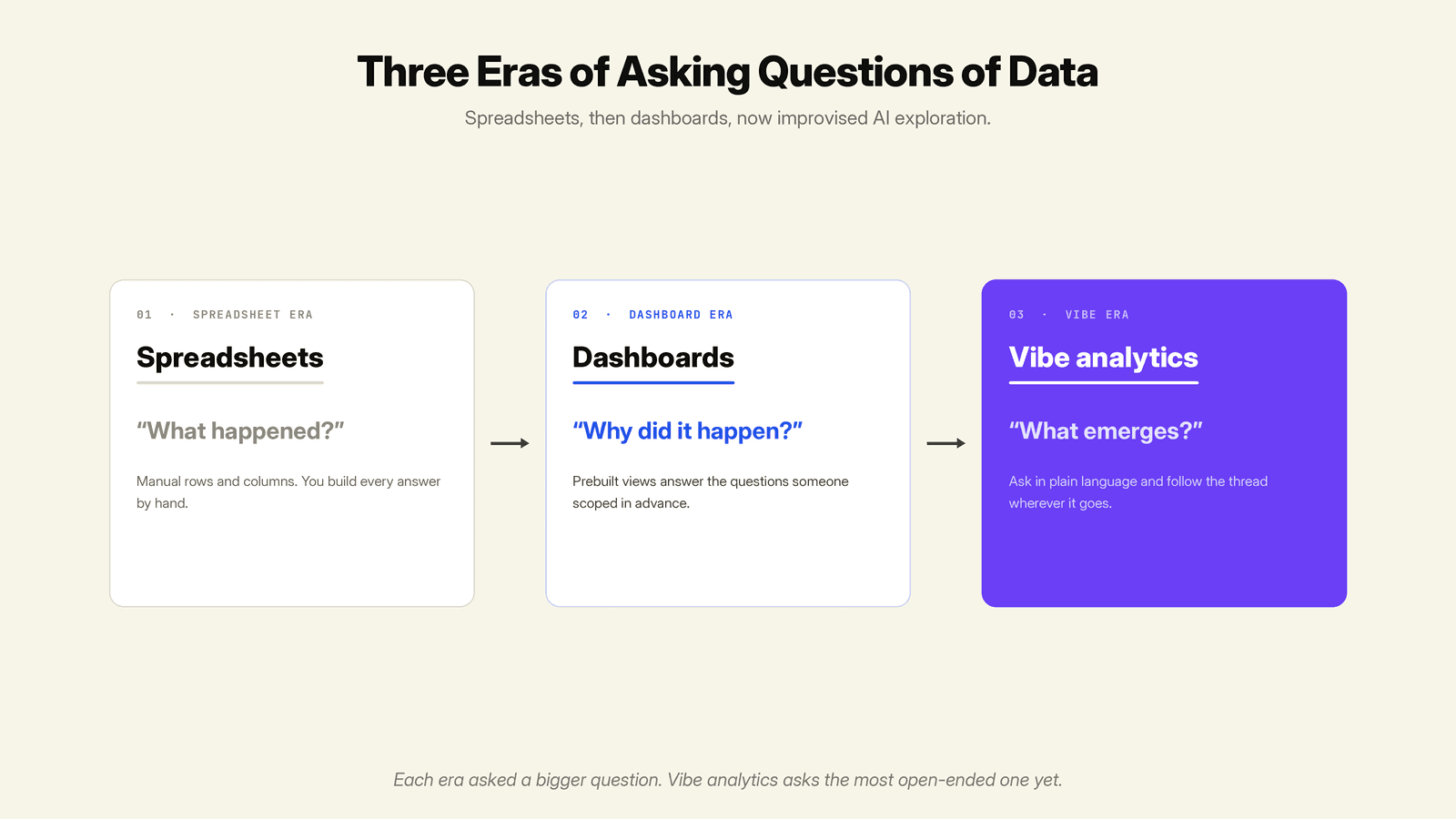
Vibe analytics is the obvious sequel. Writing in MIT Sloan Management Review, researcher Michael Schrage points the same impulse at data: spreadsheets told us what had happened, dashboards pushed us toward why, and the vibe approach asks the looser, more open-ended question of what surfaces when a person and a dataset explore together. Instead of translating a business question into SQL and waiting, you ask in plain language and let the data push back.
That is the whole pitch in one line: the query becomes a back-and-forth, and the static report becomes something closer to improvisation.
Key Takeaways |
|---|
|
Why Data Teams Are Suddenly Talking About It
Two things happened at once. The models got good enough to write competent SQL and Python from a vague prompt, and the people who need answers got tired of waiting for someone else to write that SQL.
The appeal is real. A business lead can interrogate a CSV, a warehouse table, or a transcript without filing a ticket. The conversational format invites follow-ups, so one answer sparks the next question and you end up exploring paths you would never have scoped in advance. MIT Sloan points to early wins that sound almost too good: one Southeast Asian telecom reportedly surfaced more financially relevant insight in 90 minutes than it usually produces in 90 days.
For data teams drowning in repeat requests, the promise is obvious. If business users can answer their own "what were sales by region last month" questions, the queue shrinks and analysts get to work on the problems that actually need them. This is the same frustration driving the broader shift toward agentic analytics, and vibe analytics is, in a sense, its casual front end.
You Cannot Run a Business on Vibes
Here is my opinion. Vibe analytics is a genuinely useful prototyping mode and a terrible system of record, and most of the excitement blurs that line.
Think about what "vibe coding" actually produces. It is fantastic for a weekend prototype and a real liability when it ships to production without review. Code at least has a backstop: it either runs or it does not, and you can test it. A vibe analytics answer has no such tell. A confident, well-formatted, completely wrong number looks exactly like a correct one. The model will happily join the wrong tables, use a stale definition of "active user," or quietly assume a fiscal quarter you did not mean, and it will present the result with the same polish either way.
The failure is rarely the model. It is context. When someone asks for "revenue," the model has to know which definition this company uses: booked, recognized, net of refunds, ARR, run rate. It has to know which table is authoritative and which one a thoughtful analyst would flag as deprecated. That knowledge lives in people's heads, in old Slack threads, and in a dbt file someone last touched two years ago. Strip it away and you do not get analysis. You get a plausible guess in a nice chart.
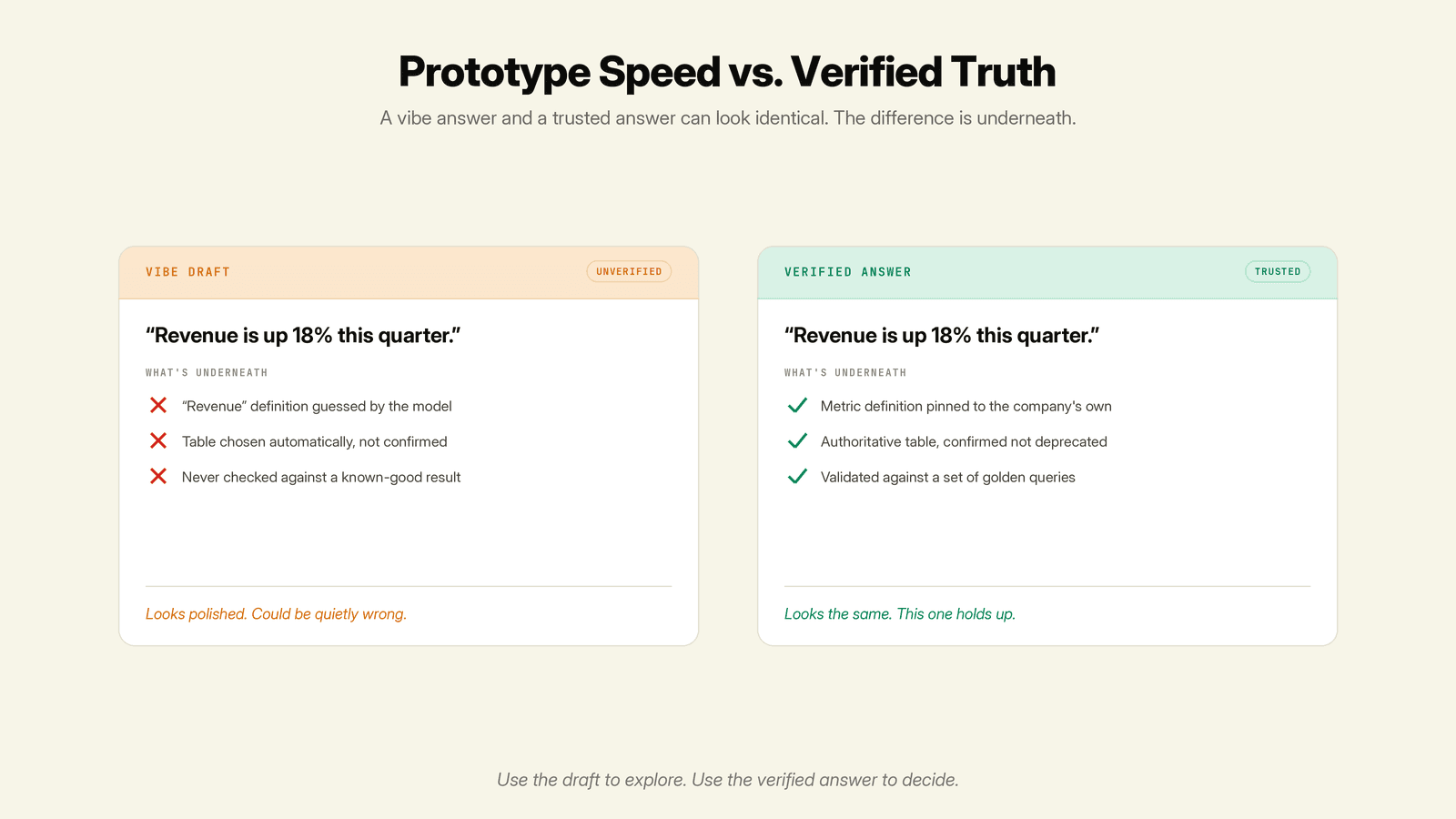
Even the people championing the term say this out loud. MIT Sloan's own coverage calls solid data quality the required foundation and warns that messy inputs do not fail loudly: they get amplified into answers that look coherent and convincing even when the data underneath is wrong. Rigor is not abandoned so much as relocated, because improvisational discovery still has to feed into formal validation before anyone trusts the result. Vibe analytics does not remove the need for that rigor. It just hides it behind a friendly chat box.
So the useful mental model is this. Vibing with data is exploratory data analysis with a turbocharger. Use it to form hypotheses, to poke at a dataset before you commit to a real model, to hand an engineer a working example instead of a vague requirement. Do not use the raw output to set a forecast, brief the board, or make a call you cannot walk back. The moment an answer needs to be trusted by someone who was not in the room when it was generated, "it felt right" is not a standard.
From Vibe to Something You Can Trust
None of this means the trend is fake. It means the interesting question is not "can I get an answer fast" (you can) but "can I get an answer I would stake a decision on." That second question is a context and validation problem, not a vibe.
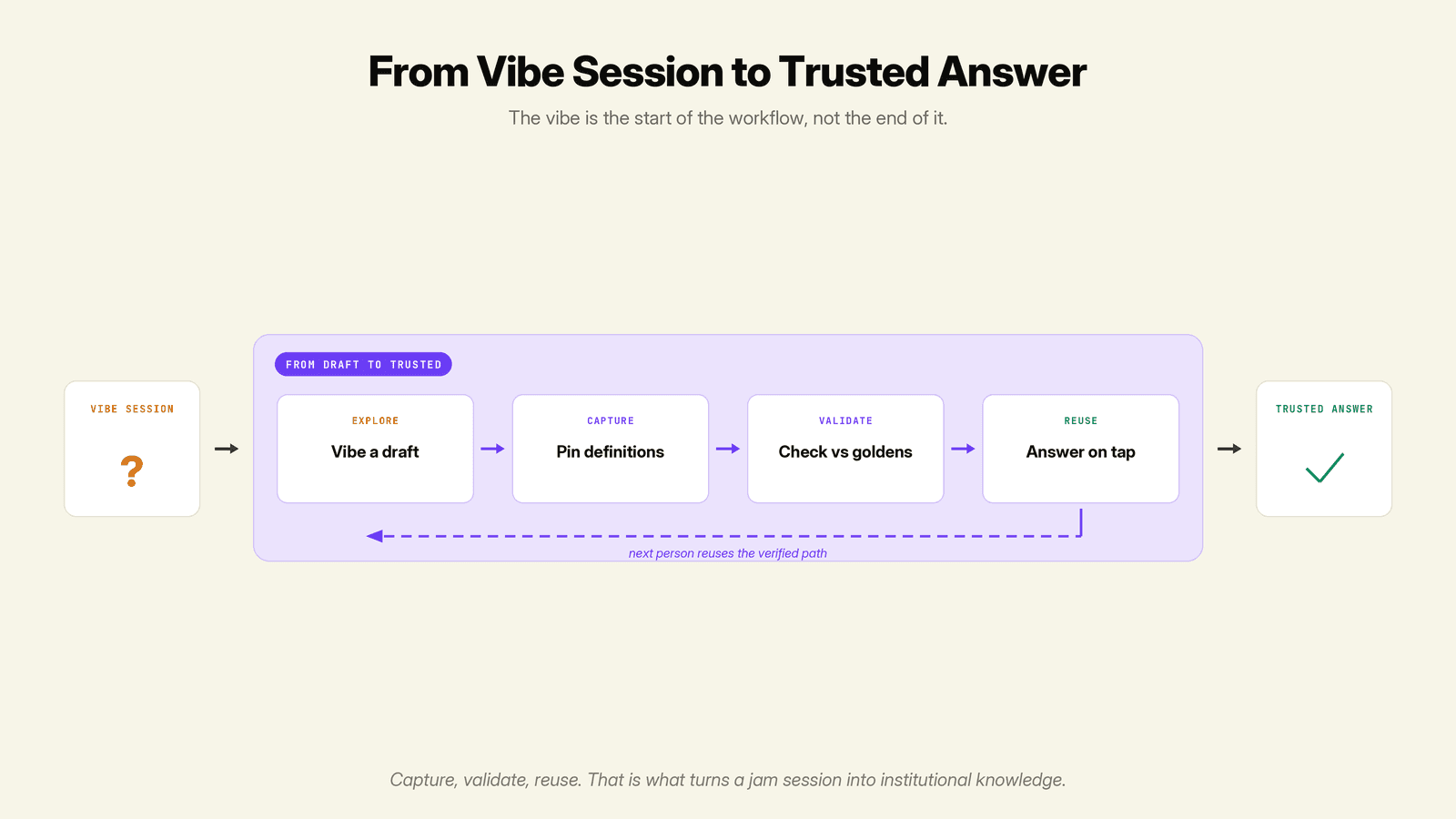
The teams getting durable value are the ones treating the vibe layer as the start of a workflow, not the end of it. The prototype gets captured, the definitions behind it get pinned down, the query that produced it gets validated, and the next person who asks the same thing gets a verified answer rather than a fresh roll of the dice. That is the unglamorous work that turns a jam session into institutional knowledge.
It also reframes a decision a lot of teams are facing right now: whether to lean on lightweight conversational tools, or invest in infrastructure that makes those answers production-ready. If you are weighing that tradeoff, it is worth thinking through whether to build or buy your analytics stack before you let "vibe analytics" become load-bearing.
Vibe analytics is here, it is real, and it is a delightful way to explore. Just remember which decisions deserve a vibe and which ones deserve a verified answer. The distinction is the entire game.
Frequently Asked Questions
What is vibe analytics?
Vibe analytics is exploring data through improvised, natural-language conversation with an AI model rather than manually building queries or dashboards. You describe what you want to understand, the model generates the analysis, and you iterate by following interesting threads. The name borrows directly from "vibe coding."
Is vibe analytics the same as agentic analytics?
No. Vibe analytics describes a casual, exploratory style of working with data. Agentic analytics describes a more structured paradigm where AI agents plan, execute, validate, and refine analytical work as a reliable, ongoing capability. Vibe analytics is closer to rapid prototyping; agentic analytics is closer to production.
Can you trust vibe analytics for real decisions?
For exploration and hypothesis generation, yes. For decisions someone has to stand behind, be careful. AI-generated analysis can be confidently wrong when it lacks context about your metric definitions and authoritative data sources, so high-stakes answers still need validation and clear data foundations.

Try Upsolve for Embedded Dashboards & AI Insights
Embed dashboards and AI insights directly into your product, with no heavy engineering required.
Fast setup
Built for SaaS products
30‑day free trial